Thank you for visiting SNEWPapers!
Sign up free
Story
August 12, 1934
Mcallen Daily Monitor
Mcallen, Brownsville, Harlingen, Hidalgo County, Cameron County, Texas
What is this article about?
The July 1934 heat wave set records for intensity and duration across the US Midwest and Southwest, surpassing 1901 highs in cities like Oklahoma City and Des Moines, per weather bureau data.
Clipping
OCR Quality
95%
Excellent
Full Text
Sizzling Weather By F. B. COLtOn
(Associated Press Science Writer)
WASHINGTON (A)—Present-day grandfathers brag about "the cold winters when I was a boy," but when boys of today become grandfathers they'll probably brag about the hot summer we had back in 1934.
It's already a record-breaker, with August still to be reckoned with, and unless Mother Nature changes her habits it will be the hottest for many a year. The last time she turned on the heat with comparable force was back in 1901.
"Not since our weather records began more than 60 years ago has the heat in any one month (July) been so intense over so wide an area in this country," says J. B. Kincer of the weather bureau, "nor have such abnormally high temperatures persisted day after day without a break.
"The highest temperatures recorded for July this year in the middle west and southwest closely paralleled, and in many places topped, the July, 1901, record in the same area."
Hot Spots
Here are some samples of hot spots in July, 1934: Oklahoma City, Okla., 104 degrees, 13 degrees above normal; Des Moines, Ia., 108 degrees, 22 above normal; Columbia, Mo., 112, or 24 above normal; North Platte, Neb., 108 degrees, 21 above normal.
Oklahoma City set an all-time record. The highest thermometer reading before was in 1901, with 102 degrees, 11 above normal. Des Moines in 1901 registered 109, or 23 above normal.
"The number of successive days when the thermometer registered 100 degrees or over puts July, 1934, in a class by itself in the records of the weather bureau," says Kincer.
"Des Moines reported 12 days with 100-degrees and higher temperatures; 9 of these were successive. In 1901 there were the same number of high-temperature days at Des Moines, but only 6 were in succession. Columbus, Mo. had 21 such days, with 16 in succession, in July, 1934, and 18 with seven in succession, in July, 1901.
"North Platte, Neb., had 16, with 13 in succession in 1934, against seven, with two in succession, in 1901. Oklahoma City had 20, with 10 in succession, in July, 1934, and four with two in. succession, in 1901. Fort Smith, Ark., had 24 and
Hotter This Year
The average maximum temperatures for the two successive hottest weeks in the heat waves of both 1934 and 1901 were uniformly higher this year. Here is the record:
Place 1934 av. 1901 av.
max. temp. max. temp
Des Moines 102 101
Columbia, Mo. 106 102
North Platte, Neb. 103 98
Concordia 106 101
Oklahoma City 102 102
Fort Smith, Ark. 104 101
The extreme heat was of longer duration this year, than in 1901, with the high July temperatures preceded by great heat in June in the midwest and southwest, which was not the case 33 years ago.
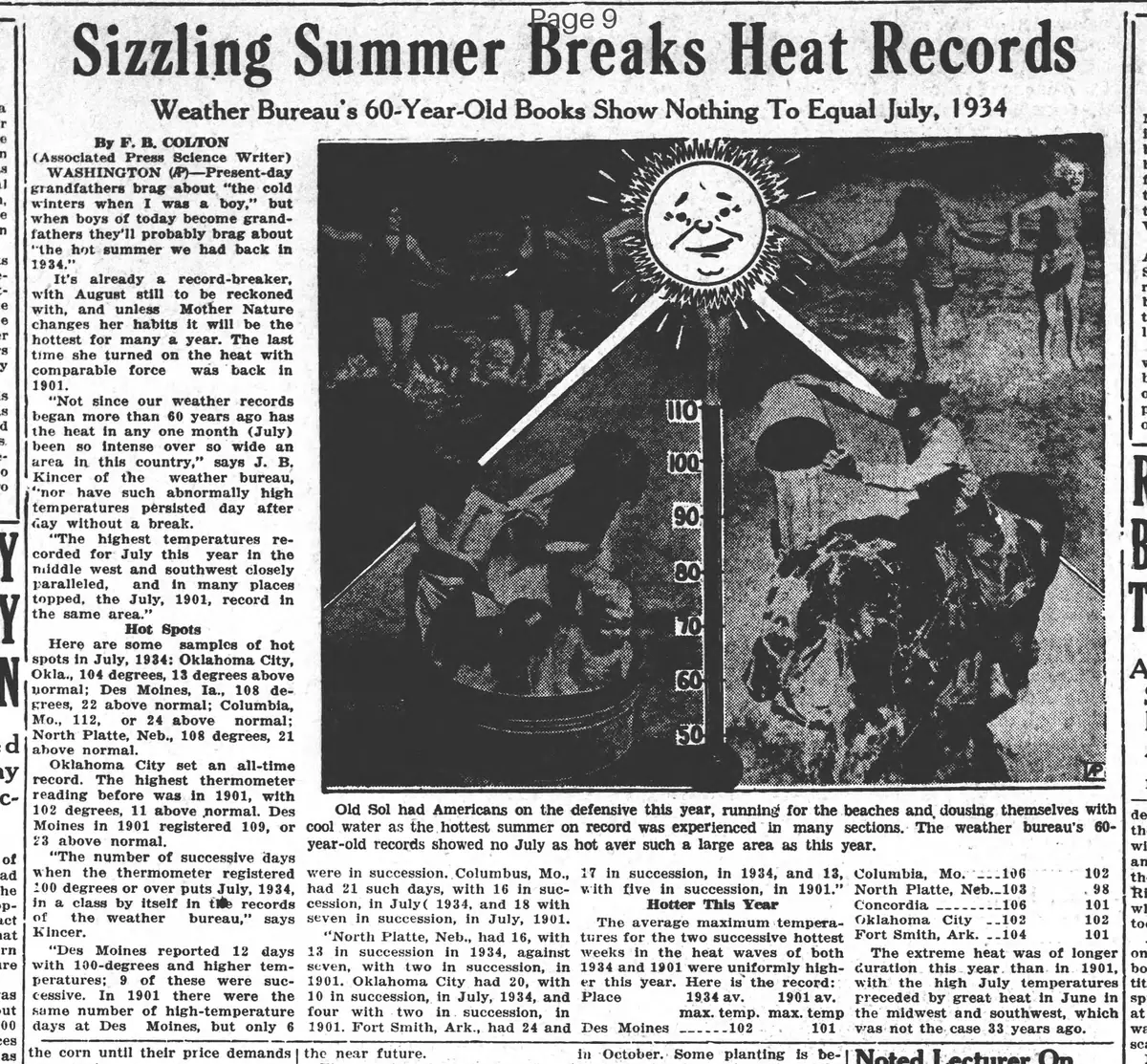
Old Sol had Americans on the defensive this year, running for the beaches and dousing themselves with cool water as the hottest summer on record was experienced in many sections. The weather bureau's 60-year-old records showed no July as hot over such a large area as this year.
17 in succession, in 1934, and 13 with five in succession, in 1901.
(Associated Press Science Writer)
WASHINGTON (A)—Present-day grandfathers brag about "the cold winters when I was a boy," but when boys of today become grandfathers they'll probably brag about the hot summer we had back in 1934.
It's already a record-breaker, with August still to be reckoned with, and unless Mother Nature changes her habits it will be the hottest for many a year. The last time she turned on the heat with comparable force was back in 1901.
"Not since our weather records began more than 60 years ago has the heat in any one month (July) been so intense over so wide an area in this country," says J. B. Kincer of the weather bureau, "nor have such abnormally high temperatures persisted day after day without a break.
"The highest temperatures recorded for July this year in the middle west and southwest closely paralleled, and in many places topped, the July, 1901, record in the same area."
Hot Spots
Here are some samples of hot spots in July, 1934: Oklahoma City, Okla., 104 degrees, 13 degrees above normal; Des Moines, Ia., 108 degrees, 22 above normal; Columbia, Mo., 112, or 24 above normal; North Platte, Neb., 108 degrees, 21 above normal.
Oklahoma City set an all-time record. The highest thermometer reading before was in 1901, with 102 degrees, 11 above normal. Des Moines in 1901 registered 109, or 23 above normal.
"The number of successive days when the thermometer registered 100 degrees or over puts July, 1934, in a class by itself in the records of the weather bureau," says Kincer.
"Des Moines reported 12 days with 100-degrees and higher temperatures; 9 of these were successive. In 1901 there were the same number of high-temperature days at Des Moines, but only 6 were in succession. Columbus, Mo. had 21 such days, with 16 in succession, in July, 1934, and 18 with seven in succession, in July, 1901.
"North Platte, Neb., had 16, with 13 in succession in 1934, against seven, with two in succession, in 1901. Oklahoma City had 20, with 10 in succession, in July, 1934, and four with two in. succession, in 1901. Fort Smith, Ark., had 24 and
Hotter This Year
The average maximum temperatures for the two successive hottest weeks in the heat waves of both 1934 and 1901 were uniformly higher this year. Here is the record:
Place 1934 av. 1901 av.
max. temp. max. temp
Des Moines 102 101
Columbia, Mo. 106 102
North Platte, Neb. 103 98
Concordia 106 101
Oklahoma City 102 102
Fort Smith, Ark. 104 101
The extreme heat was of longer duration this year, than in 1901, with the high July temperatures preceded by great heat in June in the midwest and southwest, which was not the case 33 years ago.
Old Sol had Americans on the defensive this year, running for the beaches and dousing themselves with cool water as the hottest summer on record was experienced in many sections. The weather bureau's 60-year-old records showed no July as hot over such a large area as this year.
17 in succession, in 1934, and 13 with five in succession, in 1901.
What sub-type of article is it?
Curiosity
Extraordinary Event
What themes does it cover?
Misfortune
Nature
Catastrophe
What keywords are associated?
Heat Wave
Record Temperatures
1934 Summer
Weather Records
Midwest Heat
What entities or persons were involved?
J. B. Kincer
F. B. Colton
Where did it happen?
Midwest And Southwest United States
Story Details
Key Persons
J. B. Kincer
F. B. Colton
Location
Midwest And Southwest United States
Event Date
July 1934
Story Details
Record-breaking heat wave in July 1934 across the Midwest and Southwest, with temperatures exceeding 1901 records in duration and intensity, as reported by the weather bureau.