Thank you for visiting SNEWPapers!
Sign up free
The Enquirer
Richmond, Henrico County, Virginia
What is this article about?
Governor Morgan Lewis delivers his address to the New York Legislature in Albany on November 6, 1804, covering the appointment of presidential electors, constitutional amendments, Senate vacancy, state prison fire and repairs, criminal justice reforms, coastal defense, and promotion of education.
Clipping
OCR Quality
Full Text
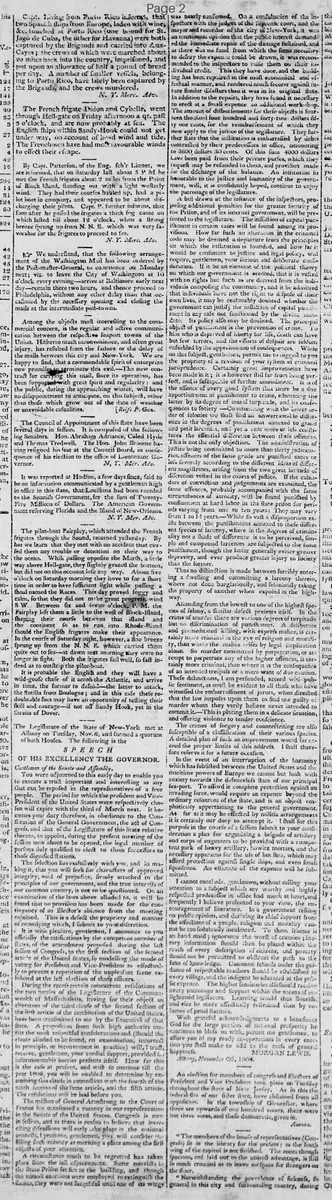
SPEECH
OF HIS EXCELLENCY THE GOVERNOR.
Gentlemen of the Senate and Assembly.
You were adjourned to this early day to enable you to execute a trust important and interesting as any that can be reposed in the representatives of a free people. The period for which the president and Vice-President of the United States were respectively chosen will expire with the third of March next. It becomes your duty therefore, in obedience to the Constitution of the General Government, the act of Congress, and that of the Legislature of this State relative thereto, to appoint, during the present meeting of the session now about to be opened, the legal number of persons duly qualified to elect to them successors to those dignified stations.
The election lies exclusively with you, and in making it, that you will seek for characters of approved integrity, void of prejudice, firmly attached to the principles of our government, and the true interests of our common country, is not to be questioned. On an examination of the laws above alluded to, it will be found that no provision has been made for the contingency of an Elector's absence from the meeting enjoined. This is a defect the propriety and manner of remedying which, I submit to your discretion.
It is with pleasure, gentlemen, I announce to you officially the ratifications by the competent number of states, of the amendment proposed during the last session of Congress, to the first section of the second article of the United States, so modelling the mode of voting for President and Vice-President as effectually to prevent a repetition of the unpleasant scene exhibited at the last election of those officers.
During the recess certain concurrent resolutions of the two houses of the Legislature of the Commonwealth of Massachusetts, having for their object an alteration of the third clause of the second section of the first article of the constitution of the United States have been transmitted to me by the Executive of that state. A proposition from such high authority merits the most respectful considerations and (should the clause alluded to be found, on examination, incorrect in principle, or inconvenient in practice) will, I trust receive, gentlemen, your cordial support, provided no insurmountable barrier presents itself. How far this is the case at present, and will so continue till the year 1808, you will be enabled to determine by examining this clause in connection with the fourth of the ninth section of the same article, and the fifth article. The resolutions will be laid before you.
The mission of General Armstrong to the Court of France has occasioned a vacancy in our representation in the Senate of the United States. Congress is now in session, and as there is reason to believe that interesting discussions will early take place in the national councils, I presume, gentlemen, you will consider the filling such vacancy as meriting a place among the first objects of your attention.
A circumstance much to be regretted has taken place since the last adjournment. Some convicts in the State Prison set fire to the building, and though the utmost exertions were employed to extinguish the flames, they were not successful until one of its wings was nearly consumed. On a consultation of the inspectors with the judges of the supreme court, and the mayor and recorder of the city of New-York, it was an unanimous opinion that the public interest demanded the immediate repair of the damage sustained, and as there was no fund from which the sums necessary to defray the expense could be drawn, it was recommended to the inspectors to raise them on their individual credit. This they have done, and the building has been repaired in the most economical and effectual manner, and rendered much securer against future similar disasters than it was in its original state. In addition to the repairs, they have found it necessary to erect at a small expense an additional work-shop. The amount of disbursements for these objects is fourteen thousand four hundred and forty-two dollars fifty one cents, for the reimbursement of which they now apply to the justice of the legislature. They further state that the institution is embarrassed by debts contracted by their predecessors in office, amounting to $8600 50 cents. Of this sum 4000 dollars have been paid from their private purses, which they request may be refunded to them, and provision made for the discharge of the balance. An institution so honorable to the justice and humanity of the government, will, it is confidently hoped, continue to enjoy the patronage of the legislature.
A bill drawn at the instance of the inspectors, proposing additional penalties for the greater security of the Prison, and of its internal government, will be presented to the legislature. The infliction of capital punishment in certain cases will be found among its provisions. How far such an alteration in the criminal code may be deemed a departure from the principles on which the institution is founded, and how far it would be consonant to justice and legal policy, will require, gentlemen, your serious and deliberate consideration. If it be an element of the political theory on which our government is erected, that it is vested with no rights but such as are derived from the individuals composing the community, and it be admitted that individuals have not the right to dispose of their own lives, it may be reasonably doubted whether the government can justify the infliction of capital punishment in any case not sanctioned by the divine mandate. Its policy also may be doubted. The principal object of punishment is the prevention of crime. To him who is deprived of his liberty for life, death can have but few terrors, and the efforts of despair are seldom enfeebled by the apprehension of consequences. While on this subject, gentlemen, permit me to suggest to you the propriety of a revision of your system of criminal jurisprudence. Certainly great improvements have been made in it; it is however still far from being perfect, and is susceptible of further amendment. It is of the essence of every good system that there be a due apportionment of punishment to crime, estimating the latter by its degree of moral turpitude, and its consequences to society -Commencing with the lower order of felonies we shall find an unwarrantable difference in the degrees of punishment annexed to grand and petit larcenies, and yet a cent more or less constitutes the essential difference between these offences. This is not the only objection. The administration of justice being committed to more than thirty judicatories, offences of the same grade are punished more or less severely according to the different ideas of different magistrates, arising from the too great latitude of discretion vested in the courts of justice. If the calendars of conviction and judgements are examined, the same offences, probably accompanied with the same circumstances of atrocity, will be found punished by confinement at hard labor in the state prison for periods varying from one to ten years: They may vary from 1 to 14 years.--While so vast a disproportion exists between the punishments annexed to these different species of larceny, where in the degrees of criminality not a shade of difference is to be perceived, simple and compound larcenies are subjected to the same punishment, though the latter generally evince greater depravity, and ever produce greater injury to society than the former.
Thus no distinction is made between forcibly entering a dwelling and committing a larceny therein, where not done burglariously, and feloniously taking the property of another when exposed in the high-way.
Ascending from the lowest to one of the highest species of felony, a similar defect presents itself. In the crime of murder there are various degrees of turpitude but no discrimination of punishment. A deliberate and premeditated killing, with express malice, is certainly more criminal in the eye of religion and morality, than where the malice arises by legal implication alone. So murder committed by perpetration, or attempt to perpetrate any of the higher offences, is certainly more criminal, than where it is the consequence of an intended trespass or a mere want of due caution. These distinctions, I am persuaded, accord with public sentiment, as must be evident to all those who have witnessed the embarrassment of jurors, when directed that the law imposes upon them to find one guilty of murder whom they verily believe never intended to commit it. This is placing them in a delicate situation, and offering violence to tender conscience.
The crimes of forgery and counterfeiting are also susceptible of a classification of their various species. A detailed plan of such an improvement would far exceed the proper limits of this address. I shall therefore reserve it for a future occasion.
In the event of an interruption of the harmony which has subsisted between the United States and the maritime powers of Europe we cannot but look with anxiety towards the defenceless state of our principal sea-port. To afford it complete protection against an invading force, would require an expense beyond the ordinary resources of the state, and is an object emphatically appertaining to the general government. As far as it may be effected by militia arrangements it is certainly our duty to attempt it. I shall for this purpose in the course of a session submit to your consideration a plan for organizing a brigade of artillery and corps of engineers to be provided with a competent park of heavy artillery, howitzers mortars, and the necessary apparatus for the use of hot shot, which may afford protection against single ships, and even small squadrons. An estimate of the expense will be submitted.
I cannot conclude, gentlemen, without calling your attention to a subject which my worthy and highly respected predecessor in office had much at heart, and frequently I believe presented to your view, the encouragement of literature. In a government resting on public opinion, and deriving its chief support from the affections of a people, religion and morality cannot be too sedulously inculcated. To them science is an hand maid; ignorance the work of enemies ; literary information should then be placed within the reach of every description of citizens, and poverty should not be permitted to obstruct the path to the temple of knowledge. Common schools under the guidance of respectable teachers should be established in every village, and the indigent be educated at the public expense. The higher seminaries also should receive every patronage and support within the means of enlightened legislators. Learning would thus flourish. and vice be more effectually restrained than by volumes of penal statutes.
With grateful acknowledgments to a beneficent God for the large portion of national prosperity he continues to bless us with, permit me gentlemen, to assure you of my ready co-operations in every exertion you shall make to add to the mass of general happiness.
MORGAN LEWIS.
Albany, November 6th, 1804.
What sub-type of article is it?
What themes does it cover?
What keywords are associated?
What entities or persons were involved?
Where did it happen?
Story Details
Key Persons
Location
Albany, State Of New York
Event Date
November 6th, 1804
Story Details
Governor Lewis urges the legislature to appoint presidential electors, announces constitutional amendments, addresses a Senate vacancy, reports on state prison fire and repairs, proposes criminal code revisions including doubts on capital punishment, suggests defense preparations for sea-ports, and advocates for public education and literature.