Thank you for visiting SNEWPapers!
Sign up free
Story
March 17, 1882
The Copiah Signal
Hazlehurst, Copiah County, Mississippi
What is this article about?
Article discusses using cotton and compressed paper pulp for fire-proof building components like doors, walls, and facades, highlighting a Canadian invention making cotton as hard as stone and fully weatherproof.
Clipping
OCR Quality
95%
Excellent
Full Text
Houses Built of Cotton.
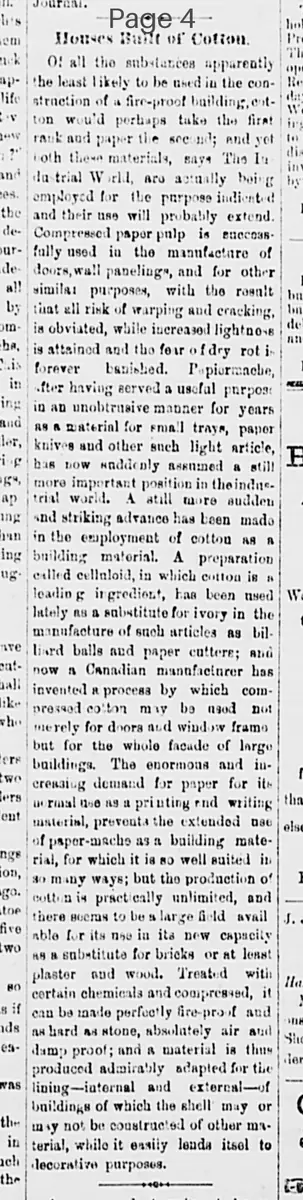
Of all the substances apparently the least likely to be used in the construction of a fire-proof building, cotton would perhaps take the first rank and paper the second; and yet both these materials, says The Industrial World, are actually being employed for the purpose indicated and their use will probably extend. Compressed paper pulp is successfully used in the manufacture of doors, wall paneling, and for other similar purposes, with the result that all risk of warping and cracking is obviated, while increased lightness is attained and the fear of dry rot is forever banished. Papier-mache, after having served a useful purpose in an unobtrusive manner for years as a material for small trays, paper knives and other such light articles, has now suddenly assumed a still more important position in the industrial world. A still more sudden and striking advance has been made in the employment of cotton as a building material. A preparation called celluloid, in which cotton is a leading ingredient, has been used lately as a substitute for ivory in the manufacture of such articles as billiard balls and paper cutters; and now a Canadian manufacturer has invented a process by which compressed cotton may be used not merely for doors and window frames but for the whole facade of large buildings. The enormous and increasing demand for paper for its normal use as a printing and writing material, prevents the extended use of paper-mache as a building material, for which it is so well suited in so many ways; but the production of cotton is practically unlimited, and there seems to be a large field available for its use in its new capacity as a substitute for bricks or at least plaster and wood. Treated with certain chemicals and compressed, it can be made perfectly fire-proof and as hard as stone, absolutely air and damp proof; and a material is thus produced admirably adapted for the lining—internal and external—of buildings of which the shell may or may not be constructed of other material, while it easily lends itself to decorative purposes.
Of all the substances apparently the least likely to be used in the construction of a fire-proof building, cotton would perhaps take the first rank and paper the second; and yet both these materials, says The Industrial World, are actually being employed for the purpose indicated and their use will probably extend. Compressed paper pulp is successfully used in the manufacture of doors, wall paneling, and for other similar purposes, with the result that all risk of warping and cracking is obviated, while increased lightness is attained and the fear of dry rot is forever banished. Papier-mache, after having served a useful purpose in an unobtrusive manner for years as a material for small trays, paper knives and other such light articles, has now suddenly assumed a still more important position in the industrial world. A still more sudden and striking advance has been made in the employment of cotton as a building material. A preparation called celluloid, in which cotton is a leading ingredient, has been used lately as a substitute for ivory in the manufacture of such articles as billiard balls and paper cutters; and now a Canadian manufacturer has invented a process by which compressed cotton may be used not merely for doors and window frames but for the whole facade of large buildings. The enormous and increasing demand for paper for its normal use as a printing and writing material, prevents the extended use of paper-mache as a building material, for which it is so well suited in so many ways; but the production of cotton is practically unlimited, and there seems to be a large field available for its use in its new capacity as a substitute for bricks or at least plaster and wood. Treated with certain chemicals and compressed, it can be made perfectly fire-proof and as hard as stone, absolutely air and damp proof; and a material is thus produced admirably adapted for the lining—internal and external—of buildings of which the shell may or may not be constructed of other material, while it easily lends itself to decorative purposes.
What sub-type of article is it?
Curiosity
What themes does it cover?
Triumph
What keywords are associated?
Cotton Construction
Fire Proof Buildings
Paper Pulp
Celluloid
Industrial Materials
Where did it happen?
Canada
Story Details
Location
Canada
Story Details
Innovative use of cotton and paper in fire-proof building materials, including compressed cotton for entire building facades invented by a Canadian manufacturer.