Thank you for visiting SNEWPapers!
Sign up free
Editorial
May 7, 1934
The Key West Citizen
Key West, Monroe County, Florida
What is this article about?
The editorial cites National Industrial Conference Board data showing unemployment dropped from 13.2 million in March 1933 to 8 million in March 1934, a gain of over 5 million jobs. It warns that 8 million idle workers threaten economic stability and critiques laissez-faire, calling for a planned society to address the crisis.
Clipping
OCR Quality
98%
Excellent
Full Text
THE UNEMPLOYED
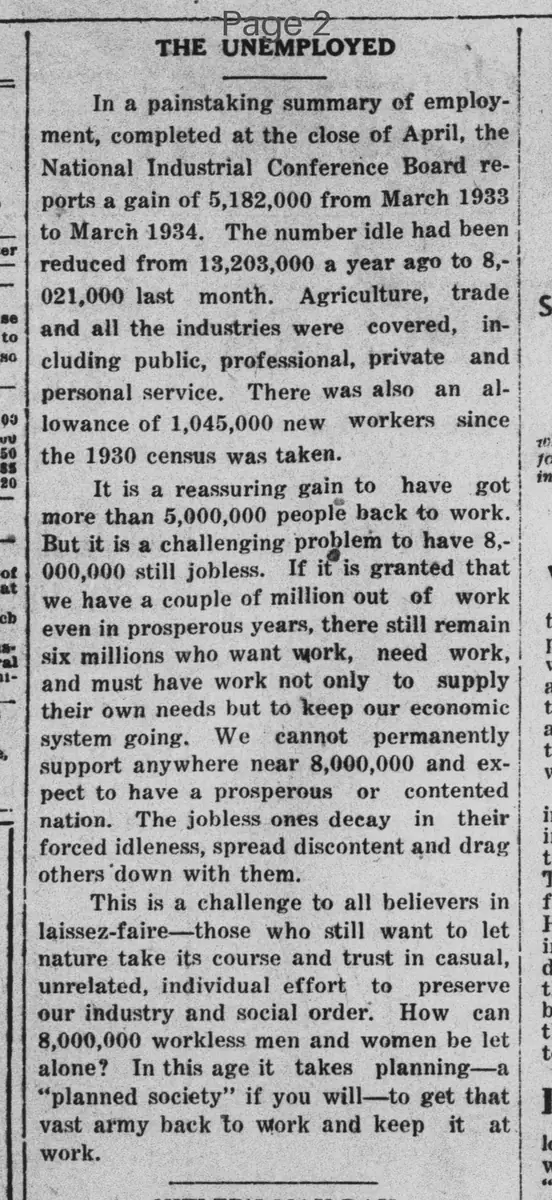
In a painstaking summary of employment, completed at the close of April, the National Industrial Conference Board reports a gain of 5,182,000 from March 1933 to March 1934. The number idle had been reduced from 13,203,000 a year ago to 8,021,000 last month. Agriculture, trade and all the industries were covered, including public, professional, private and personal service. There was also an allowance of 1,045,000 new workers since the 1930 census was taken.
It is a reassuring gain to have got more than 5,000,000 people back to work.
But it is a challenging problem to have 8,000,000 still jobless. If it is granted that we have a couple of million out of work even in prosperous years, there still remain six millions who want work, need work, and must have work not only to supply their own needs but to keep our economic system going. We cannot permanently support anywhere near 8,000,000 and expect to have a prosperous or contented nation. The jobless ones decay in their forced idleness, spread discontent and drag others down with them.
This is a challenge to all believers in laissez-faire—those who still want to let nature take its course and trust in casual, unrelated, individual effort to preserve our industry and social order. How can 8,000,000 workless men and women be let alone? In this age it takes planning—a "planned society" if you will—to get that vast army back to work and keep it at work.
In a painstaking summary of employment, completed at the close of April, the National Industrial Conference Board reports a gain of 5,182,000 from March 1933 to March 1934. The number idle had been reduced from 13,203,000 a year ago to 8,021,000 last month. Agriculture, trade and all the industries were covered, including public, professional, private and personal service. There was also an allowance of 1,045,000 new workers since the 1930 census was taken.
It is a reassuring gain to have got more than 5,000,000 people back to work.
But it is a challenging problem to have 8,000,000 still jobless. If it is granted that we have a couple of million out of work even in prosperous years, there still remain six millions who want work, need work, and must have work not only to supply their own needs but to keep our economic system going. We cannot permanently support anywhere near 8,000,000 and expect to have a prosperous or contented nation. The jobless ones decay in their forced idleness, spread discontent and drag others down with them.
This is a challenge to all believers in laissez-faire—those who still want to let nature take its course and trust in casual, unrelated, individual effort to preserve our industry and social order. How can 8,000,000 workless men and women be let alone? In this age it takes planning—a "planned society" if you will—to get that vast army back to work and keep it at work.
What sub-type of article is it?
Economic Policy
Labor
Social Reform
What keywords are associated?
Unemployment Statistics
Job Gains
Laissez Faire Critique
Planned Society
Economic Recovery
Great Depression Labor
What entities or persons were involved?
National Industrial Conference Board
Editorial Details
Primary Topic
Unemployment Reduction And Critique Of Laissez Faire
Stance / Tone
Reassuring Of Gains But Challenging Need For Planned Intervention
Key Figures
National Industrial Conference Board
Key Arguments
Unemployment Fell From 13,203,000 To 8,021,000 Between March 1933 And 1934
Over 5 Million Jobs Gained Across All Sectors
8 Million Jobless Remains A Major Problem Even Accounting For Normal Unemployment
Jobless Workers Cause Decay, Discontent, And Economic Drag
Laissez Faire Cannot Address Mass Unemployment
Requires Planning And A Planned Society To Reintegrate Workers