Thank you for visiting SNEWPapers!
Sign up free
The Patowmac Guardian, And Berkeley Advertiser
Martinsburg, Shepherdstown, Berkeley County, Jefferson County, West Virginia
What is this article about?
The French National Assembly's address to Ireland celebrates newfound liberty, refutes prejudices, details sweeping reforms against despotism including rights declaration, constitutional changes, and calls for mutual understanding and alliance for humanity's welfare.
Merged-components note: Continuation of the Address from the National Assembly of France to the People of Ireland across pages 1 and 2.
Clippings
1 of 2
OCR Quality
Full Text
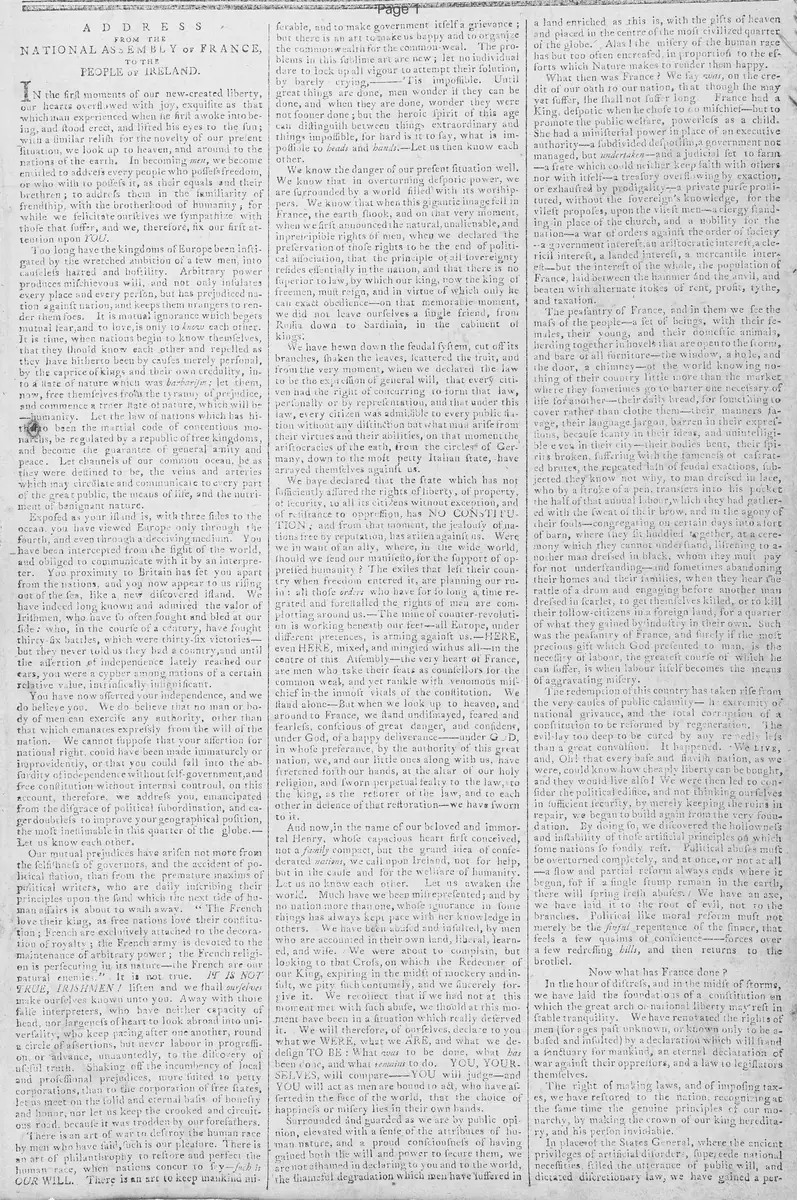
FROM THE
NATIONAL ASSEMBLY OF FRANCE,
TO THE
PEOPLE OF IRELAND.
In the first moments of our new-created liberty, our hearts overflowed with joy, exquisite as that which man experienced when he first awoke into being, and stood erect, and lifted his eyes to the sun: with a similar relish for the novelty of our present situation, we look up to heaven, and around to the nations of the earth. In becoming men, we become entitled to address every people who possess freedom, or who wish to possess it, as their equals and their brethren; to address them in the familiarity of friendship, with the brotherhood of humanity: for while we felicitate ourselves we sympathize with those that suffer, and we, therefore, fix our first attention upon YOU.
Too long have the kingdoms of Europe been instigated by the wretched ambition of a few men, into causeless hatred and hostility. Arbitrary power produces mischievous will, and not only insulates every place and every person, but has prejudiced nation against nation, and keeps them strangers to render them foes. It is mutual ignorance which begets mutual fear, and to love, is only to know each other. It is time, when nations begin to know themselves, that they should know each other and repelled as they have hitherto been by causes merely personal. By the caprice of kings and their own credulity, into a state of nature which was barbarism; let them now, free themselves from the tyranny of prejudice, and commence a truer state of nature, which will be --humanity. Let the law of nations which has hitherto been the martial code of contentious monarchs, be regulated by a republic of free kingdoms, and become the guarantee of general amity and peace. Let channels of our common ocean, be as they were destined to be, the veins and arteries which may circulate and communicate to every part of the great public, the means of life, and the nutriment of benignant nature.
Exposed as your island is, with three sides to the ocean, you have viewed Europe only through the fourth, and even through a deceiving medium. You have been intercepted from the sight of the world, and obliged to communicate with it by an interpreter. Your proximity to Britain has set you apart from the nations, and you now appear to us rising out of the sea, like a new discovered island. We have indeed long known and admired the valor of Irishmen, who have so often fought and bled at our side: who, in the course of a century, have fought thirty-six battles, which were thirty-six victories-- but they never told us they had a country, and until the assertion of independence lately reached our ears, you were a cypher among nations of a certain relative value, intrinsically insignificant.
You have now asserted your independence, and we do believe you. We do believe that no man or body of men can exercise any authority, other than that which emanates expressly from the will of the nation. We cannot suppose that your assertion for national right, could have been made immaturely or improvidently, or that you could fall into the absurdity of independence without self-government, and free constitution without internal controul, on this account, therefore, we address you, emancipated from the disgrace of political subordination, and eager doubtless to improve your geographical position, the most inestimable in this quarter of the globe. Let us know each other.
Our mutual prejudices have arisen not more from the selfishness of governors, and the accident of political station, than from the premature maxims of political writers, who are daily inscribing their principles upon the sand which the next tide of human affairs is about to wash away. "The French love their king, as free nations love their constitution: French are exclusively attached to the decoration of royalty; the French army is devoted to the maintenance of arbitrary power; the French religion is persecuting in, its nature--the French are our natural enemies." It is not true. IT IS NOT TRUE. IRISHMEN! listen and we shall ourselves make ourselves known unto you. Away with those false interpreters, who have neither capacity of head, nor largeness of heart to look abroad into universality, who keep pacing after one another, round a circle of assertions, but never labour in progression, or advance, unauntedly, to the discovery of useful truth. Shaking off the incumbrancy of local and professional prejudices, more suited to petty corporations, than to the corporation of free states, let us meet on the solid and eternal basis of honesty and honor, nor let us keep the crooked and circuitous road, because it was trodden by our forefathers.
There is an art of war to destroy the human race by men who have said, such is our pleasure. There is an art of philanthropy to restore and perfect the human race, when nations concur to say--such is OUR WILL. There is an art to keep mankind miserable, and to make government itself a grievance; but there is an art to make us happy and to organize the commonwealth for the common-weal. The problems in this sublime art are new; let no individual dare to lock up all vigour to attempt their solution, by barely crying, --'Tis impossible. Until great things are done, men wonder if they can be done, and when they are done, wonder they were not sooner done: but the heroic spirit of this age can distinguish between things extraordinary and things impossible. For hard is it to say, what is impossible to heads and hands.--Let us then know each other.
We know the danger of our present situation well. We know that in overturning despotic power, we are surrounded by a world filled with its worshippers. We know that when this gigantic image fell in France, the earth shook, and on that very moment, when we first announced the natural, unalienable, and imprescriptible rights of men, when we declared the preservation of those rights to be the end of political association, that the principle of all sovereignty resides essentially in the nation, and that there is no superior to law, by which our king, now the king of freemen, must reign, and in virtue of which only he can exact obedience--on that memorable moment, we did not leave ourselves a single friend, from Russia down to Sardinia, in the cabinet of kings.
We have hewn down the feudal system, cut off its branches, shaken the leaves, scattered the fruit, and from the very moment, when we declared the law to be the expression of general will, that every citizen had the right of concurring to form that law, personally or by representation, and that under this law, every citizen was admissible to every public station without any distinction but what might arise from their virtues and their abilities, on that moment the aristocracies of the earth, from the circles of Germany, down to the most petty Italian state, have arrayed themselves against us.
We have declared that the state which has not sufficiently assured the rights of liberty, of property, of security, to all its citizens without exception, and of resistance to oppression, has NO CONSTITUTION: and from that moment, the jealousy of nations free by reputation, has arisen against us. Were we in want of an ally, where, in the wide world, should we send our manifesto, for the support of oppressed humanity? The exiles that left their country when freedom entered it, are planning our ruin: all those orders who have for so long a time regulated and forestalled the rights of men are conspiring around us.--The mine of counter-revolution is working beneath our feet--all Europe, under different pretences, is arming against us.--HERE, even HERE, mixed, and mingled with us all--in the centre of this Assembly--the very heart of France, are men who take their seats as counsellors for the common weal, and yet rankle with venomous mischief in the inmost vitals of the constitution. We stand alone--But when we look up to heaven, and around to France, we stand undismayed, fearless and fearless, conscious of great danger, and confident, under God, of a happy deliverance---under GOD, in whose presence, by the authority of this great nation, we, and our little ones along with us, have stretched forth our hands, at the altar of our holy religion, and sworn perpetual fealty to the law, to the king, as the restorer of the law, and to each other in defence of that restoration--we have sworn to it.
And now, in the name of our beloved and immortal Henry, whose capacious heart first conceived, not a family compact, but the grand idea of confederated nations, we call upon Ireland, not for help, but in the cause and for the welfare of humanity. Let us now know each other. Let us awaken the world. Much have we been misrepresented; and by no nation more than one, whose ignorance in some things has always kept pace with her knowledge in others. We have been abused and insulted, by men who are accounted in their own land, liberal, learned, and wise. -- We were about to complain, but looking to that Cross, on which the Redeemer of our King, expiring in the midst of mockery and insult, we pity such contumely, and we sincerely forgive it. We recollect that if we had not at this moment met with such abuse, we should at this moment have been in a situation which really deserved it. We will therefore, of ourselves, declare to you what we WERE, what we ARE, and what we design TO BE: What was to be done, what has been done, and what remains to do. YOU, YOURSELVES, will compare--YOU will judge--and YOU will act as men are bound to act, who have asserted in the face of the world, that the choice of happiness or misery lies in their own hands.
Surrounded and guarded as we are by public opinion, elevated with a sense of the attributes of human nature, and a proud consciousness of having gained both the will and power to secure them, we are not ashamed in declaring to you and to the world, the shameful degradation which men have suffered in a land enriched as this is, with the gifts of heaven and placed in the centre of the most civilized quarter of the globe. Alas! the misery of the human race has but too often increased, in proportion to the efforts which Nature makes to render them happy.
What then was France? We say was, on the credit of our oath to our nation, that though she may yet suffer, she shall not suffer long. France had a King, despotic when he chose to do mischief--but to promote the public welfare, powerless as a child. She had a ministerial power in place of an executive authority--a subdivided despotism, a government not managed, but undertaken--and a judicial set to farm --a state which could neither keep faith with others nor with itself--a treasury overflowing by exaction, or exhausted by prodigality--a private purse profited, without the sovereign's knowledge, for the vilest purposes, upon the vilest men--a clergy standing in place of the church, and a nobility for the nation--a war of orders against the order of society --a government interest, an aristocratic interest, a clerical interest, a landed interest, a mercantile interest but the interest of the whole, the population of France, laid between the hammer and the anvil, and beaten with alternate strokes of rent, profit, tythe, and taxation.
The peasantry of France, and in them we see the mass of the people--a set of beings, with their females, their young, and their domestic animals, herding together in hovels that are open to the storm, and bare of all furniture--the window, a hole, and the door, a chimney--of the world knowing nothing of their country little more than the market where they sometimes go to barter one necessary of life for another--their daily bread, for something to cover rather than clothe them--their manners savage, their language jargon, barren in their expressions, because scanty in their ideas, and unintelligible even in their city--their bodies bent, their spirits broken, suffering with the tameness of castrated brutes, the repeated lash of feudal exactions, subjected they know not why, to man dressed in lace, who by a stroke of a pen, transfers into his pocket the half of that annual labour, which they had gathered with the sweat of their brow, and in the agony of their souls--congregating on certain days into a sort of barn, where they sit huddled together, at a ceremony which they cannot understand, listening to another man dressed in black, whom they must pay for not understanding--and sometimes abandoning their homes and their families, when they hear the rattle of a drum and engaging before another man dressed in scarlet, to get themselves killed, or to kill their fellow-citizens in a foreign land, for a quarter of what they gained by industry in their own. Such was the peasantry of France, and surely if the most precious gift which God presented to man, is the necessity of labour, the greatest curse of which he can suffer, is when labour itself becomes the means of aggravating misery.
The redemption of this country has taken rise from the very causes of public calamity-- the extremity of national grievance, and the total corruption of a constitution to be reformed by regeneration. The evil lay too deep to be cured by any remedy less than a great convulsion. It happened. We LIVE, and, Oh! that every base and slavish nation, as we were, could know how cheaply liberty can be bought, and they would live also! We were then led to consider the political edifice, and not thinking ourselves in sufficient security, by merely keeping the ruins in repair, we began to build again from the very foundation. By doing so, we discovered the hollowness and instability of those artificial principles on which some nations so fondly rest. Political abuses must be overturned completely, and at once, or not at all --a slow and partial reform always ends where it begun, for if a single stump remain in the earth, there will spring fresh abuses. We have an axe, we have laid it to the root of evil, not to the branches. Political like moral reform must not merely be the sinful repentance of the sinner, that feels a few qualms of conscience---forces over a few redressing bills, and then returns to the brothel.
Now what has France done?
In the hour of distress, and in the midst of storms, we have laid the foundations of a constitution on which the great arch of national liberty may rest in stable tranquility. We have renovated the rights of men (for ages past unknown, or known only to be abused and insulted) by a declaration which will stand a sanctuary for mankind, an eternal declaration of war against their oppressors, and a law to legislators themselves.
The right of making laws, and of imposing taxes, we have restored to the nation, recognizing at the same time the genuine principles of our monarchy, by making the crown of our king hereditary, and his person inviolable.
In place of the States General, where the ancient privileges of artificial disorders, superseded national necessities, stifled the utterance of public will, and dictated discretionary law, we have gained a permanent
From the Journal of the National Assembly, where hereditary honours, and fictitious distinctions are melted down, and assimilated under the comprehensive and endearing appellations of citizens. All orders give place to the social order. Every Frenchman is a citizen, and every citizen a Frenchman.
What citizens have created, it is their duty and their right to defend—Our National Guard that started at the strong and sonorous sound of Liberty, are now, with wakeful eye, and indefatigable spirit, superintending the private safety and the public good.
The means of happiness have been hitherto hoarded, and the enjoyment of them doled out at the discretion of the few. We have therefore enfranchised our provinces, and have cleansed them from the vexatious and noisome reliques of feudality, a system, which though dead, still spread contagion, and was to be banished from the habitations of men, like those cemeteries which contaminate the air, and diffuse putrefaction.
Arbitrary orders for imprisonment, which lay in wait for the liberties of citizens, as beasts of prey in their dens, have been annihilated, and we have said, Fiat Justitia—Let justice be done to all.
Our criminal code has already received a provisional reform, and we are busied about a more perfect one, in which juries shall never be superseded by judges, written by extemporaneous law, nor the summary jurisdiction of particular courts converted into an omnipotent and omnipresent instrument of ministerial vengeance.
We have not, like you, felt the panic of innovation, but by a radical reform of the elective bodies, and by a new division of this kingdom, we founded representation on property, population and contribution to the state, completely obliterating every remaining mark of those inhuman distinctions which had parcelled out the common weal into immunity, privilege and prerogative. We have substituted general welfare in place of provincial interest, restored the unity of the state, apportioned the rights of every man, and every division according to their relative value to the whole, and in short, by arranging the mighty mass into such organization that every part and particle live, move and have a being.
We have solved a problem in a nation of twenty-five millions which your little island lately abandoned in despair. Our cantons, our communities, our districts, and our departments are all concentric circles, instinct with spirit, that gradually contract from the widest range, until at length the will and energy, the heads and hearts, and hands of twenty-four million four hundred thousand active citizens are collected and condensed into one focus of legislation. How small a part of your small island is that part which lives! how much is dead and rotten!
All power which does not emanate from and is not accountable to the people must be usurpation.
We have marked the sagacious nature of ministerial power. We have not suffered the authority of the king to be plundered by his own servants under the shadow of prerogative, but pursued them through all their evasions, brought them into light, and tied them down by rigid responsibility.
—No Minister can sit and influence this Assembly.
The necessity of the state does not form the sole rule for taxation. We wish not to eviscerate the poor, or to extort from the hovel in order to pamper the pensioner and feed rapacious prodigality, but have endeavoured to lighten the burden which it is necessary to bear, and to distribute it with equality, with wisdom and with mercy.
We have curtailed the enormity of our pension list, subjected it to the broad eye of the public, and converted it into a fund for discharging the obligations of the nation to men who have dedicated their time, their fortunes and their health to the public, and for its good have lost—their all.
We have, in the name of the nation (the great and only Lord of the soil) reclaimed tithes, and territorial possessions of the clergy—a profession existing by the nation for national functions and services—a property beneficiary in its nature, and entrusted on the condition of allotting a chief portion to the necessities of the poor and the instruction of youth, while at the same time we have reserved an adequate provision for the culture of religion; the maintenance of its ministers, and the liquidation of their debts. The use only of the estate was in them, and in revoking this property as we have done, for the permanence of public faith and the redemption of France, we have not encroached on the rights of persons which are antecedent to law, but only resumed the donation of the state to an order, which depends for its existence on the public will, and for the mode of that existence must conform to the public welfare—an order which is now placed on a similar stipendiary footing with other servants of the public, with ministers, with judges, and with kings.
Finally, we have regulated the finances, by balancing the revenues of the state with its expenditure, assisted in the work by a minister, whose policy, founded on virtue and religion, has gained the confidence of France, and whose only misfortune was a want of power to push good principles as far as we have been enabled to do, by the unexampled sacrifices of a magnanimous public.
Such was France, as we received it from our fathers, and such the improved heritage, we leave to our children. We now look upon our offspring with redoubled, with unutterable delight. We feel their hearts: they beat with joy and hope. We mark the enthusiasm that sparkles in their eyes, and how longingly they look out for that day when they are
What sub-type of article is it?
What keywords are associated?
What entities or persons were involved?
Where did it happen?
Foreign News Details
Primary Location
France
Key Persons
Outcome
french constitutional reforms including declaration of rights, hereditary monarchy, national guard, abolition of feudalism, reform of criminal code, new administrative divisions, financial regulation, and reclamation of clerical properties.
Event Details
The National Assembly of France addresses the people of Ireland, expressing joy in their new liberty, criticizing past European divisions caused by arbitrary power, praising Irish independence, refuting prejudices against France, describing the dangers faced after overturning despotism, outlining past miseries in France, detailing reforms achieved including rights declaration, legislative restoration to the nation, permanent assembly, national guard, provincial enfranchisement, justice reforms, administrative reorganization, ministerial responsibility, equitable taxation, pension reforms, and clerical property reclamation.