Thank you for visiting SNEWPapers!
Sign up free
Kentucky Gazette
Lexington, Fayette County, Kentucky
What is this article about?
In January 1820, Tennessee and Kentucky commissioners negotiated their shared boundary line at Mansion House. Proposals involved Walker's and Alexander's lines, with exchanges on jurisdiction, grants, and arbitration. After rejections and legislative input, they agreed on Walker's line east of the Tennessee River and Alexander's west, causing some Tennessee dissatisfaction.
Clipping
OCR Quality
Full Text
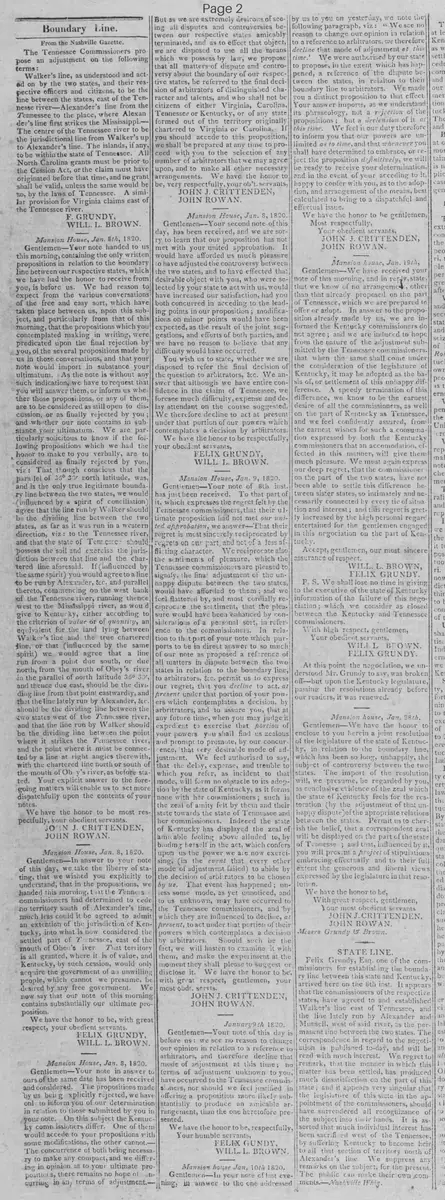
From the Nashville Gazette.
The Tennessee Commissioners propose an adjustment on the following terms:
Walker's line, as understood and acted on by the two states, and their respective officers and citizens, to be the line between the states, east of the Tennessee river—Alexander's line from the Tennessee to the place, where Alexander's line first strikes the Mississippi.—The centre of the Tennessee river to be the jurisdictional line from Walker's up to Alexander's line. The islands, if any, to be within the state of Tennessee. All North Carolina grants must be prior to the Cession Act, or the claim must have originated before that time, and no grant shall be valid, unless the same would be so, by the laws of Tennessee. A similar provision for Virginia claims east of the Tennessee river.
F. GRUNDY.
WILL. L. BROWN.
Mansion House, Jan. 8th, 1820.
Gentlemen—Your note handed to us this morning, containing the only written propositions in relation to the boundary line between our respective states, which we have had the honor to receive from you, is before us. We had reason to expect from the various conversations of the free and easy sort, which have taken place between us, upon this subject, and particularly from that of this morning, that the propositions which you contemplated making in writing, were predicated upon the final rejection by you, of the several propositions made by us in those conversations, and that your note would import in substance your ultimatum. As the note is without any such indication, we have to request that you will answer them, or inform us whether those propositions, or any of them, are to be considered as still open to discussion, or as finally rejected by you; and whether our note contains in substance your ultimatum. We are particularly solicitous to know if the following propositions which we had the honor to make to you verbally, are to be considered as finally rejected by you, viz: That though conscious that the parallel of 36° 30' north latitude, was, and is the only true legitimate boundary line between the two states, we would (influenced by a spirit of conciliation) agree that the line run by Walker should be the dividing line between the two states, as far as it was run in a western direction, viz: to the Tennessee river. and that the state of Tennessee should possess the soil and exercise the jurisdiction between that line and the chartered line aforesaid. If (influenced by the same spirit) you would agree to a line to be run by Alexander, &c. and parallel thereto, commencing on the west bank of the Tennessee river, running thence west to the Mississippi river, as would give to Kentucky, either according to the criterion of value or of quantity, an equivalent for the land lying between Walker's line and the true chartered line, or that (influenced by the same spirit) we would agree that a line run from a point due south, or due north, from the mouth of Obey's river in the parallel of north latitude 36° 30', and thence due east, should be the dividing line from that point eastwardly, and that the line lately run by Alexander, &c. should be the dividing line between the two states west of the Tennessee river, and that the line run by Walker should be the dividing line between the point where it strikes the Tennessee river, and the point where it must be connected by a line at right angles therewith. with the chartered line north or south of the mouth of Obey's river, as before stated. Your explicit answer to the foregoing matters will enable us to act more dispatchfully upon the contents of your notes.
We have the honor to be most respectfully, your obedient servants.
JOHN J. CRITTENDEN,
JOHN ROWAN.
Mansion House, Jan. 8, 1820.
Gentlemen—In answer to your note of this day, we take the liberty of stating, that we wished you explicitly to understand, that in the propositions, we handed this morning, that the Tennessee commissioners had determined to cede no territory south of Alexander's line, much less could it be agreed to admit an extension of the jurisdiction of Kentucky, into what is now considered the settled part of Tennessee, east of the mouth of Obed's river. That territory is all granted, where it is of value, and Kentucky, by such cession, would only acquire the government of an unwilling people, which cannot we presume, be desired by any free government. We now say that our note of this morning contains substantially our ultimate proposition.
We have the honor to be, with great respect, your obedient servants.
FELIX GRUNDY.
WILL. L. BROWN.
Mansion House, Jan. 8, 1820.
Gentlemen—Your note in answer to ours of the same date has been received and considered. The propositions made by us being explicitly rejected, we have only to inform you of our determination in relation to those submitted by you in your note. On this subject the Kentucky commissioners differ. One of them would accede to your propositions with some modifications, the other cannot.—The concurrence of both being necessary to make any compact, and we differing in opinion as to your ultimate propositions, there remains no hope of concurring in any, terms of adjustment.—
But as we are extremely desirous of seeing all disputes and controversies between our respective states amicably terminated, and as to effect that object, we are disposed to use all the means which we possess by law, we propose that all matters of dispute and controversy about the boundary of our respective states, be referred to the final decision of arbitrators of distinguished character and talents, and who shall not be citizens of either Virginia, Carolina, Tennessee or Kentucky, or of any state formed out of the territory originally chartered to Virginia or Carolina. If you should accede to this proposition, we shall be prepared at any time to proceed with you to the selection of any number of arbitrators that we may agree upon, and to make all other necessary arrangements. We have the honor to be, very respectfully, your ob't. servants
JOHN J. CRITTENDEN,
JOHN ROWAN.
Mansion House, Jan. 8, 1820.
Gentlemen—Your second note of this day, has been received, and we are sorry to learn that our proposition has not met with your united approbation. It would have afforded us much pleasure to have adjusted the controversy between the two states, and to have effected that desirable object with you, who were selected by your state to act with us, would have increased our satisfaction, had you both concurred in acceding to the leading points in our proposition; modifications on minor points would have been expected, as the result of the joint suggestions, and efforts of both parties, and we have no reason to believe that any difficulty would have occurred.
You wish us to state, whether we are disposed to refer the final decision of the question to arbitrators, &c. We answer that although we have entire confidence in the claim of Tennessee, we foresee much difficulty, expense and delay attendant on the course suggested. We therefore decline to act at present under that portion of our powers which contemplates a decision by arbitrators.
We have the honor to be respectfully, your obedient servants,
FELIX GRUNDY.
WILL L. BROWN.
Mansion House, Jan. 9, 1820.
Gentlemen—Your note of 8th inst. has just been received. To that part of it, which expresses the regret felt by the Tennessee commissioners, that their ultimate proposition had not met our united approbation, we answer—That their regret is most sincerely reciprocated by regrets on our part, and not of a less afflicting character. We reciprocate also the sentiments of pleasure, which the Tennessee commissioners are pleased to signify, the final adjustment of the unhappy dispute between the two states, would have afforded to them; and we feel flattered by, and most cordially reciprocate the sentiment, that the pleasure would have been enhanced by considerations of a personal sort, in reference to the commissioners. In relation to that part of your note which purports to be in direct answer to so much of our note as proposed a reference of all matters in dispute between the two states in relation to the boundary line, to arbitrators. &c. permit us to express our regret, that you decline to act, at present under that portion of your powers which contemplates a decision, by arbitrators, and to assure you, that at any future time, when you may judge it expedient to exercise that portion of your powers you shall find us zealous and prompt to promote, by our concurrence, that very desirable mode of adjustment. We feel authorised to say, that the delay, expense, and trouble to which you refer, as incident to that mode, will form no obstacle to its adoption by the state of Kentucky, as it forms none with her commissioners; such is the zeal of amity felt by them and their state towards the state of Tennessee and her commissioners. Indeed the state of Kentucky has displayed the zeal of amicable feeling above alluded to, by binding herself in the act, which confers upon us the power we are now exercising, (in the event that every other mode of adjustment failed) to abide by the decision of arbitrators to be chosen by us. That event has happened; unless some mode, as yet unnoticed, and to us unknown, may have occurred to the Tennessee commissioners, and by which they are influenced to decline, at present, to act under that portion of their powers which contemplates a decision by arbitrators. Should such be the fact, we will hasten to examine it with them, and make the experiment at the moment they shall please to suggest or disclose it. We have the honor to be, with great respect, gentlemen, your most obdt. servts.
JOHN J. CRITTENDEN,
JOHN ROWAN.
January 9th 1820.
Gentlemen—Your note of this day is before us: we see no reason to change our opinion in relation to a reference to arbitrators, and therefore decline that mode of adjustment at this time; no terms of adjustment unknown to you, have occurred to the Tennessee commissioners, nor should we feel justified in offering a proposition more likely substantially to produce an amicable arrangement, than the one heretofore presented.
We have the honor to be, respectfully, Your humble servants,
FELIX GRUNDY,
WILL. L. BROWN.
Mansion house Jan. 10th 1820.
Gentlemen—In your note of last evening, in answer to the one addressed by us to you on yesterday, we note the following paragraph, viz: "We see no reason to change our opinion in relation to a reference to arbitrators, we therefore decline that mode of adjustment at this time.' We were authorised by our state to propose, in the event which has happened, a reference of the dispute between the states, in relation to their boundary line to arbitrators. We made you a distinct proposition to that effect. Your answer imports, as we understand its phraseology, not a rejection of the propositions; but a declension of it at this time. We feel it our duty therefore to inform you that our powers are unlimited as to time, and that whenever you shall have determined to embrace, or reject the proposition definitively, we will be ready to receive your determination. and in the event of your acceding to it, happy to confer with you, as to the adoption, and arrangement of the means, best calculated to bring to a dispatchful and effectual issue.
We have the honor to be gentlemen, Most respectfully, Your obedient servants,
JOHN J. CRITTENDEN
JOHN ROWAN.
Mansion house, Jan. 19th,
Gentlemen—We have received your note of this morning, and in reply, state, that we know of no arrangement, other than that already proposed on the part of Tennessee, which we are prepared to offer or adopt. In answer to the proposition already made by us, we are informed the Kentucky commissioners do not agree; and we are induced to hope from the nature of the adjustment submitted by the Tennessee commissioners. that when the same shall come under the consideration of the legislature of Kentucky, it may be adopted as the basis of, or settlement of this unhappy difference. A speedy termination of this difference, we know to be the earnest desire of all the commissioners, as well on the part of Kentucky as Tennessee, and we feel confidently assured, from the earnest wishes for such a consummation expressed by both the Kentucky commissioners that an accommodation, effected in this manner, will give them much pleasure. We must again express our deep regret, that the commissioners on the part of the two states, have not been able to settle this difference between sister states, so intimately and necessarily connected by every tie of situation and interest; and this regret is greatly increased by the high personal regard entertained for the gentlemen engaged in this negociation on the part of Kentucky.
Accept, gentlemen, our most sincere assurance of respect.
WILL. L. BROWN,
FELIX GRUNDY.
P. S. We shall lose no time in giving to the executive of the state of Kentucky information of the failure of this negociation; which we consider as closed between the Kentucky and Tennessee commissioners.
With high respect, gentlemen, Your obedient servants,
WILL. BROWN.
FELIX GRUNDY.
At this point the negociation, we understood Mr. Grundy to say, was broken off—but upon the Kentucky legislature, passing the resolutions already before our readers, it was renewed.
Mansion house, Jan. 28th.
Gentlemen—We have the honor to enclose to you herein a joint resolution of the legislature of the state of Kentucky, in relation to the boundary line, which has been so long, unhappily, the subject of controversy between the two states. The import of the resolution will, we presume, be regarded by you, as conclusive evidence of the zeal which the state of Kentucky feels for the restoration (by the adjustment of that unhappy dispute) of the appropriate relations between the states. Permit us to cherish the belief, that a correspondent zeal will be displayed on the part of the state of Tennessee; and that, influenced by it, you will present a project of stipulations embracing effectually and to their full extent the generous and liberal views expressed by the legislature in that resolution.
We have the honor to be, With great respect, gentlemen, your most obedient servants
JOHN J. CRITTENDEN.
JOHN ROWAN.
Messrs Grundy & Brown.
STATE LINE.
Felix Grundy, Esq. one of the commissioners for establishing the boundary line between this state and Kentucky, arrived here on the 5th inst. It appears that the commissioners of the respective states, have agreed to and established Walker's line east of Tennessee, and the line lately run by Alexander and Munsell, west of said river, as the permanent line between the two states. The correspondence in regard to the negociation is published to-day, and will be read with much interest. We regret to remark, that the manner in which this matter has been settled, has produced much dissatisfaction on the part of this state; and it appears very singular that the legislature of this state in the appointment of the commissioners, should have surrendered all recognizance of the subject into their hands. It is asserted that much individual interest has been sacrificed west of the Tennessee, by suffering Kentucky to become heir to all that section of territory north of Alexander's line We suppress any remarks on the subject, for the present. The public can make their own comments.—Nashville Whig.
What sub-type of article is it?
What themes does it cover?
What keywords are associated?
What entities or persons were involved?
Where did it happen?
Story Details
Key Persons
Location
Mansion House, Between Tennessee And Kentucky
Event Date
January 1820
Story Details
Commissioners from Tennessee and Kentucky exchanged letters proposing boundary adjustments using Walker's and Alexander's lines, discussing jurisdiction over rivers and islands, validity of grants, rejecting arbitration initially, breaking off then renewing negotiations after Kentucky legislative resolutions, ultimately agreeing on the lines despite Tennessee dissatisfaction over lost territory.