Thank you for visiting SNEWPapers!
Sign up free
The Virginian
Lynchburg, Virginia
What is this article about?
The Duke of Saxe-Weimar visits Economy, the new settlement of George Rapp's Harmony Society, describing its patriarchal community, religious practices, communal economy, industries like cotton and wool factories, and the elder Rapp's leadership and personal prosperity.
Merged-components note: These two components form a continuous narrative on Rapp's Economy community from the Duke of Saxe-Weimar's Travels, with sequential reading orders and matching topic.
Clippings
1 of 2
OCR Quality
Full Text
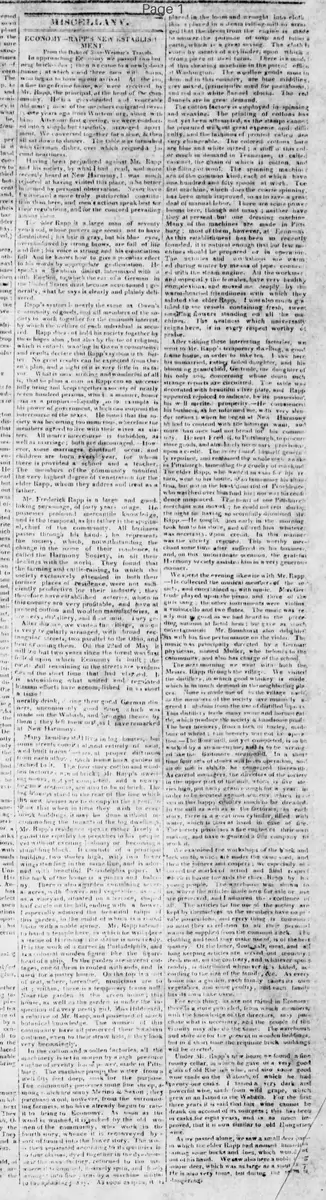
From the Duke of Saxe-Weimar's Travels.
In approaching Economy we passed two large brick-stables: then we came to a newly-built house; at which stood three men with horns, who began to blow on our arrival. At the inn, a fine large frame house, we were received by Mr. Rapp, the principal, at the head of the community. He is a gray-headed and venerable old man: most of the members emigrated twenty-one years ago from Wurtemberg, along with him. After our first greeting, we were conducted into a simply but tastefully arranged apartment. We conversed together for some time, & then all sat down to dinner. The table was furnished with German dishes, over which reigned a jovial heartiness.
Having been prejudiced against Mr. Rapp and his society, by what I had read, and more recently heard at New Harmony, I was much rejoiced at having visited this place, to be better informed by personal observation. Never have I witnessed a more truly patriarchal community than here, and men's actions speak best for their religion, and for the concord prevailing among them.
The elder Rapp is a large man of seventy seven years old, whose powers age seems not to have diminished; his hair is gray, but his blue eyes, overshadowed by strong brows, are full of life and fire: his voice is strong and his enunciation full. And he knows how to give a peculiar effect to his words by appropriate gesticulation. He speaks a Swabian dialect, intermixed with a rude English, to which the ear of a German in the United States must become accustomed: generally, what he says is clearly and plainly delivered.
Rapp's system is nearly the same as Owen's community of goods, and all members of the society to work together for the common interest, by which the welfare of each individual is secured. Rapp does not hold his society together by these hopes alone, but also by the tie of religion, which is entirely wanting in Owen's community: and results declare that Rapp's system is the better. No great results can be expected from Owen's plan, and a sight of it is very little in its favour. What is most striking and wonderful of all is, that so plain a man as Rapp can so successfully bring and keep together a society of nearly seven hundred persons, who in a manner, honor him as a prophet—Equally so to example is his power of government, which can suspend the intercourse of the sexes. He found that the society was becoming too numerous, wherefore the members agreed to live with their wives as sisters. All nearer intercourse is forbidden, as well as marriage; both are discouraged.—However, some marriages constantly occur, and children are born every year, for whom there is provided a school and a teacher.
The members of the community manifest the very highest degree of veneration for the elder Rapp, whom they address and treat as a father.
Mr. Frederick Rapp is a large and good looking personage, of forty years of age. He possesses profound mercantile knowledge, and is the temporal, as his father is the spiritual, chief of the community. All business passes through his hand; he represents the society, which, notwithstanding the change in the name of their residence, is called the Harmony Society, in all their dealings with the world. They found that the farming and cattle-raising, to which the society exclusively extended in both their former places of residence, were not sufficiently productive for their industry; they therefore have established factories, which in this country are very profitable, and have at present cotton and woollen manufactories, a tannery, distillery, and saw mill. They generally drink, during their good German dinners, uncommonly good wine such was made on the Wabash, and brought thence by them; they left none at New Harmony, as I have remarked.
Many families still live in log houses, but some streets consist almost entirely of neat, well framed stone houses, at proper distances from each other; each house has a garden attached to it. The four story cotton and woollen factories, are of red brick; Mr. Rapp's dwelling house, not yet completed, and a newly begun academy, are also to be of brick. The log houses stand in the rear of the line which the new houses are to occupy with the streets, so that when in time they wish to tear down brick houses, it may be done without incommoding the tenants of the log dwellings.
Mr. Rapp's residence speaks rather freely against the equality he preaches to his people, yet without exciting jealousy or becoming a stumbling block. It consists of a principal building, two stories high, with two lower wings standing in the same line, and is adorned with beautiful Philadelphia paper. At the back of the house is a piazza and balcony. There is also a garden containing three acres, with flowers and vegetables, as well as a vineyard, situated on a terrace, shaded half carelessly on the hill, ending with a bower. I especially admired the horizontal tulips of this garden, in the midst of which is a basin with a noble spring. Mr. Rapp intends to build a temple here, in which he will place a statue of Harmony; the statue is now ready. It is the work of a carver in Philadelphia, and is a colossal wooden figure like the figure-head of a ship. In the garden are several cottages, one of them is roofed with sods, and is used for a pastry house. On the top is a sort of seat, where, hereafter, musicians are to sit: within, there is a temporary dancing hall. Near the garden is the green house; this house, as well as the garden is under the inspection of a very pretty girl, Miss Hildebrand, a relative of Mr. Rapp, and possessed of much botanical knowledge. The women of this community have all preserved their Swabian costume, even to their straw hats, & they look very becomingly.
In the cotton and woollen factories, all the machinery is set in motion by a high pressure engine of seventy horse power, made in Pittsburg. The machine pumps the water from a well forty feet deep, sunk for the purpose. The community possesses some fine sheep, among which are many Merino & Saxon; they purchase wool, however, from the surrounding farmers, who have already begun to raise it to bring to Economy. As soon as the wool is washed, it is picked by the old women of the community, who work in the fourth story, whence it is reconveyed by a sort of tunnel into the lower story. The wool is then separated according to its qualities into four classes, dyed together in the dye-house near the manufactory, returned to the mill, where it is carded, coarsely spun, and finally wrought into fine yarn by a machine spinning at once plaid. As soon as spun, it is placed in the loom and wrought into cloth in a steam fulling-mill so arranged that the steam from the engine is made to answer the purpose of soap and fuller's earth, which is a great saving. The cloth is shorn by means of a cylinder, upon which a strong piece of steel turns. There is a model of this shearing machine in the patent office at Washington. The woollen goods most in demand in this country, are blue middlings, grey mixed, (principally used for pantaloons,) and red and white flannel cloths. The red flannels are in great demand.
The cotton factory is employed in spinning and weaving. The printing of cottons has not yet been attempted, as the stamps cannot be procured without great expense and difficulty, and the fashions of printed calicoes are very changeable. The colored cottons that are made are blue and white mixed; a stuff of this color, much in demand in Tennessee, is called cassinet, the chain of which is cotton, and the filling of wool. The spinning machines are of the common kind, each of which have one hundred and fifty spools at work. The first machine, which does the coarse spinning, has been much improved, so as to save a great deal of manual labor. There are some power looms here, though not many; neither have they at present but one dressing machine. Many of the machines are made in Pittsburgh; most of them, however, at Economy.
As this establishment has been so recently founded, it is natural enough that but few machines should be prepared or in operation. The factories and wool shop are warmed during winter by means of pipes connected with the steam engine. By the complexions of the workmen and especially the females, have very healthy, and moved me deeply by the warm hearted friendliness with which they saluted the elder Rapp. I was also much touched to see vessels containing fresh, sweet smelling flowers standing on all the machines. The neatness which universally reigns here, is in every respect worthy of praise.
After visiting these interesting factories, we went to Mr. Rapp's temporary dwelling, a good frame house, in order to take tea. I saw here his unmarried, rather faded daughter, and his blooming grandchild, Gertrude, the daughter of his only son, concerning whose death such strange reports are circulated. The table was decorated with beautiful silver plate, and Rapp appeared rejoiced to indicate, by its possession, his well merited prosperity.—He commenced his business, as he informed me, with very slender means; when he began at New Harmony he had to contend with the bitterest want, and more than once had not bread for his community. He sent Fred. R. to Pittsburgh, to procure store goods, and absolutely necessary provisions, upon a credit. The latter found himself go fully repulsed, and remained the whole night awake in Pittsburgh, lamenting the cruelty of mankind. The elder Rapp, who waited in vain for his return, went to his house, not lamenting his situation, but not on the least doubt of the aid of Providence who watched over him and his: nor was his confidence misplaced. The heart of one Pittsburgh merchant was moved; he could not rest during the night to having so scornfully dismissed Mr. Rapp. He sought him early in the morning, took him to his store, and offered him whatever was necessary, upon credit. In this manner was the society rescued. This worthy merchant some time after suffered in his business, and, on this unfortunate occasion, the grateful Harmony society assisted him in a very generous manner.
We spent the evening likewise with Mr. Rapp —He collected the musical members of the society, and entertained us with music. Miss Gertrude played upon the piano, and three of the girls sang, the other instruments were violins, a violincello and two flutes. The music was really not so good as we had heard in the place dining autumn at Berlin; but gave us much entertainment. Mr. Buonaparte also delighted us with his fine performance on the viola. The music was principally directed by a German physician, named Muller, who belongs to the community, and also has charge of the school.
The next morning we went with both the Messrs. Rapps through the village. We visited the distillery, in which good whiskey is made which is in much demand in the neighbouring places. None is made use of in the village itself as the members of the society have mutually agreed to abstain from the use of distilled liquors. This distillery feeds many swine and horses that produce the society a handsome profit. The beer brewery, from a lack of barley, made beer of wheat: this brewery was not in operation.—The flour mill, not yet completed, is to be worked by a steam-engine, now to be arranged like the Baltimore steam mill. In a short time four sets of stones will be in operation, and an oil mill is also to be connected therewith.
As careful managers, the directors of the society in the upper part of the mill, which is five stories high, lay away grain enough for a year in order to be secured against scarcity, which is even in this happy country much to be dreaded. In the mill as well as in the factory, in each story, there is a great stone cylinder, filled with water, which is thus at hand in case of fire. The society possesses a fire engine of their own making, and have organized a fire company to work it.
We examined the workshops of the blacksmith and lock smith, which are under the same roof, and then the joiners and coopers; we especially observed the marked accord and social respect which is borne towards the elder Rapp by the young people. The warehouse was shown to us, where the articles made here for sale or use are preserved, and I admired the excellence of all. The articles for the use of the society are kept by themselves as the members have no private possessions, and every thing is common so must they in relation to all their present wants be supplied from the common stock; but clothing and food they make use of, is of the best quality. Of the latter, doubt less, meat, and all long keeping articles are served out monthly: fresh meat, on the contrary, and whatever spoils, is distributed whenever it is killed, according to the size of the family, &c. As every house has a garden, each family raises its own vegetables, and some poultry, and each family has its own bake oven.
For such things as are not raised in Economy there is a store provided, from which members, with the knowledge of the directors, may purchase what is necessary, and the people of the vicinity may also do the same. The warehouse and store are for the present in wooden buildings, but in a short time the requisite brick buildings will be erected.
Under Mr. Rapp's new house we found a fine roomy cellar, in which he gave us a very good glass of old Rhenish wine, and also some good wine made on the Wabash, of which he had twenty-one casks. I tasted a very dark and powerful wine, made from wild grape, which grew in an island in the Wabash. For the first three years it is said that this wine cannot be drank on account of its sourness; this has been in casks for eight years, and is so much improved, that it is now similar to old Hungarian wine.
As we passed along, we saw a small deer park, in which the elder Rapp had amused himself taming some bucks and does, which would not get out of his hand. We saw also here a noble moose deer, which was as large as a stout horse. He is also very tame, but during the dangerous season.
I requested as this visit, that I might hear them sing. Try again, and said that the girls had especially M. Rapp quietly conducted us into the Jacobs. When their work is done they collect in one of the factory rooms, to the number of sixty or seventy, to sing spiritual and other songs. They have a prayer hymn-book, containing hymns from the Wurtemberg psalm-book, and others written by the elder Rapp. The latter are truly in prose, but have been arranged to old tunes pious mode, and the girls must devote themselves by the rules. The elder Rapp is very fond of considerably thereto, since Gertrude is "profi- cient and receives musical instruction. A chair the girls and they commenced a s. ah sa a ve- was played for the old parents, way but amidst ay delightful manner It was naturally a n- phonous and exceedingly well arranged. The girls sang two pieces, a aras .. v.al- terwards, by or. Rapp's desire, u a gay Cantata. Yet. duh real emotion did I witness tats inter- esting scene We had an excellent dinner in Mr. Rapp's house, and the musical members of the society took this oppertunity play thest best jrout und performed very well, among them were two of it. The band consisted of twelve musicians. who played bugles. Both the Rapps, and espe- bence, the Beaver Paths on Beaver Creek, for their neighborhood, and purchase, at ten miles cially the elder, advised me strongly to settle in tweuty-five thousand dollars. There I might subinh ton woins, sand they, amd make a great geal of money ; th'y and thet: society would us. sist me in every possible manner. With peculiar feelings, we took leave of the friendly and m lusubus Guo somy at taee o'- tlock. No payment was received at the tavern, and we sat out through the same beautiful place by which we had copne towards Pittsburgh. Mr. F. Rapp. wao had bosines there, followed us, accompanred by Gertrude. Daring tais ride 4 had another opporumity of adouriag the beau- uful rocks as we pmssed by, and particularly the Caveras, probably urade in them by watur, wltch remind one of he caves sear Eins, on the Lahn
What sub-type of article is it?
What themes does it cover?
What keywords are associated?
What entities or persons were involved?
Where did it happen?
Story Details
Key Persons
Location
Economy
Story Details
The Duke visits the Harmony Society at Economy, led by elder George Rapp, describing their communal living, religious devotion, suspension of marriage, industrial factories, and the elder's leadership and personal residence, contrasting favorably with Owen's New Harmony.