Thank you for visiting SNEWPapers!
Sign up free
Editorial
September 29, 1892
Los Angeles Herald
Los Angeles, Los Angeles County, California
What is this article about?
The editorial contrasts Democratic tariff principles—free necessaries, heavy taxes on luxuries, free raw materials, and wage-equalizing duties—with the Republican McKinley bill's violations, which tax essentials heavily and burden manufacturers. It traces Democratic policy from the 1861 Morrill tariff through Tilden and Cleveland.
Clipping
OCR Quality
98%
Excellent
Full Text
THE DEMOCRATIC TARIFF.
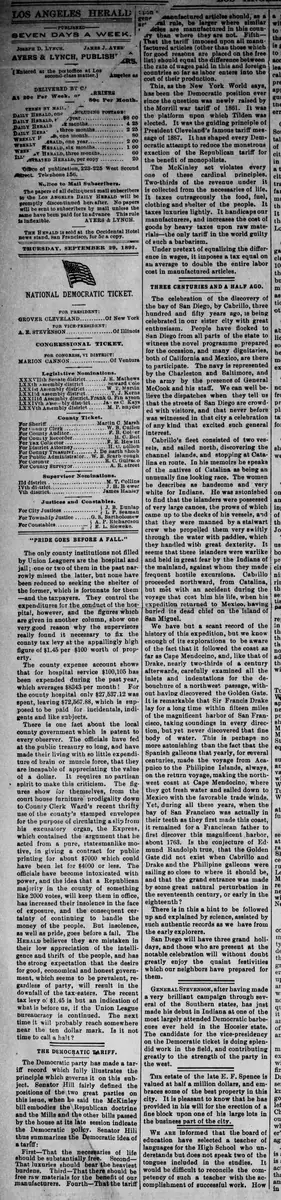
The Democratic party has made a tariff record which fully illustrates the principle which governs it on this subject. Senator Hill fairly defined the positions of the two great parties on this issue, when he said the McKinley bill embodies the Republican doctrine and the Mills and the other bills passed by the house at its late session indicate the Democratic policy. Senator Hill thus summarizes the Democratic idea of a tariff:
First-That the necessaries of life should be substantially free. Second-That luxuries should bear the heaviest burdens. Third-That there should be free raw materials for the benefit of our manufacturers. Fourth-That the tariff on manufactured articles should, as a rule, be larger where similar articles are manufactured in this country than where they are not. Fifth-That the tariff imposed upon all manufactured articles (other than those which for good reasons are placed on the free list) should equal the difference between the rate of wages paid in this and foreign countries so far as labor enters into the cost of their production.
This, as the New York World says, has been the Democratic position ever since the question was newly raised by the Morrill war tariff of 1861. It was the platform upon which Tilden was elected. It was the guiding principle of President Cleveland's famous tariff message of 1887. It has shaped every Democratic attempt to reduce the monstrous exaction of the Republican tariff for the benefit of monopolists.
The McKinley act violates every one of these cardinal principles. Two-thirds of the revenue under it is collected from the necessaries of life. It taxes outrageously the food, fuel, clothing and shelter of the people. It taxes luxuries lightly. It handicaps our manufacturers, and increases the cost of goods by heavy taxes upon raw materials-the only tariff in the world guilty of such a barbarism. Under pretext of equalizing the difference in wages, it imposes a tax equal on an average to double the entire labor cost in manufactured articles.
The Democratic party has made a tariff record which fully illustrates the principle which governs it on this subject. Senator Hill fairly defined the positions of the two great parties on this issue, when he said the McKinley bill embodies the Republican doctrine and the Mills and the other bills passed by the house at its late session indicate the Democratic policy. Senator Hill thus summarizes the Democratic idea of a tariff:
First-That the necessaries of life should be substantially free. Second-That luxuries should bear the heaviest burdens. Third-That there should be free raw materials for the benefit of our manufacturers. Fourth-That the tariff on manufactured articles should, as a rule, be larger where similar articles are manufactured in this country than where they are not. Fifth-That the tariff imposed upon all manufactured articles (other than those which for good reasons are placed on the free list) should equal the difference between the rate of wages paid in this and foreign countries so far as labor enters into the cost of their production.
This, as the New York World says, has been the Democratic position ever since the question was newly raised by the Morrill war tariff of 1861. It was the platform upon which Tilden was elected. It was the guiding principle of President Cleveland's famous tariff message of 1887. It has shaped every Democratic attempt to reduce the monstrous exaction of the Republican tariff for the benefit of monopolists.
The McKinley act violates every one of these cardinal principles. Two-thirds of the revenue under it is collected from the necessaries of life. It taxes outrageously the food, fuel, clothing and shelter of the people. It taxes luxuries lightly. It handicaps our manufacturers, and increases the cost of goods by heavy taxes upon raw materials-the only tariff in the world guilty of such a barbarism. Under pretext of equalizing the difference in wages, it imposes a tax equal on an average to double the entire labor cost in manufactured articles.
What sub-type of article is it?
Economic Policy
Partisan Politics
What keywords are associated?
Democratic Tariff
Mckinley Bill
Tariff Principles
Free Necessaries
Luxury Taxes
Raw Materials
Wage Equalization
Republican Policy
What entities or persons were involved?
Democratic Party
Senator Hill
Mckinley Bill
Mills Bills
Tilden
President Cleveland
New York World
Morrill Tariff
Editorial Details
Primary Topic
Democratic Tariff Principles Versus Republican Mckinley Bill
Stance / Tone
Supportive Of Democratic Policy, Critical Of Republican Tariff
Key Figures
Democratic Party
Senator Hill
Mckinley Bill
Mills Bills
Tilden
President Cleveland
New York World
Morrill Tariff
Key Arguments
Necessaries Of Life Should Be Substantially Free
Luxuries Should Bear The Heaviest Burdens
Free Raw Materials Benefit Manufacturers
Tariff On Manufactured Articles Larger Where Produced Domestically
Tariff Equals Wage Difference In Labor Costs
Mckinley Act Taxes Necessaries Heavily, Violating Democratic Principles
Mckinley Act Lightly Taxes Luxuries
Mckinley Act Burdens Manufacturers With Raw Material Taxes
Mckinley Act Imposes Excessive Duties Beyond Wage Equalization