Thank you for visiting SNEWPapers!
Sign up free
Letter to Editor
May 12, 1758
The New Hampshire Gazette
Portsmouth, Rockingham County, New Hampshire
What is this article about?
Eyewitness report from London, February 17, 1758, of an elderly Quaker hermit preaching repentance and a solemn fast to England for its sins, echoing Jonah's call to Nineveh. He attempts to enter the King's palace but is denied. The writer urges the government to free a Quaker imprisoned over 12 years in the Ecclesiastical court.
Clipping
OCR Quality
98%
Excellent
Full Text
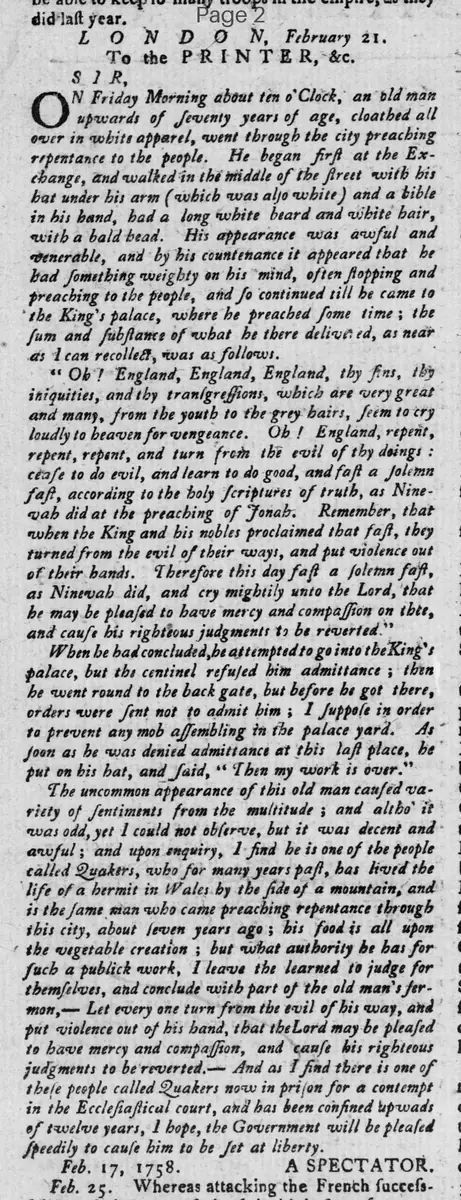
LONDON, February 21.
To the PRINTER, &c.
SIR,
On Friday Morning about ten o'Clock, an old man upwards of seventy years of age, clothed all over in white apparel, went through the city preaching repentance to the people. He began first at the Exchange, and walked in the middle of the street with his hat under his arm (which was also white) and a bible in his hand. Had a long white beard and white hair, with a bald head. His appearance was awful and venerable, and by his countenance it appeared that he had something weighty on his mind, often stopping and preaching to the people, and so continued till he came to the King's palace, where he preached some time; the sum and substance of what he there delivered, as near as I can recollect, was as follows.
"Oh! England, England, England, thy sins, thy iniquities, and thy transgressions, which are very great and many, from the youth to the grey hairs, seem to cry loudly to heaven for vengeance. Oh! England, repent, repent, repent, and turn from the evil of thy doings: cease to do evil, and learn to do good, and fast a solemn fast, according to the holy scriptures of truth, as Nineveh did at the preaching of Jonah. Remember, that when the King and his nobles proclaimed that fast, they turned from the evil of their ways, and put violence out of their hands. Therefore this day fast a solemn fast, as Nineveh did, and cry mightily unto the Lord, that he may be pleased to have mercy and compassion on thee, and cause his righteous judgments to be averted."
When he had concluded he attempted to go into the King's palace, but the sentinel refused him admittance; then he went round to the back gate, but before he got there, orders were sent not to admit him; I suppose in order to prevent any mob assembling in the palace yard. As soon as he was denied admittance at this last place, he put on his hat, and said, "Then my work is over."
The uncommon appearance of this old man caused variety of sentiments from the multitude; and although it was odd, yet I could not observe, but it was decent and awful; and upon enquiry, I find he is one of the people called Quakers, who for many years past, has lived the life of a hermit in Wales by the side of a mountain, and is the same man who came preaching repentance through this city, about seven years ago; his food is all upon the vegetable creation; but what authority he has for such a publick work, I leave the learned to judge for themselves, and conclude with part of the old man's sermon,-- Let every one turn from the evil of his way, and put violence out of his hand, that the Lord may be pleased to have mercy and compassion, and cause his righteous judgments to be averted. And as I find there is one of these people called Quakers now in prison for a contempt in the Ecclesiastical court, and has been confined upwards of twelve years, I hope, the Government will be pleased speedily to cause him to be set at liberty.
Feb. 17, 1758.
A SPECTATOR.
To the PRINTER, &c.
SIR,
On Friday Morning about ten o'Clock, an old man upwards of seventy years of age, clothed all over in white apparel, went through the city preaching repentance to the people. He began first at the Exchange, and walked in the middle of the street with his hat under his arm (which was also white) and a bible in his hand. Had a long white beard and white hair, with a bald head. His appearance was awful and venerable, and by his countenance it appeared that he had something weighty on his mind, often stopping and preaching to the people, and so continued till he came to the King's palace, where he preached some time; the sum and substance of what he there delivered, as near as I can recollect, was as follows.
"Oh! England, England, England, thy sins, thy iniquities, and thy transgressions, which are very great and many, from the youth to the grey hairs, seem to cry loudly to heaven for vengeance. Oh! England, repent, repent, repent, and turn from the evil of thy doings: cease to do evil, and learn to do good, and fast a solemn fast, according to the holy scriptures of truth, as Nineveh did at the preaching of Jonah. Remember, that when the King and his nobles proclaimed that fast, they turned from the evil of their ways, and put violence out of their hands. Therefore this day fast a solemn fast, as Nineveh did, and cry mightily unto the Lord, that he may be pleased to have mercy and compassion on thee, and cause his righteous judgments to be averted."
When he had concluded he attempted to go into the King's palace, but the sentinel refused him admittance; then he went round to the back gate, but before he got there, orders were sent not to admit him; I suppose in order to prevent any mob assembling in the palace yard. As soon as he was denied admittance at this last place, he put on his hat, and said, "Then my work is over."
The uncommon appearance of this old man caused variety of sentiments from the multitude; and although it was odd, yet I could not observe, but it was decent and awful; and upon enquiry, I find he is one of the people called Quakers, who for many years past, has lived the life of a hermit in Wales by the side of a mountain, and is the same man who came preaching repentance through this city, about seven years ago; his food is all upon the vegetable creation; but what authority he has for such a publick work, I leave the learned to judge for themselves, and conclude with part of the old man's sermon,-- Let every one turn from the evil of his way, and put violence out of his hand, that the Lord may be pleased to have mercy and compassion, and cause his righteous judgments to be averted. And as I find there is one of these people called Quakers now in prison for a contempt in the Ecclesiastical court, and has been confined upwards of twelve years, I hope, the Government will be pleased speedily to cause him to be set at liberty.
Feb. 17, 1758.
A SPECTATOR.
What sub-type of article is it?
Informative
Religious
Ethical Moral
What themes does it cover?
Religion
Morality
What keywords are associated?
Quaker Preacher
Repentance
England Sins
Solemn Fast
Nineveh
Ecclesiastical Court
Prisoner Release
What entities or persons were involved?
A Spectator.
The Printer
Letter to Editor Details
Author
A Spectator.
Recipient
The Printer
Main Argument
reports an elderly quaker preacher urging england to repent for its sins and observe a solemn fast like nineveh to avert divine judgment; calls for the release of a quaker imprisoned over 12 years in the ecclesiastical court.
Notable Details
- preacher in all-white apparel, long white beard, bald head, carrying bible
- lived as hermit in wales, vegetarian diet
- previous preaching in city seven years ago
- quotes sermon referencing jonah and nineveh
- attempted entry to king's palace denied to prevent mob