Thank you for visiting SNEWPapers!
Sign up free
Literary
July 30, 1838
Alexandria Gazette
Alexandria, Alexandria County, District Of Columbia
What is this article about?
Satirical tale of the trial of David Dubius, where a divided jury, starved overnight, sways to a guilty verdict under hunger's influence, prioritizing dinner over justice. Evidence is circumstantial; prisoner's character dubious.
Clipping
OCR Quality
85%
Good
Full Text
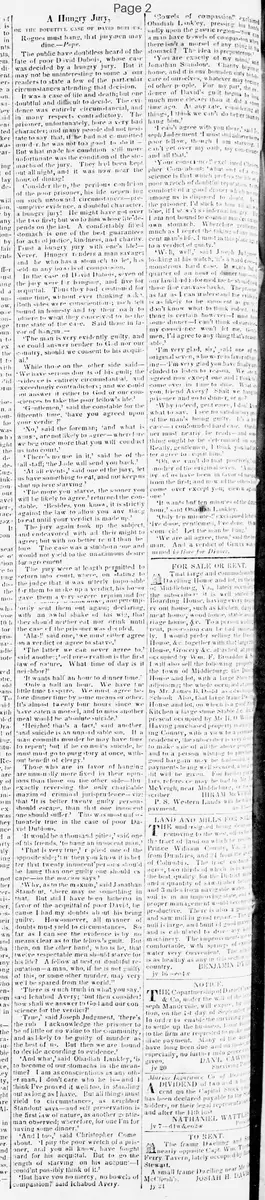
A Hungry Jury,
OR THE DOUBTFUL CASE OF DAVID DUBIUS.
Rogues must hang, that jurymen may dine.—Pope.
The public have doubtless heard of the fate of poor David Dubois, whose case was decided by a hungry jury. But it may not be uninteresting to some of our readers to state a few of the particular circumstances attending that decision.
It was a case of life and death; but one doubtful and difficult to decide. The evidence was entirely circumstantial, and in many respects contradictory. The prisoner, unfortunately, bore a very bad character; and many people did not hesitate to say that, if he had not committed murder, he was not too good to do it.
But what made his condition still more unfortunate was the condition of the stomachs of the jury. They had been kept out all night, and it was now near the hour of dining.
Consider then, the perilous condition of the poor prisoner, his life depending on such untoward circumstances—presumptive evidence, a doubtful character, a hungry jury! He might have got over the two first; but woe to him whose life depends on the last. A comfortably filled stomach is one of the best guarantees for acts of justice, kindness, and charity. Trust a hungry jury with one's life!—Never. Hunger renders a man savage: and he who has a stomach to fill renders himself incapable of any bouts of compassion.
In the case of David Dubois, seven of the jury were for hanging, and five for acquittal. Thus they had continued for some time, without ever thinking alike. Both sides were conscientious: Both felt bound in honesty and by their oath to adhere to what they conceived to be the true state of the case. Said those in favor of hanging—
'The man is very evidently guilty, and we could answer neither to God nor our country, should we consent to his acquittal.'
While those on the other side said—
'We have serious doubts of his guilt; the evidence is entirely circumstantial, and exceedingly contradictory; and we could not answer it either to God or our consciences to take the poor fellow's life.'
'Gentlemen,' said the constable for the fifteenth time, 'have you agreed upon your verdict?'
'No,' said the foreman; 'and what is worse, are not likely to agree—wherefore we beg once more that you will conduct us into court.'
'There's no use in it,' said he of the rattles; 'the Judge will send you back?'
'At all events,' said one of the jury, 'let us have something to eat, and not keep us shut up here starving.'
'The more you starve, the sooner you will be likely to agree.' returned the constable. 'Besides, you know, it is strictly against the law to allow you any thing to eat until your verdict is made up.'
The jury again took up the subject, and endeavored with all their might to agree; but with no better result than before. The case was a stubborn one and would not yield to the unanimous desire for agreement.
The jury were at length permitted to return into court, where, on stating to the judge that it was utterly impossible for them to make up a verdict, his honor gave them a very severe reprimand and peremptorily sent them out again; declaring, with an awful shake of his wig, that they should neither eat nor drink until the case of the prisoner was decided.
'Alas!' said one, 'we must either agree on a verdict or agree to starve.'
'The latter we can never agree to,' said another; 'self preservation is the first law of nature. What time of day is it neighbor?'
'It wants half an hour to dinner time.'
'Only a half an hour. We have but little time to spare. We must agree before dinner time by some means or other. It's almost twenty four hours since we have eaten a morsel, and to miss another meal would be absolute suicide.'
'Heigho! that's a fact,' said another 'and suicide is an unpardonable sin. If a man commits murder he may have time to repent: but if he commits suicide, he must go to purgatory at once, without benefit of clergy.'
Those who are in favor of hanging are unusually more fixed in their opinions than those on the other side—thus exactly reversing the only charitable maxim of criminal jurisprudence—viz: that 'It is better twenty guilty persons should escape, than that one innocent one should suffer.' This was most unfortunately true in the case of poor David Dubois.
'It would be a thousand pities,' said one of his friends, 'to hang an innocent man.'
'That is very true,' replied one of the opposite side; 'but then you know it is better that twenty innocent persons should be hung than one guilty one should escape—so the maxim says.'
'Why, as to the maxim,' said Jonathan Standout, 'there may be something in that. But still I have been hitherto in favor of the acquittal of poor David, because I had my doubts about his being guilty.
Howsomever, all manner of doubts must yield to circumstances. So far as I can see the evidence is by no means clear as to the fellow's guilt. But then, on the other hand, who is he, that twelve respectable men should starve for his life? A fellow at best of doubtful reputation—a man, who, if he is not guilty of this, or some other murder, may very well be spared from the world.'
There is much truth in what you say,' said Ichabod Avery; 'but then consider! how shall we answer to God and our conscience for the verdict?'
'True,' said Joseph Judgment, 'there's the rub. I acknowledge the prisoner to be of little or no value to the community, and as likely to be guilty of murder as the best of us.
But then we are bound to decide according to evidence.'
'And what,' said Obadiah Lankley, 'is to become of our stomachs in the mean time? I am as conscientious as any other man, I don't care who he is—and I think I've proved it well too, in standing out as long as I have. But all things must yield to circumstances, as neighbor Standout says—and self preservation is the first law of nature, as another gentleman observed; wherefore, for one I'm for having some dinner.'
'And I too,' said Christopher Come about. 'I pity the poor wretch of a prisoner, and you all know, have fought hard for his acquittal. But to go the length of starving on his account—I couldn't possibly think of it.'
'But have you no mercy, no bowels of compassion?' said Ichabod Avery.
"Bowels of compassion?" exclaimed Obadiah Lankley, sadly pressing upon the gastric region—how can his bowels of compassion be in a man who hasn't had a morsel of anything in his stomach? The idea is preposterous.'
"You are exactly of my mind," said Jonathan Standout. 'Charity begins at home, and it is our bounden duty to take care of ourselves. For whatever my part may become of poor David, the evidence of his guilt begins to look much more clear than it did a time ago. At any rate considering all things, I think we can't do better than hang him.'
"I can't agree with you there," said Joseph Judgment. 'I must still adhere to the poor fellow though I am starving. I ain't yet over my oath, my conscience and all that.'
"Your conscience!" exclaimed Christopher Comeabout 'what sort of a conscience is that which prefers the poor wretch of doubtful reputation to the comforts of a good dinner which none among us is disposed to doubt, is the prisoner. I'd stick to him also if it wasn't for this infernal hunger. I am not bound to commit murder on my own stomach. Wherefore gentlemen much as I regret the taking of any innocent man's life, I must in this case agree to a verdict of guilty.'
'Well, well,' said Joseph Judgment looking at his watch, 'it's a hard case—monstrous hard case: it's want but a quarter of an hour of dinner time. Our landlord will have those fine canvass backs. The prisoner as far as I can understand the evidence is as likely to be innocent as guilty. I don't know what to think indeed. But one thing is certain however—I must have some dinner—I can't think of starving. My conscience won't let me. But gentlemen, I'll agree to any thing that's reasonable.'
'I'm very glad, sir,' said one of the original seven, who were in favor of hanging—'I'm very glad you have finally concluded to listen to reason. We are agreed now except one and I think he will come over in time to dine. What say you, friend Avery? Shall we hang the prisoner and go to dinner, or no?'
'Why indeed, gentlemen, I don't know what to say. I see no satisfactory proof of the man's being guilty. It's a hard case—confounded hard case. Our dinner must nearly be ready—and something ought to be determined on some how. Really, gentlemen, I think you had better agree to acquit him.'
'Oh, we can't do that positively,' said another of the original seven. 'All the way of us have been in favor of hanging from the first; and now all the others have come over except you; eleven against one,'
'It wants but ten minutes of the dinner hour,' said Obadiah Lankley.
'Only ten minutes!' exclaimed Ichabod 'I've done, gentlemen, I've done. O my stomach! Let the man be hung.'
We are all agreed, then,' said the foreman. And a verdict of Guilty was made in time for Dinner.
OR THE DOUBTFUL CASE OF DAVID DUBIUS.
Rogues must hang, that jurymen may dine.—Pope.
The public have doubtless heard of the fate of poor David Dubois, whose case was decided by a hungry jury. But it may not be uninteresting to some of our readers to state a few of the particular circumstances attending that decision.
It was a case of life and death; but one doubtful and difficult to decide. The evidence was entirely circumstantial, and in many respects contradictory. The prisoner, unfortunately, bore a very bad character; and many people did not hesitate to say that, if he had not committed murder, he was not too good to do it.
But what made his condition still more unfortunate was the condition of the stomachs of the jury. They had been kept out all night, and it was now near the hour of dining.
Consider then, the perilous condition of the poor prisoner, his life depending on such untoward circumstances—presumptive evidence, a doubtful character, a hungry jury! He might have got over the two first; but woe to him whose life depends on the last. A comfortably filled stomach is one of the best guarantees for acts of justice, kindness, and charity. Trust a hungry jury with one's life!—Never. Hunger renders a man savage: and he who has a stomach to fill renders himself incapable of any bouts of compassion.
In the case of David Dubois, seven of the jury were for hanging, and five for acquittal. Thus they had continued for some time, without ever thinking alike. Both sides were conscientious: Both felt bound in honesty and by their oath to adhere to what they conceived to be the true state of the case. Said those in favor of hanging—
'The man is very evidently guilty, and we could answer neither to God nor our country, should we consent to his acquittal.'
While those on the other side said—
'We have serious doubts of his guilt; the evidence is entirely circumstantial, and exceedingly contradictory; and we could not answer it either to God or our consciences to take the poor fellow's life.'
'Gentlemen,' said the constable for the fifteenth time, 'have you agreed upon your verdict?'
'No,' said the foreman; 'and what is worse, are not likely to agree—wherefore we beg once more that you will conduct us into court.'
'There's no use in it,' said he of the rattles; 'the Judge will send you back?'
'At all events,' said one of the jury, 'let us have something to eat, and not keep us shut up here starving.'
'The more you starve, the sooner you will be likely to agree.' returned the constable. 'Besides, you know, it is strictly against the law to allow you any thing to eat until your verdict is made up.'
The jury again took up the subject, and endeavored with all their might to agree; but with no better result than before. The case was a stubborn one and would not yield to the unanimous desire for agreement.
The jury were at length permitted to return into court, where, on stating to the judge that it was utterly impossible for them to make up a verdict, his honor gave them a very severe reprimand and peremptorily sent them out again; declaring, with an awful shake of his wig, that they should neither eat nor drink until the case of the prisoner was decided.
'Alas!' said one, 'we must either agree on a verdict or agree to starve.'
'The latter we can never agree to,' said another; 'self preservation is the first law of nature. What time of day is it neighbor?'
'It wants half an hour to dinner time.'
'Only a half an hour. We have but little time to spare. We must agree before dinner time by some means or other. It's almost twenty four hours since we have eaten a morsel, and to miss another meal would be absolute suicide.'
'Heigho! that's a fact,' said another 'and suicide is an unpardonable sin. If a man commits murder he may have time to repent: but if he commits suicide, he must go to purgatory at once, without benefit of clergy.'
Those who are in favor of hanging are unusually more fixed in their opinions than those on the other side—thus exactly reversing the only charitable maxim of criminal jurisprudence—viz: that 'It is better twenty guilty persons should escape, than that one innocent one should suffer.' This was most unfortunately true in the case of poor David Dubois.
'It would be a thousand pities,' said one of his friends, 'to hang an innocent man.'
'That is very true,' replied one of the opposite side; 'but then you know it is better that twenty innocent persons should be hung than one guilty one should escape—so the maxim says.'
'Why, as to the maxim,' said Jonathan Standout, 'there may be something in that. But still I have been hitherto in favor of the acquittal of poor David, because I had my doubts about his being guilty.
Howsomever, all manner of doubts must yield to circumstances. So far as I can see the evidence is by no means clear as to the fellow's guilt. But then, on the other hand, who is he, that twelve respectable men should starve for his life? A fellow at best of doubtful reputation—a man, who, if he is not guilty of this, or some other murder, may very well be spared from the world.'
There is much truth in what you say,' said Ichabod Avery; 'but then consider! how shall we answer to God and our conscience for the verdict?'
'True,' said Joseph Judgment, 'there's the rub. I acknowledge the prisoner to be of little or no value to the community, and as likely to be guilty of murder as the best of us.
But then we are bound to decide according to evidence.'
'And what,' said Obadiah Lankley, 'is to become of our stomachs in the mean time? I am as conscientious as any other man, I don't care who he is—and I think I've proved it well too, in standing out as long as I have. But all things must yield to circumstances, as neighbor Standout says—and self preservation is the first law of nature, as another gentleman observed; wherefore, for one I'm for having some dinner.'
'And I too,' said Christopher Come about. 'I pity the poor wretch of a prisoner, and you all know, have fought hard for his acquittal. But to go the length of starving on his account—I couldn't possibly think of it.'
'But have you no mercy, no bowels of compassion?' said Ichabod Avery.
"Bowels of compassion?" exclaimed Obadiah Lankley, sadly pressing upon the gastric region—how can his bowels of compassion be in a man who hasn't had a morsel of anything in his stomach? The idea is preposterous.'
"You are exactly of my mind," said Jonathan Standout. 'Charity begins at home, and it is our bounden duty to take care of ourselves. For whatever my part may become of poor David, the evidence of his guilt begins to look much more clear than it did a time ago. At any rate considering all things, I think we can't do better than hang him.'
"I can't agree with you there," said Joseph Judgment. 'I must still adhere to the poor fellow though I am starving. I ain't yet over my oath, my conscience and all that.'
"Your conscience!" exclaimed Christopher Comeabout 'what sort of a conscience is that which prefers the poor wretch of doubtful reputation to the comforts of a good dinner which none among us is disposed to doubt, is the prisoner. I'd stick to him also if it wasn't for this infernal hunger. I am not bound to commit murder on my own stomach. Wherefore gentlemen much as I regret the taking of any innocent man's life, I must in this case agree to a verdict of guilty.'
'Well, well,' said Joseph Judgment looking at his watch, 'it's a hard case—monstrous hard case: it's want but a quarter of an hour of dinner time. Our landlord will have those fine canvass backs. The prisoner as far as I can understand the evidence is as likely to be innocent as guilty. I don't know what to think indeed. But one thing is certain however—I must have some dinner—I can't think of starving. My conscience won't let me. But gentlemen, I'll agree to any thing that's reasonable.'
'I'm very glad, sir,' said one of the original seven, who were in favor of hanging—'I'm very glad you have finally concluded to listen to reason. We are agreed now except one and I think he will come over in time to dine. What say you, friend Avery? Shall we hang the prisoner and go to dinner, or no?'
'Why indeed, gentlemen, I don't know what to say. I see no satisfactory proof of the man's being guilty. It's a hard case—confounded hard case. Our dinner must nearly be ready—and something ought to be determined on some how. Really, gentlemen, I think you had better agree to acquit him.'
'Oh, we can't do that positively,' said another of the original seven. 'All the way of us have been in favor of hanging from the first; and now all the others have come over except you; eleven against one,'
'It wants but ten minutes of the dinner hour,' said Obadiah Lankley.
'Only ten minutes!' exclaimed Ichabod 'I've done, gentlemen, I've done. O my stomach! Let the man be hung.'
We are all agreed, then,' said the foreman. And a verdict of Guilty was made in time for Dinner.
What sub-type of article is it?
Prose Fiction
Satire
What themes does it cover?
Moral Virtue
Political
What keywords are associated?
Hungry Jury
Justice Satire
Guilty Verdict
Hunger Influence
Moral Dilemma
Circumstantial Evidence
Self Preservation
Literary Details
Title
A Hungry Jury, Or The Doubtful Case Of David Dubius.
Subject
Satire On Hunger Influencing Jury Justice
Form / Style
Narrative Prose Satire
Key Lines
Rogues Must Hang, That Jurymen May Dine.—Pope.
Trust A Hungry Jury With One's Life!—Never. Hunger Renders A Man Savage: And He Who Has A Stomach To Fill Renders Himself Incapable Of Any Bouts Of Compassion.
It Is Better Twenty Guilty Persons Should Escape, Than That One Innocent One Should Suffer.
Charity Begins At Home, And It Is Our Bounden Duty To Take Care Of Ourselves.
And A Verdict Of Guilty Was Made In Time For Dinner.