Thank you for visiting SNEWPapers!
Sign up free
The Indiana State Sentinel
Indianapolis, Marion County, Indiana
What is this article about?
Reports on U.S. 44th Congress sessions in Washington, Jan. 29-31: Senate debates resolution against sinking fund taxes by Mr. Beck, extensive discussions and amendments on silver remonetization bill by Messrs. Wallace, Bayard, Christiancy, and others; House considers bills on legal tender notes, distilled spirits tax, and pensions.
Clipping
OCR Quality
Full Text
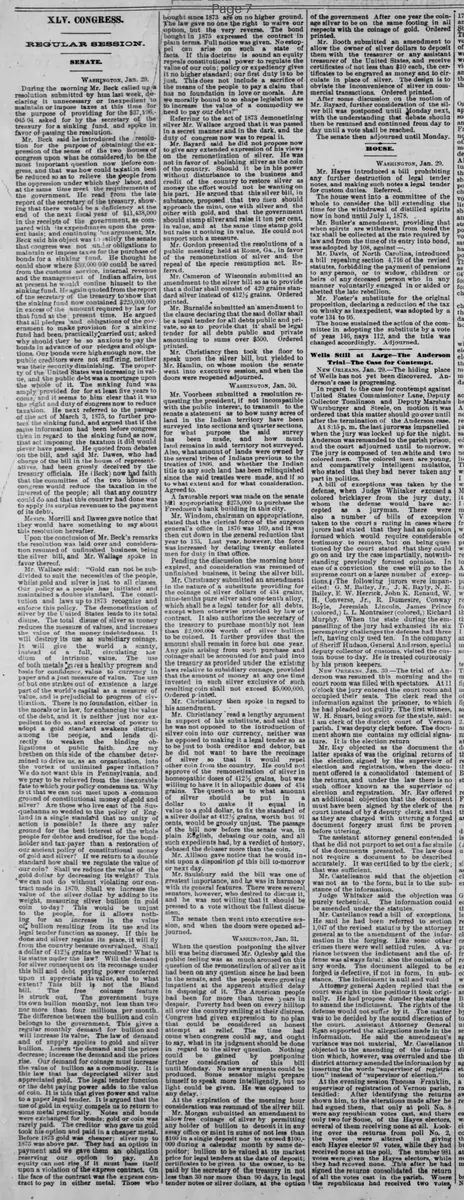
REGULAR SESSION.
SENATE.
Washington, Jan. 29.
During the morning Mr. Beck called up a resolution submitted by him last week, declaring it unnecessary or inexpedient to maintain or impose taxes at this time for the purpose of providing for the $37,196,045.04 asked for by the Secretary of the Treasury for a sinking fund, and spoke in favor of passing the resolution.
Mr. Beck said he introduced the resolution for the purpose of obtaining the expression of the sense of the two houses of Congress upon what he considered to be the most important question now before Congress, and that was how could taxation best be reduced so as to relieve the people from the oppression under which they labor, and at the same time meet the requirements of the government. He read from the late report of the Secretary of the Treasury, showing that there would be a deficiency at the end of the next fiscal year of $11,438,000 in the receipts of the government, as compared with its expenditures upon the present basis; and continuing his argument, Mr. Beck said his object was to satisfy the Senate that Congress was not under obligations to maintain or impose taxes for the purchase of bonds for a sinking fund. He thought he could show where $30,000,000 could be saved from the customs service, internal revenue and the management of Indian affairs, but at present he would confine himself to the sinking fund. He again quoted from the report of the Secretary of the Treasury to show that the sinking fund now contained $220,000,000 in excess of the amount required by law for that fund at the present time. He argued that all pledges and obligations of the government to make provision for a sinking fund had been practically carried out; asked why should they be so anxious to pay the bonds in advance of our pledges and obligations. Our bonds were high enough now. The public creditors were not suffering, neither was their security diminishing. The property of the United States was increasing in value, and the public debt was a mortgage upon the whole of it. The sinking fund was amply provided for for at least five years to come, and it seems to him clear that it was the right and duty of Congress now to reduce taxation. He next referred to the passage of the act of March 3, 1875, to further protect the sinking fund, and argued that if the same information had been before Congress then in regard to the sinking fund as now, that act imposing the taxation it did would never have passed. He quoted from debates on the bill, and said Mr. Dawes, who had charge of the bill in the House of Representatives, had been grossly deceived by the Treasury officials. He (Beck) now had faith that the committee of the two houses of Congress would reduce the taxation in the interest of the people; all that any country could do and that this country had done was to apply its surplus revenues to the payment of its debts.
Messrs. Morrill and Dawes gave notice that they would have something to say about this resolution hereafter.
Upon the conclusion of Mr. Beck's remarks the resolution was laid over and consideration resumed of unfinished business, being the silver bill, and Mr. Wallace spoke in favor thereof.
Mr. Wallace said: "Gold cannot be subdivided to suit the necessities of the people, whilst gold and silver is just to all classes. Our policy as a people has initiated and maintained a double standard. The Constitution and laws up to 1873 recognize and enforce this policy. The demonetization of silver by the United States leads to its total disuse. The total disuse of silver as money reduces the measure of values, and increases the value of the money indebtedness. It will destroy its use as subsidiary coinage. It will give the world a scanty, instead of a full, circulating medium of intrinsic value. The use of both metals gives a healthy progress and basis for confidence, value to currency in paper and a just measure of value. The use of but one strikes out of existence a large part of the world's capital as a measure of value, and is prejudicial to progress of civilization. There is no foundation, either in morals or in law, for enhancing the value of the debt, and it is neither just nor expedient to do so, and exercise of power to adopt a gold standard awakens distrust among the people, and lends directly to weaken the binding obligations of public faith. Are my brethren on this side of the chamber determined to drive us, as an organization, into the vortex of unlimited paper inflation? We do not want this in Pennsylvania, and we pray to be relieved from the inexorable fate to which your policy condemns us. Why is it that we cannot meet upon a common ground of constitutional money of gold and silver? Are those who live east of the Susquehanna so wedded to the policy of England in a single standard that no unity of action is possible? Is there any safer ground for the best interest of the whole people for debtor and creditor, for the bondholder and tax-payer than a restoration of our ancient policy of constitutional money of gold and silver? If we return to a double standard how shall we regulate the value of our coin? Shall we reduce the value of the gold dollar by decreasing its weight? This we cannot do without violating our contract made in 1870. Shall we increase the value of the silver dollar by adding to its weight, measuring silver bullion in gold coin to-day? This would be unjust to the people, for it allows nothing for an increase in the value of bullion resulting from its use and its legal tender functions as money. If this be done and silver regains its place, it will fly from the country because overvalued. Shall a dollar of 412½ grains be recoined? What is its status under the law? Will the demand for silver consequent on its recoinage under this bill and debt paying power conferred upon it appreciate its value, and to what extent? This bill is not the Bland bill. The free coinage feature is struck out. The government buys its own bullion monthly, not less than two nor more than four millions per month. The difference between the bullion and coin belongs to the government. This gives a regular monthly demand for bullion and will increase its value. The law of demand and of supply applies to gold and silver bullion. Lessen the demand and the prices decrease; increase the demand and the prices rise. Our demand for coinage must increase the value of bullion as a commodity. It is this law that has depreciated silver and appreciated gold. The legal tender function or the debt paying power adds to the value of coin. It is this that gives power and value to a paper legal tender. It is argued that the use of gold in equity compels us to return to some metal practically. Notes and bonds were exchanged for bonds; gold or coin was rarely paid. The creditor who gave us gold took his option and paid in a cheaper metal. Before 1873 gold was cheaper; silver up to 1873 was above par. They had an option in payment and we gave them an obligation reserving our option to pay. An equity cannot rise if it must base itself upon a violation of the express contract. On the face of the contract was the express contract to pay in either metal. Those who bought since 1873 are on no higher ground. The law gave no one the right to waive our option, but the very reverse. The bond bought in 1875 expressed the contract in plain terms. Full notice was given. No estoppel can arise on such a state of facts. If this doctrine is sound an equity repeals constitutional power to regulate the value of our coin; policy or expediency gives it no higher standard; our first duty is to be just. This does not include a sacrifice of the means of the people to pay a claim that has no foundation in law or morals. Are we morally bound to so shape legislation as to increase the value of a commodity we need to pay our debts?"
Referring to the act of 1873 demonetizing silver Mr. Wallace argued that it was passed in a secret manner and in the dark, and the duty of Congress now was to repeal it.
Mr. Bayard said he did not propose now to give any extended expression of his views on the remonetization of silver. He was not in favor of abolishing silver as the coin of the country. Should it be in his power without disturbance to the business and credit of the country to restore silver as money the effort would not be wanting on his part. He argued that this silver bill, in substance, proposed that two men should approach the mint, one with silver and the other with gold, and that the government should stamp silver and raise it ten per cent. in value, and at the same time stamp gold but raise it nothing in value. He could not support such a measure.
Mr. Gordon presented the resolutions of a public meeting held at Rome, Ga., in favor of the remonetization of silver and the repeal of the specie resumption act. Referred.
Mr. Cameron of Wisconsin submitted an amendment to the silver bill so as to provide that a dollar shall consist of 420 grains standard silver instead of 412½ grains. Ordered printed.
Mr. Burnside submitted an amendment to the clause declaring that the said dollar shall be a legal tender for all debts public and private, so as to provide that it shall be legal tender for all debts public and private amounting to sums over $500. Ordered printed.
Mr. Christiancy then took the floor to speak upon the silver bill, but yielded to Mr. Hamlin, on whose motion the Senate went into executive session, and when the doors were reopened adjourned.
WASHINGTON, Jan. 30.
Mr. Voorhees submitted a resolution requesting the President, if not incompatible with the public interest, to transmit to the Senate a statement as to how many acres of land in the Indian territory have been surveyed into sections and quarter sections, for what purpose the said survey has been made, and how much land remains in said territory not surveyed. Also, what amount of lands were owned by the several tribes of Indians previous to the treaties of 1866, and whether the Indian title to any such land has been relinquished since the said treaties were made, and if so to what extent and for what consideration. Agreed to.
A favorable report was made on the Senate bill appropriating $275,000 to purchase the Freedmen's bank building in this city.
Mr. Windom, Chairman on Appropriations, stated that the clerical force of the Surgeon General's office in 1876 was 169, and it was then cut down in the general reduction that year to 135. Last year, however, the force was increased by detailing twenty enlisted men for duty in that office.
Pending the discussion the morning hour expired, and consideration was resumed of unfinished business, it being the silver bill.
Mr. Christiancy submitted an amendment in the nature of a substitute providing for the coinage of silver dollars of 434 grains, nine-tenths pure silver and one-tenth alloy, which shall be a legal tender for all debts, except when otherwise provided by law or contract. It also authorizes the Secretary of the Treasury to purchase monthly not less than $2,000,000 worth of silver bullion to be coined. It further provides that the amount shall remain in force but one year. Any gain arising from such purchase and coinage shall be accounted for and paid into the Treasury as provided under the existing laws relative to subsidiary coinage, provided that the amount of money at any one time invested in such silver exclusive of such resulting coin shall not exceed $5,000,000. Ordered printed.
Mr. Christiancy then spoke in regard to his amendment.
Mr. Christiancy read a lengthy argument in support of his substitute, and said that he was not opposed to the introduction of silver coin into our currency, neither was he opposed to making it a legal tender so as to be just to both creditor and debtor, but he did not want to have the recoinage of silver so that it would repel other coin from the country. He could not approve of the remonetization of silver in homeopathic doses of 412½ grains, but was willing to have it in allopathic doses of 434 grains. The question as to what amount of silver should be put in a dollar to make it equal in value to a gold dollar, to fix the standard of a silver dollar at 412½ grains, worth but 91 cents, would be grossly unjust. The passage of the bill now before the Senate was, in plain English, debasing our coin, and all such expedients had, by a verdict of history, debased the debaser more than the coin.
Mr. Allison gave notice that he would insist upon a disposition of this bill to-morrow or next day.
Mr. Saulsbury said the bill was one of greatest importance, and he was in harmony with its general features. There were several senators, however, who desired to discuss it, and he was not willing that it should be pressed to a vote without the fullest discussion.
The Senate then went into executive session, and when the doors were opened adjourned.
Washington, Jan. 31.
When the question postponing the silver bill was being discussed Mr. Oglesby said the public feeling was as much aroused on this question of the remonetization of silver as it had been on any question since he had been in the Senate, and the people were growing impatient at the apparent studied delay in disposing of it. The American people had been for more than three years in despair. Poverty had been on every hilltop all over the country smiling at their distress. Congress had given expression to no plan that could be considered an honest attempt at relief. The time had come when Congress could say, and ought to say, what in its judgment should be done in regard to the silver question. Nothing could be gained by postponing further consideration of this bill until Monday. No new arguments could be produced. Some senator might prepare himself to speak more intelligently, but no light could be given. He was opposed to any delay.
At the expiration of the morning hour consideration was resumed of the silver bill.
Mr. Morgan submitted an amendment to allow free coinage of silver by permitting any holder of bullion to deposit it in any assay office or mint in sums of not less than $100 in a single deposit nor to exceed $100,000 during a calendar month by same depositor; bullion to be valued at its market price for legal tenders at the date of deposit; certificates to be given to the owner, to be paid by the Secretary of the Treasury in not less than 30 nor more than 90 days, in legal tender notes or silver dollars, at the option of the government. After one year the coinage silver to be on the same footing in all respects with the coinage of gold. Ordered printed.
Mr. Booth submitted an amendment to allow the owner of silver dollars to deposit them with the Treasurer or any assistant Treasurer of the United States, and receive certificates of not less than $10 each, the certificates to be engraved as money and to circulate in place of silver. The design is to obviate the inconvenience of silver in commercial transactions. Ordered printed.
After some discussion on the motion of Mr. Bayard, further consideration of the silver bill was postponed until Monday next, with the understanding that debate should then be resumed and continued from day to day until a vote shall be reached.
The Senate then adjourned until Monday.
HOUSE.
WASHINGTON, Jan. 29.
Mr. Hayes introduced a bill prohibiting any further destruction of legal tender notes, and making such notes a legal tender for custom duties. Referred.
The House went into a committee of the whole to consider the bill extending the time for the withdrawal of distilled spirits now in bond until July 1, 1878.
Mr. Butler's amendment, providing that when spirits are withdrawn from bond the tax shall be collected at the rate required by law and from the time of its entry into bond, was adopted by 108, against -.
Mr. Davis, of North Carolina, introduced a bill repealing section 4,716 of the Revised Statutes, forbidding the payment of pensions to any person, or to widow, children or heirs of any deceased person who in any manner voluntarily engaged in or aided or abetted the late rebellion.
Mr. Foster's substitute for the original proposition, declaring a reduction of the tax on whisky as inexpedient, was adopted by a vote 134 to 95.
The House sustained the action of the committee in adopting the substitute by a vote of yeas 146, nays 112, and the title was changed accordingly. Adjourned.
What sub-type of article is it?
What keywords are associated?
What entities or persons were involved?
Where did it happen?
Domestic News Details
Primary Location
Washington
Event Date
Jan. 29 31
Key Persons
Outcome
resolution on sinking fund taxes laid over; silver bill debated with multiple amendments ordered printed and postponed to monday; house adopts amendments on distilled spirits and whisky tax bills, refers others.
Event Details
Senate debates Mr. Beck's resolution against maintaining taxes for sinking fund, citing excess funds and need for tax reduction; extensive arguments by Mr. Wallace and others in favor of silver remonetization, criticizing 1873 demonetization; various amendments proposed for silver dollar weight, legal tender limits, free coinage; additional resolutions on Indian lands and appropriations. House introduces and refers bills on legal tender notes and pensions; committee adopts amendments extending distilled spirits withdrawal and rejecting whisky tax reduction.