Thank you for visiting SNEWPapers!
Sign up free
The Wilmington Morning Star
Wilmington, New Hanover County, North Carolina
What is this article about?
In a 1944 New York speech, Gov. Thomas E. Dewey blamed President Roosevelt's 'confused incompetence' and the leaked Morgenthau Plan for prolonging WWII in Europe by reinvigorating German army resistance, contradicting Gen. Eisenhower's prediction of quick victory.
Merged-components note: Continuation of 'Claims Morgenthau Plan' '(Continued on Page Three, Col. 1)'.
Clippings
1 of 2
OCR Quality
Full Text
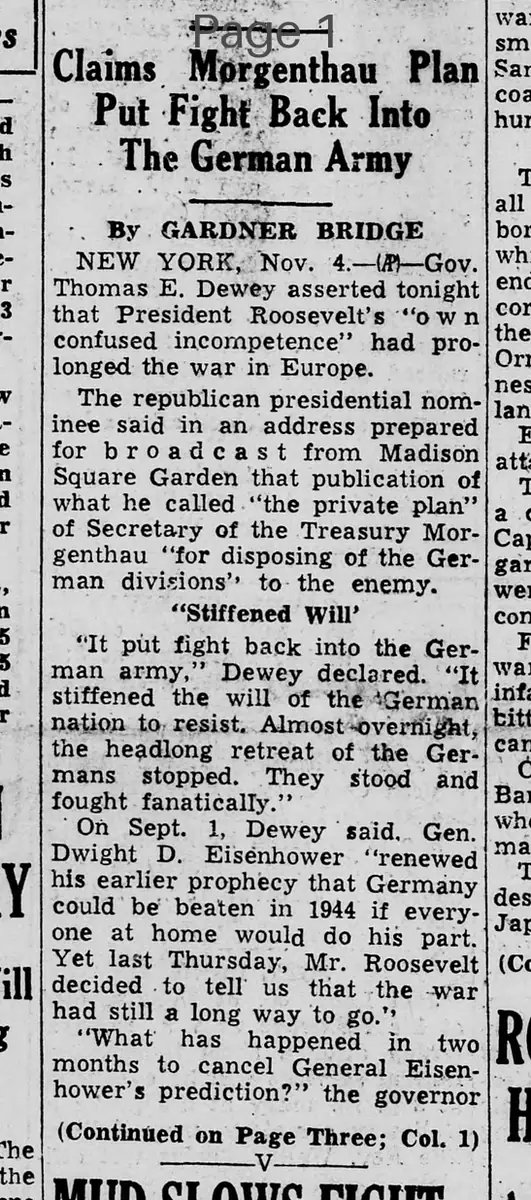
Put Fight Back Into
The German Army
By GARDNER REEL
NEW YORK, NOV. 4.-(AP)-Gov. Thomas E. Dewey asserted tonight that President Roosevelt's own "confused incompetence" had prolonged the war in Europe.
The republican presidential nominee said in an address prepared for broadcast from Madison Square Garden that publication of what he called "the private plan" of Secretary of the Treasury Morgenthau "for disposing of the German divisions" to the enemy.
"Stiffened Will"
"It put fight back into the German army," Dewey declared. "It stiffened the will of the German nation to resist. Almost overnight, the headlong retreat of the Germans stopped. They stood and fought fanatically."
On Sept. 1, Dewey said, Gen. Dwight D. Eisenhower "renewed his earlier prophecy that Germany could be beaten in 1944 if everyone at home would do his part."
Yet last Thursday, Mr. Roosevelt decided to tell us that the war had still a long way to go."
'What has happened in two months to cancel General Eisenhower's prediction?" the governor
DEWEY DECLARES
WAR PROLONGED
Asked. He said the President has not told us the whole story, but part of it we know. Instead of the secretary of state or secretary of war, Mr. Roosevelt took to the Quebec conference Secretary Morgenthau 'with his private plan for disposing of the German people after the war,' Dewey said.
'That plan was so clumsy,' he continued, 'that Mr. Roosevelt himself finally dropped it—but the damage was done.'
The Morgenthau plan was described in published reports as appalling for reduction of Germany to an agricultural state. It raised a sharp issue between Morgenthau and Secretaries Hull and Stimson.
President Roosevelt was asked about this split at his news conference Sept. 29 and called it a newspaper story. Asked whether he meant there was no foundation for the report of the split, he said no, that every story that had come out about it was essentially untrue in basic facts. He emphasized basic but did not name the facts he considered untrue.
'The publishing of this plan while everything else was kept secret,' Dewey said, 'was just what the Nazi propagandists needed.'
Alluding sarcastically to Morgenthau as 'that master of military strategy and foreign affairs,' the candidate asserted there had been 'tragic consequences of this blunder.'
Dewey quoted published stories to the effect that American troops overseas had found stiffened resistance by the Nazis and wondered if this had been caused by announcement of plans at home of what might be done with a defeated Germany.
'What does this mean?' Dewey demanded. It means that the blood of our fighting men is paying for this improvised meddling which is so much a part and parcel of the Roosevelt administration.
'And at the very moment when his own confused incompetence has thus prolonged the war in Europe,' the nominee continued, 'Franklin Roosevelt goes on the radio and claims for himself the credit for everything our engineers, our war workers, our industry, our farmers and our fighting sons have done.
'We are advancing and shall reach our goals. Once rid of capricious, personal government, once we give our whole, our united thoughts to victory, we shall reach Berlin and Tokyo quicker—with less cost.'
What sub-type of article is it?
What themes does it cover?
What keywords are associated?
What entities or persons were involved?
Where did it happen?
Story Details
Key Persons
Location
New York, Madison Square Garden
Event Date
1944 11 04
Story Details
Gov. Thomas E. Dewey accuses President Roosevelt's incompetence and the Morgenthau Plan of prolonging the European war by stiffening German resistance, halting their retreat and increasing fanaticism.