Thank you for visiting SNEWPapers!
Sign up free
Story
August 18, 1897
Clarke Courier
Berryville, Clarke County, Virginia
What is this article about?
Professor R. C. Ringwalt praises intercollegiate debating for enhancing wits, research, judgment, responsibility, and public speaking skills, arguing it provides unique educational opportunities in college.
Clipping
OCR Quality
98%
Excellent
Full Text
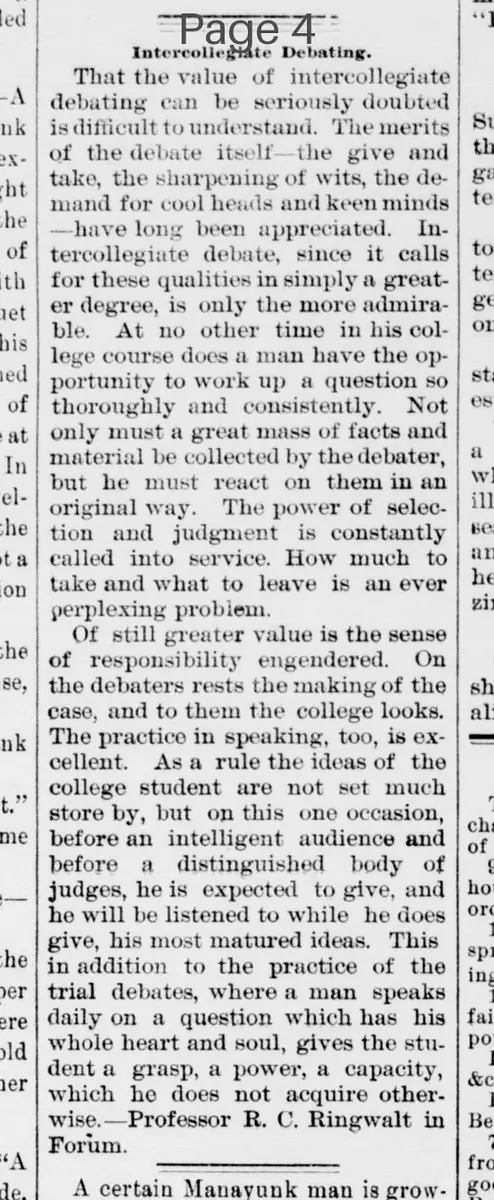
Intercollegiate Debating.
That the value of intercollegiate debating can be seriously doubted is difficult to understand. The merits of the debate itself—the give and take, the sharpening of wits, the demand for cool heads and keen minds—have long been appreciated. Intercollegiate debate, since it calls for these qualities in simply a greater degree, is only the more admirable. At no other time in his college course does a man have the opportunity to work up a question so thoroughly and consistently. Not only must a great mass of facts and material be collected by the debater, but he must react on them in an original way. The power of selection and judgment is constantly called into service. How much to take and what to leave is an ever perplexing problem.
Of still greater value is the sense of responsibility engendered. On the debaters rests the making of the case, and to them the college looks. The practice in speaking, too, is excellent. As a rule the ideas of the college student are not set much store by, but on this one occasion, before an intelligent audience and before a distinguished body of judges, he is expected to give, and he will be listened to while he does give, his most matured ideas. This in addition to the practice of the trial debates, where a man speaks daily on a question which has his whole heart and soul, gives the student a grasp, a power, a capacity, which he does not acquire otherwise.—Professor R. C. Ringwalt in Forum.
That the value of intercollegiate debating can be seriously doubted is difficult to understand. The merits of the debate itself—the give and take, the sharpening of wits, the demand for cool heads and keen minds—have long been appreciated. Intercollegiate debate, since it calls for these qualities in simply a greater degree, is only the more admirable. At no other time in his college course does a man have the opportunity to work up a question so thoroughly and consistently. Not only must a great mass of facts and material be collected by the debater, but he must react on them in an original way. The power of selection and judgment is constantly called into service. How much to take and what to leave is an ever perplexing problem.
Of still greater value is the sense of responsibility engendered. On the debaters rests the making of the case, and to them the college looks. The practice in speaking, too, is excellent. As a rule the ideas of the college student are not set much store by, but on this one occasion, before an intelligent audience and before a distinguished body of judges, he is expected to give, and he will be listened to while he does give, his most matured ideas. This in addition to the practice of the trial debates, where a man speaks daily on a question which has his whole heart and soul, gives the student a grasp, a power, a capacity, which he does not acquire otherwise.—Professor R. C. Ringwalt in Forum.
What sub-type of article is it?
Opinion Piece
Educational Advocacy
What themes does it cover?
Moral Virtue
What keywords are associated?
Intercollegiate Debating
Education Benefits
Public Speaking
Research Skills
Responsibility
What entities or persons were involved?
Professor R. C. Ringwalt
Story Details
Key Persons
Professor R. C. Ringwalt
Story Details
Professor Ringwalt argues that intercollegiate debating fosters thorough research, original thinking, judgment, responsibility, and effective public speaking, providing unparalleled educational benefits to college students.