Thank you for visiting SNEWPapers!
Sign up free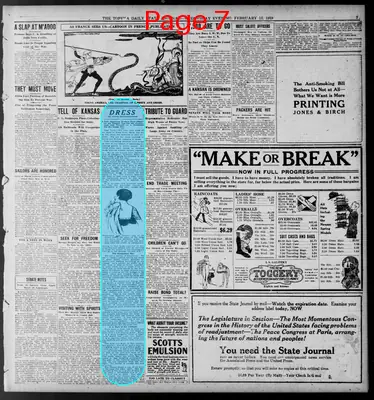
Literary
February 12, 1919
The Topeka State Journal
Topeka, Shawnee County, Kansas
What is this article about?
Article discusses American women's adoption of a French-inspired jet cap as a substitute for large hats in restaurants and theaters, contrasting U.S. customs with French and British practices, and describing its design and context in public dining culture.
Clipping

OCR Quality
95%
Excellent
Full Text
(From the Bayonette, Paris.)
DRESS BY ANNE RITTENHOUSE.
A Few American Women Have Adopted the French Cap for the Restaurant and Theater, as a Substitute for the Large Hat.
New York.—We may take most of the ideas in dress from Paris, but we do not adopt her fashions in their entirety.
We are far more inclined to follow the British customs in dress. This interesting national trait crops up now in our choice of headdress for evening gayety in public places.
We swing from bare heads to covered heads with an almost certain regularity. We do not always wear the same kind of headgear, however, when we grow tired of going bareheaded to the restaurants and the play.
There are practical reasons why we do not accept the French idea of covering the head at the play. Our theaters are not arranged with a semi-circle of loges in which the smart people sit. They are arranged in the English manner of an orchestra, with proscenium boxes in which no one wants to sit. The French naturally can keep on their hats in their boxes; the Americans cannot do this when in the orchestra: it is against the rules.
It is to meet this practical condition that the American women go bareheaded to the play, unless they wear the restaurant and theater cap of jet which takes the place of the large hat worn with decollete gown. It has pendants of jet over the temples, and the crown is transparent.
We are a nation of diners-out. We see no reason against taking our meals in great herds, closely grouped together and feeding according to our purses. As a nation, we prefer to do this than to dine at home, especially in large cities; and to judge from the mad rush to these places by the thousands of visitors in large centers every week, it looks as tho the women in the small towns and villages enjoy this eating in public as much as those who have the opportunity thrust upon them every night.
Out of this restaurant dining there has grown a certain form of fashionable dressing. It was necessary, probably, to give the great masses of people with money and no particular social engagements a place to display their clothes and meet on common ground.
This is the reason that so many new fashions are launched at restaurants. They are worn by those who follow fashion faithfully, who care to exploit new clothes, and who have nothing in common with that element of ultra-fashionable society that keeps its good clothes for its own home.
Dinner at the restaurant is usually a prelude to the play, and just here came the trouble concerning the large hat which has been the fashion now for about two years. It was fashionable at the restaurant, and yet it did not serve for the theater. To cut this Gordian knot, the cap has been offered as a substitute for the large hat.
It Is Part of the Coiffure.
Once upon a time, not so long ago, the Indian turban was the thing to wear with a low evening gown. Today it is a more primitive form of headdress which has come into fashion.
It is a cap-like affair that sinks into the coiffure and glitters with cut crystals.
The first one worn in this country last autumn was of jet, and it was the crowning touch to a brilliant gown of velvet and jet. It had a tiny fringe of thin jet beads that hung over the eyes, as well as the ears and back of the neck. It was effective, but fantastic.
The really smart cap which has followed it, has dangling ornaments at the side, in the Oriental fashion, but they do not interfere with the eyesight. No oculist is needed the next morning.
The sketch shows a cap of jet worn to the play the other night. She who adopted it had on a gown of satin and lace, with a decolletage low in front and half low in back.
The sleeves were short, the bodice was of the satin, and the skirt was draped with a hip scarf of lace caught in front with a medallion of jet, before it dropped to the hem of the skirt.
DRESS BY ANNE RITTENHOUSE.
A Few American Women Have Adopted the French Cap for the Restaurant and Theater, as a Substitute for the Large Hat.
New York.—We may take most of the ideas in dress from Paris, but we do not adopt her fashions in their entirety.
We are far more inclined to follow the British customs in dress. This interesting national trait crops up now in our choice of headdress for evening gayety in public places.
We swing from bare heads to covered heads with an almost certain regularity. We do not always wear the same kind of headgear, however, when we grow tired of going bareheaded to the restaurants and the play.
There are practical reasons why we do not accept the French idea of covering the head at the play. Our theaters are not arranged with a semi-circle of loges in which the smart people sit. They are arranged in the English manner of an orchestra, with proscenium boxes in which no one wants to sit. The French naturally can keep on their hats in their boxes; the Americans cannot do this when in the orchestra: it is against the rules.
It is to meet this practical condition that the American women go bareheaded to the play, unless they wear the restaurant and theater cap of jet which takes the place of the large hat worn with decollete gown. It has pendants of jet over the temples, and the crown is transparent.
We are a nation of diners-out. We see no reason against taking our meals in great herds, closely grouped together and feeding according to our purses. As a nation, we prefer to do this than to dine at home, especially in large cities; and to judge from the mad rush to these places by the thousands of visitors in large centers every week, it looks as tho the women in the small towns and villages enjoy this eating in public as much as those who have the opportunity thrust upon them every night.
Out of this restaurant dining there has grown a certain form of fashionable dressing. It was necessary, probably, to give the great masses of people with money and no particular social engagements a place to display their clothes and meet on common ground.
This is the reason that so many new fashions are launched at restaurants. They are worn by those who follow fashion faithfully, who care to exploit new clothes, and who have nothing in common with that element of ultra-fashionable society that keeps its good clothes for its own home.
Dinner at the restaurant is usually a prelude to the play, and just here came the trouble concerning the large hat which has been the fashion now for about two years. It was fashionable at the restaurant, and yet it did not serve for the theater. To cut this Gordian knot, the cap has been offered as a substitute for the large hat.
It Is Part of the Coiffure.
Once upon a time, not so long ago, the Indian turban was the thing to wear with a low evening gown. Today it is a more primitive form of headdress which has come into fashion.
It is a cap-like affair that sinks into the coiffure and glitters with cut crystals.
The first one worn in this country last autumn was of jet, and it was the crowning touch to a brilliant gown of velvet and jet. It had a tiny fringe of thin jet beads that hung over the eyes, as well as the ears and back of the neck. It was effective, but fantastic.
The really smart cap which has followed it, has dangling ornaments at the side, in the Oriental fashion, but they do not interfere with the eyesight. No oculist is needed the next morning.
The sketch shows a cap of jet worn to the play the other night. She who adopted it had on a gown of satin and lace, with a decolletage low in front and half low in back.
The sleeves were short, the bodice was of the satin, and the skirt was draped with a hip scarf of lace caught in front with a medallion of jet, before it dropped to the hem of the skirt.
What sub-type of article is it?
Essay
What themes does it cover?
Social Manners
What keywords are associated?
Fashion
Headdress
Restaurant Cap
Theater Cap
American Dress
French Influence
Jet Cap
What entities or persons were involved?
Anne Rittenhouse
Literary Details
Title
Dress By Anne Rittenhouse.
Author
Anne Rittenhouse
Subject
A Few American Women Have Adopted The French Cap For The Restaurant And Theater, As A Substitute For The Large Hat.
Key Lines
We May Take Most Of The Ideas In Dress From Paris, But We Do Not Adopt Her Fashions In Their Entirety.
It Is To Meet This Practical Condition That The American Women Go Bareheaded To The Play, Unless They Wear The Restaurant And Theater Cap Of Jet Which Takes The Place Of The Large Hat Worn With Decollete Gown.