Thank you for visiting SNEWPapers!
Sign up free
The New York Journal, And Daily Patriotic Register
New York, New York County, New York
What is this article about?
Historical review from London Evening Post, May 5, 1788, highlighting remarkable events in English history for years ending in 88 over the past millennium, including Danish invasions, Alfred's militia and navy, civil wars, crusades, judicial punishments, insurrections, Spanish Armada, and the 1688 Revolution.
Clipping
OCR Quality
Full Text
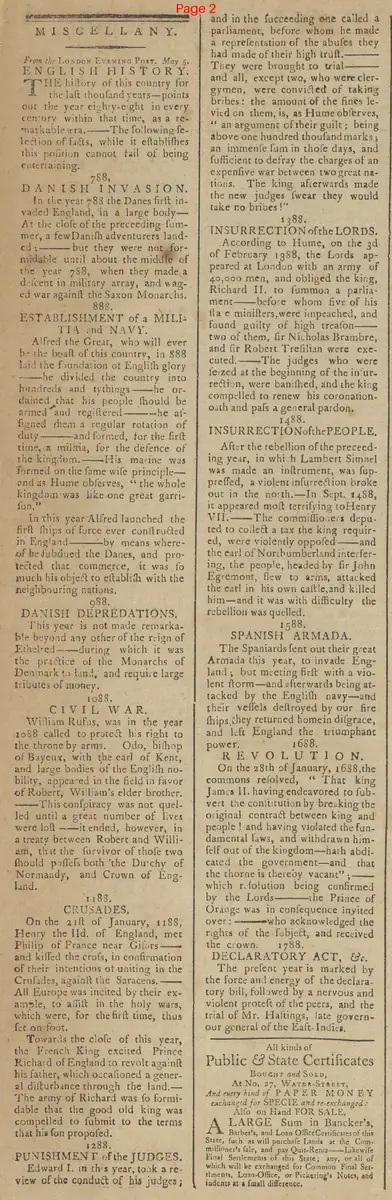
ENGLISH HISTORY.
The history of this country for the last thousand years points out the year eighty-eight in every century within that time, as a remarkable era.--The following selection of facts, while it establishes this position cannot fail of being entertaining.
788.
DANISH INVASION.
In the year 788 the Danes first invaded England, in a large body--At the close of the preceding summer, a few Danish adventurers landed;--but they were not formidable until about the middle of the year 788, when they made a descent in military array, and waged war against the Saxon Monarchs.
888.
ESTABLISHMENT of a MILITIA and NAVY.
Alfred the Great, who will ever be the boast of this country, in 888 laid the foundation of English glory he divided the country into hundreds and tithings --he ordained that his people should be armed and registered--he assigned them a regular rotation of duty--and formed, for the first time, a militia, for the defence of the kingdom.-His marine was formed on the same wise principle-- and as Hume observes, " the whole kingdom was like one great garrison."
In this year Alfred launched the first ships of force ever constructed in England-by means whereof he subdued the Danes, and protected that commerce, it was so much his object to establish with the neighbouring nations.
988.
DANISH DEPREDATIONS.
This year is not made remarkable beyond any other of the reign of Ethelred--during which it was the practice of the Monarchs of Denmark to land, and require large tributes of money.
1088.
CIVIL WAR.
William Rufus, was in the year 1088 called to protect his right to the throne by arms. Odo, bishop of Bayeux, with the earl of Kent, and large bodies of the English nobility, appeared in the field in favor of Robert, William's elder brother. This conspiracy was not quelled until a great number of lives were lost --it ended, however, in a treaty between Robert and William, that the survivor of those two should possess both the Duchy of Normandy, and Crown of England.
1188.
CRUSADES.
On the 21st of January, 1188, Henry the II.d. of England, met Philip of France near Gisors--and kissed the cross, in confirmation of their intentions of uniting in the Crusades, against the Saracens. All Europe was incited by their example, to assist in the holy wars, which were, for the first time, thus set on foot. Towards the close of this year, the French King excited Prince Richard of England to revolt against his father, which occasioned a general disturbance through the land.- The army of Richard was so formidable that the good old king was compelled to submit to the terms that his son proposed.
1288.
PUNISHMENT of the JUDGES.
Edward I. in this year, took a review of the conduct of his judges; and in the succeeding one called a parliament, before whom he made a representation of the abuses they had made of their high trust. They were brought to trial- and all, except two, who were clergymen, were convicted of taking bribes: the amount of the fines levied on them, is, as Hume observes, " an argument of their guilt; being above one hundred thousand marks: an immense sum in those days, and sufficient to defray the charges of an expensive war between two great nations. The king afterwards made the new judges swear they would take no bribes!"
1388.
INSURRECTION of the LORDS.
According to Hume, on the 3d of February 1388, the Lords appeared at London with an army of 40,000 men, and obliged the king, Richard II. to summon a parliament-before whom five of his state's ministers, were impeached, and found guilty of high treason- two of them, Sir Nicholas Brambre, and Sir Robert Treilian were executed.--The judges who were seized at the beginning of the insurrection, were banished, and the king compelled to renew his coronation- oath and pass a general pardon.
1488.
INSURRECTION of the PEOPLE.
After the rebellion of the preceding year, in which Lambert Simnel was made an instrument, was suppressed, a violent insurrection broke out in the north. In Sept. 1488, it appeared most terrifying to Henry VII. -The commissioners deputed to collect a tax the king required, were violently opposed --and the earl of Northumberland interfering, the people, headed by Sir John Egremont, flew to arms, attacked the earl in his own castle, and killed him—and it was with difficulty the rebellion was quelled.
1588.
SPANISH ARMADA.
The Spaniards sent out their great Armada this year, to invade England; but meeting first with a violent storm-and afterwards being attacked by the English navy-and their vessels destroyed by our fire ships, they returned home in disgrace, and left England the triumphant power.
1688.
REVOLUTION.
On the 28th of January, 1688, the commons resolved, " That king James II. having endeavored to subvert the constitution by breaking the original contract between king and people ! and having violated the fundamental laws, and withdrawn himself out of the kingdom hath abdicated the government-and that the throne is thereby vacant"; which resolution being confirmed by the Lords—the Prince of Orange was in consequence invited over: -and who acknowledged the rights of the subject, and received the crown.
1788.
DECLARATORY ACT, &c.
The present year is marked by the force and energy of the declaratory bill, followed by a nervous and violent protest of the peers, and the trial of Mr. Hastings, late governor general of the East-Indies.
What sub-type of article is it?
What keywords are associated?
What entities or persons were involved?
Where did it happen?
Foreign News Details
Primary Location
England
Event Date
May 5
Key Persons
Outcome
danish invasions repelled; militia and navy established; tributes paid; civil war ended in treaty; crusades initiated, revolt subdued; judges fined over 100,000 marks; ministers executed, judges banished; earl killed, rebellion quelled; armada defeated; james ii. abdicated, orange crowned; declaratory bill and hastings trial.
Event Details
Selection of remarkable events in English history for years ending in 88: 788 Danish invasion; 888 Alfred establishes militia and navy; 988 Danish depredations; 1088 civil war; 1188 crusades and revolt; 1288 judges punished; 1388 lords' insurrection; 1488 people's insurrection; 1588 Spanish Armada; 1688 Revolution; 1788 declaratory act and Hastings trial.