Thank you for visiting SNEWPapers!
Sign up free
The Fairfield News And Herald
Winnsboro, Fairfield County, South Carolina
What is this article about?
South Carolina Senate debated a bill to abolish the Phosphate Inspector office. An attempt to strike the enacting clause failed (14-24 vote). An amendment reducing the salary from $1,500 to $800 passed (28-9). The bill advanced to third reading.
Clipping
OCR Quality
Full Text
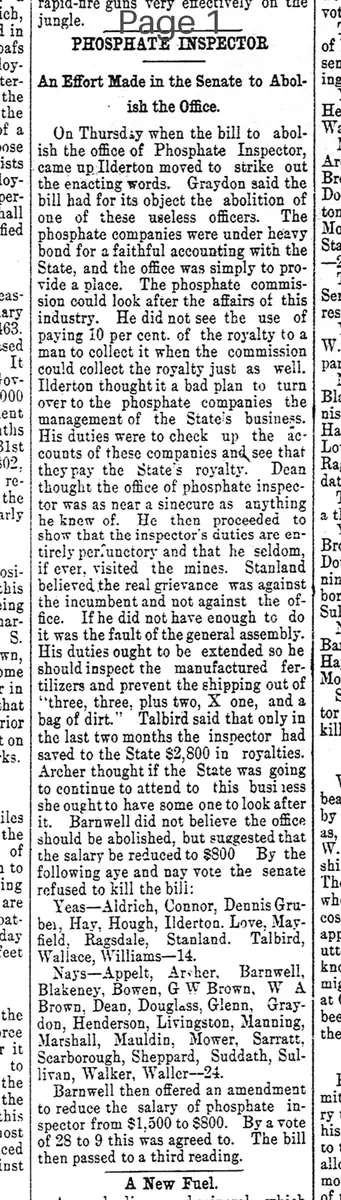
An Effort Made in the Senate to Abolish the Office.
On Thursday when the bill to abolish the office of Phosphate Inspector, came up Ilderton moved to strike out the enacting words. Graydon said the bill had for its object the abolition of one of these useless officers. The phosphate companies were under heavy bond for a faithful accounting with the State, and the office was simply to provide a place. The phosphate commission could look after the affairs of this industry. He did not see the use of paying 10 per cent. of the royalty to a man to collect it when the commission could collect the royalty just as well. Ilderton thought it a bad plan to turn over to the phosphate companies the management of the State's business. His duties were to check up the accounts of these companies and see that they pay the State's royalty. Dean thought the office of phosphate inspector was as near a sinecure as anything he knew of. He then proceeded to show that the inspector's duties are entirely perfunctory and that he seldom, if ever, visited the mines. Stanland believed the real grievance was against the incumbent and not against the office. If he did not have enough to do it was the fault of the general assembly. His duties ought to be extended so he should inspect the manufactured fertilizers and prevent the shipping out of "three, three, plus two, X one, and a bag of dirt." Talbird said that only in the last two months the inspector had saved to the State $2,800 in royalties Archer thought if the State was going to continue to attend to this business she ought to have some one to look after it. Barnwell did not believe the office should be abolished, but suggested that the salary be reduced to $800 By the following aye and nay vote the senate refused to kill the bill:
Yeas—Aldrich, Connor, Dennis Gruber, Hay, Hough, Ilderton, Love, Mayfield, Ragsdale, Stanland, Talbird, Wallace, Williams—14.
Nays—Appelt, Archer, Barnwell, Blakeney, Bowen, G W Brown, W A Brown, Dean, Douglass, Glenn, Graydon, Hopkins, Henderson, Livingston, Manning, Marshall, Mauldin, Mower, Sarratt, Scarborough, Sheppard, Suddath, Sullivan, Walker, Waller—24.
Barnwell then offered an amendment to reduce the salary of phosphate inspector from $1,500 to $800. By a vote of 28 to 9 this was agreed to. The bill then passed to a third reading.
What sub-type of article is it?
What keywords are associated?
What entities or persons were involved?
Domestic News Details
Event Date
Thursday
Key Persons
Outcome
motion to strike enacting words failed 14-24; salary reduction amendment from $1,500 to $800 passed 28-9; bill advanced to third reading.
Event Details
Senate debate on bill to abolish Phosphate Inspector office. Speakers argued over necessity, duties, and efficiency. Ilderton opposed abolition; Graydon supported it as useless; Dean called it a sinecure; Stanland suggested expanding duties; Talbird noted recent savings; Archer favored oversight; Barnwell proposed salary cut.