Thank you for visiting SNEWPapers!
Sign up free
Story
December 6, 1938
Henderson Daily Dispatch
Henderson, Vance County, North Carolina
What is this article about?
Article by Logan Clendening, M.D., explains the complex mechanics of the eye, including retina function, light and color perception, automatic focusing, night blindness, and qualities of vision like brilliance, hue, and saturation.
Clipping
OCR Quality
95%
Excellent
Full Text
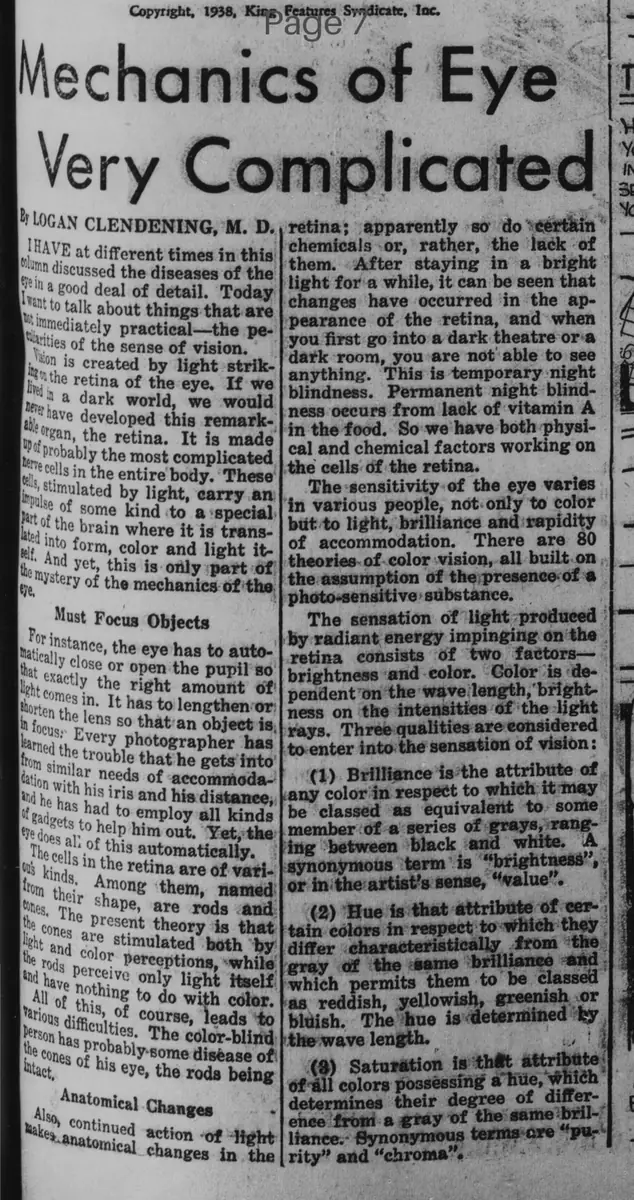
Mechanics of Eye
Very Complicated
By Logan Clendening, M. D.
I have at different times in this column discussed the diseases of the eye in a good deal of detail. Today I want to talk about things that are not immediately practical-the peculiarities of the sense of vision.
Vision is created by light striking upon the retina of the eye. If we lived in a dark world we would never have developed the organ. It is remarkable that this retina is probably the most complicated nerve cells in the entire body. These cells, stimulated by light, carry an impulse of some kind to a special part of the brain where it is translated into form, color and light intensity.
And yet this is only the mystery of the mechanics of the eye.
Must Focus Objects
For instance, the eye has to automatically close or open the pupil so that exactly the right amount of light comes in. It has to lengthen or shorten the lens so that an object is in focus. Every photographer has learned the trouble that he gets into from similar needs of accommodation with his iris and his distance, and he has had to employ all kinds of gadgets to help him out.
Yet, the eye does all of this automatically.
The cells in the retina are of various kinds. Among them, named from their present shape, are the cones. The rods and the cones are stimulated both by light and color perceptions, while the rods perceive only light and have nothing to do with color.
All of this, of course, leads to various difficulties. The color-blind person has probably some disease of the cones of his eye, the rods being intact.
Anatomical Changes
Also, continued action of light makes anatomical changes in the retina; apparently so do certain chemicals or, rather, the lack of them. After staying in a bright light for a while, it can be seen that changes have occurred in the appearance of the retina, and when you first go into a dark theatre or a dark room, you are not able to see anything. This is temporary night blindness. Permanent night blindness occurs from lack of vitamin A in the food. So we have both physical and chemical factors working on the cells of the retina.
The sensitivity of the eye varies in various people, not only to color but to light, brilliance and rapidity of accommodation. There are 80 theories of color vision, all built on the assumption of the presence of a photo-sensitive substance.
The sensation of light produced by radiant energy impinging on the retina consists of two factors-brightness and color. Color is dependent on the wavelength, brightness on the intensities of the light rays. Three qualities are considered to enter into the sensation of vision:
1) Brilliance is the attribute of any color in respect to which it may be classed as equivalent to some member of a series of grays, ranging between black and white. A synonymous term is "brightness" or in the artist's sense, "value".
2) Hue is that attribute of certain colors in respect to which they differ characteristically from the gray of the same brilliance and which permits them to be classed as reddish, yellowish, greenish or bluish. The hue is determined by the wave length.
3) Saturation is that attribute of all colors possessing a hue, which determines their degree of difference from a gray of the same brilliancy. Synonymous terms are "purity" and "chroma".
.P
Very Complicated
By Logan Clendening, M. D.
I have at different times in this column discussed the diseases of the eye in a good deal of detail. Today I want to talk about things that are not immediately practical-the peculiarities of the sense of vision.
Vision is created by light striking upon the retina of the eye. If we lived in a dark world we would never have developed the organ. It is remarkable that this retina is probably the most complicated nerve cells in the entire body. These cells, stimulated by light, carry an impulse of some kind to a special part of the brain where it is translated into form, color and light intensity.
And yet this is only the mystery of the mechanics of the eye.
Must Focus Objects
For instance, the eye has to automatically close or open the pupil so that exactly the right amount of light comes in. It has to lengthen or shorten the lens so that an object is in focus. Every photographer has learned the trouble that he gets into from similar needs of accommodation with his iris and his distance, and he has had to employ all kinds of gadgets to help him out.
Yet, the eye does all of this automatically.
The cells in the retina are of various kinds. Among them, named from their present shape, are the cones. The rods and the cones are stimulated both by light and color perceptions, while the rods perceive only light and have nothing to do with color.
All of this, of course, leads to various difficulties. The color-blind person has probably some disease of the cones of his eye, the rods being intact.
Anatomical Changes
Also, continued action of light makes anatomical changes in the retina; apparently so do certain chemicals or, rather, the lack of them. After staying in a bright light for a while, it can be seen that changes have occurred in the appearance of the retina, and when you first go into a dark theatre or a dark room, you are not able to see anything. This is temporary night blindness. Permanent night blindness occurs from lack of vitamin A in the food. So we have both physical and chemical factors working on the cells of the retina.
The sensitivity of the eye varies in various people, not only to color but to light, brilliance and rapidity of accommodation. There are 80 theories of color vision, all built on the assumption of the presence of a photo-sensitive substance.
The sensation of light produced by radiant energy impinging on the retina consists of two factors-brightness and color. Color is dependent on the wavelength, brightness on the intensities of the light rays. Three qualities are considered to enter into the sensation of vision:
1) Brilliance is the attribute of any color in respect to which it may be classed as equivalent to some member of a series of grays, ranging between black and white. A synonymous term is "brightness" or in the artist's sense, "value".
2) Hue is that attribute of certain colors in respect to which they differ characteristically from the gray of the same brilliance and which permits them to be classed as reddish, yellowish, greenish or bluish. The hue is determined by the wave length.
3) Saturation is that attribute of all colors possessing a hue, which determines their degree of difference from a gray of the same brilliancy. Synonymous terms are "purity" and "chroma".
.P
What sub-type of article is it?
Medical Curiosity
Curiosity
What themes does it cover?
Nature
What keywords are associated?
Eye Mechanics
Retina
Vision
Color Perception
Night Blindness
Rods And Cones
What entities or persons were involved?
Logan Clendening
Story Details
Key Persons
Logan Clendening
Story Details
Explanation of the eye's complex mechanics, including retina cells (rods and cones), automatic pupil and lens adjustments, color and light perception, night blindness causes, and vision qualities: brilliance, hue, saturation.