Thank you for visiting SNEWPapers!
Sign up free
Portland Gazette, And Maine Advertiser
Portland, Cumberland County, Maine
What is this article about?
Mercator critiques a published view that real estate appraised and set off to satisfy a usurious judgment is void as an 'assurance' under usury statutes, arguing the creditor acquires a perfect fee simple title, defeasible only by the debtor's redemption within one year, and usury does not void judicial proceedings.
Merged-components note: This is a continuation of the same letter to the editor discussing the usury statute and its implications for judgments and executions, signed by MERCATOR.
Clippings
1 of 2
OCR Quality
Full Text
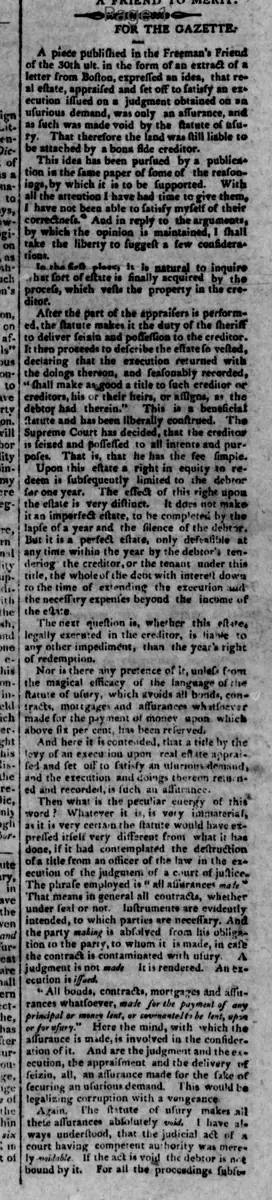
A piece published in the Freeman's Friend of the 30th ult. in the form of an extract of a letter from Boston, expressed an idea, that real estate, appraised and set off to satisfy an execution issued on a judgment obtained on an usurious demand, was only an assurance, and as such was made void by the statute of usury. That therefore the land was still liable to be attached by a bona fide creditor.
This idea has been pursued by a publication in the same paper of some of the reasoning, by which it is to be supported. With all the attention I have had time to give them, I have not been able to satisfy myself of their correctness. And in reply to the arguments by which the opinion is maintained, I shall take the liberty to suggest a few considerations.
In the first place, it is natural to enquire what sort of estate is finally acquired by the process, which vests the property in the creditor. After the part of the appraisers is performed, the statute makes it the duty of the sheriff to deliver seisin and possession to the creditor. It then proceeds to describe the estate so vested, declaring that the execution returned with the doings thereon, and seasonably recorded, "shall make as good a title to such creditor or creditors, his or their heirs, or assigns, as the debtor had therein." This is a beneficial statute and has been liberally construed. The Supreme Court has decided, that the creditor is seized and possessed to all intents and purposes. That is, that he has the fee simple. Upon this estate a right in equity to redeem is subsequently limited to the debtor for one year. The effect of this right upon the estate is very distinct. It does not make it an imperfect estate, to be completed by the lapse of a year and the silence of the debtor. But it is a perfect estate, only defeasible at any time within the year by the debtor's tendering the creditor, or the tenant under this title, the whole of the debt with interest down to the time of extending the execution and the necessary expenses beyond the income of the estate.
The next question is, whether this estate, legally executed in the creditor, is liable to any other impediment, than the year's right of redemption. Nor is there any pretence of it, unless from the magical efficacy of the language of the statute of usury, which avoids all bonds, contracts, mortgages and assurances whatsoever made for the payment of money upon which above six per cent, has been reserved: And here it is contended, that a title by the levy of an execution upon real estate appraised and set off to satisfy an usurious demand and the execution and doings thereon returned and recorded, is such an assurance. Then what is the peculiar energy of this word? Whatever it is, is very immaterial, as it is very certain the statute would have expressed itself very different from what it has done, if it had contemplated the destruction of a title from an officer of the law in the execution of the judgment of a court of justice. The phrase employed is "all assurances made." That means in general all contracts, whether under seal or not. Instruments are evidently intended, to which parties are necessary. And the party making is absolved from his obligation to the party, to whom it is made, in case the contract is contaminated with usury. A judgment is not made. It is rendered. An execution is issued.
"All bonds, contracts, mortgages and assurances whatsoever, made for the payment of any principal or money lent, or covenanted to be lent, upon or for usury." Here the mind, with which the assurance is made, is involved in the consideration of it. And are the judgment and the execution, the appraisement and the delivery of seisin, all, an assurance made for the sake of securing an usurious demand. This would be legalizing corruption with a vengeance.
Again. The statute of usury makes all these assurances absolutely void. I have always understood, that the judicial act of a court having competent authority was merely assailable. If the act is void the debtor is not bound by it. For all the proceedings must be a nullity. But if the judgment and execution are void, how came the court to order the appraisal and setting off of the estate? And if the appraisal and setting off are void, what title does the creditor acquire by the delivery of seisin and possession, and the recording of the proceedings? None at all. And yet the statute of usury, if it avoids these assurances, avoids them all, and leaves the creditor without remedy. But the statute of executions, which vests the estate in the creditor, knows nothing of this. It makes a good title, as the debtor had. And this title the usury law is to overthrow. But how? Not by avoiding the judgment—for that is not an assurance made by the debtor. Not by avoiding the execution—for that is the act of the court, not of the debtor. Not by avoiding the appraisal—for that is the act of the appraisers, officers of the law. Not by avoiding the delivery of seisin—for that is the act of the sheriff, another officer of the law. What then is avoided? The recording of the proceedings? But that is only evidence of title. The title itself must remain. And if the title remains, the estate cannot be attached. The idea that the title is an assurance made by the debtor is too absurd to require further notice.
went to the judgment are only fruits of it and
On : with it. The debtor is not bound by it,
it is void; nor is there any need of waiting
for a bona fide creditor to attach the property
over again. He may take advantage of it
himself. And so may any stranger.
But how does this matter stand? Lord Mansfield said : it was the very same thing in the world.
that the merits of a judgment never could be
overruled by an original suit either at law
or in equity. Till the judgment is set aside
or reversed, it is conclusive as to the subject
matter at all intents and purposes. And in
an action of debt on judgment unless recovered
in another state, the plaintiff is exempted
from the pains of proving the original cause
of action
As to the execution, when the creditor's
demand is satisfied by it, the satisfaction is to
be entered of record, that the party may not
be harassed a second time on the same ac-
count. But if, since judgment, the debtor
has discharged himself by payment, or is in
possession of a release, or is in any danger
from neglect in the satisfaction not being en-
tered of record, he may come with his com-
plaint and be relieved.
But on the part of those, who insist on the
inefficacy of a judgment on an usurious de-
mand, they take care to beg one very impor-
tant question-that the demand was usurious.
Whereas the judgment was rendered on the
ground that there was no usury in it. The
question of usury is frequently a subject of no
little delicacy and difficulty--many of the
fairest transactions being susceptible of. con-
structions the farthest from the meaning of
the parties. And whether the transaction
was fair. or whether the contract was only a
colour for the usury, is, under all the circum-
stanc-es a matter for the jury under the direc-
tion of the judge, and subject to the discretion
of the court afterwards.
These hasty remarks, and may be very
imperfect;-but if they are extremely inaccu-
rate, or if the opinion, of which they are the
shadow, is altogether incorrect, it is more than I
am at present aware of.
MERCATOR.
What sub-type of article is it?
What themes does it cover?
What keywords are associated?
What entities or persons were involved?
Letter to Editor Details
Author
Mercator
Recipient
For The Gazette
Main Argument
a title to real estate obtained through execution on a usurious judgment is not void as an 'assurance' under usury statutes; the creditor receives a perfect fee simple estate, defeasible only by the debtor's redemption within one year, as judicial acts cannot be undone by usury laws in this manner.
Notable Details