Thank you for visiting SNEWPapers!
Sign up free
Portland Gazette, And Maine Advertiser
Portland, Cumberland County, Maine
What is this article about?
A letter to the Portland Gazette opposing the separation of Maine from Massachusetts, arguing that the current constitution protects rights, judicial grievances are resolved, separation would lose qualified judges and impose heavy costs on coastal trade via new customs fees, benefiting only self-interested politicians.
Merged-components note: These two components form a single continuous letter to the editor discussing the separation of Maine from Massachusetts.
Clipping
OCR Quality
Full Text
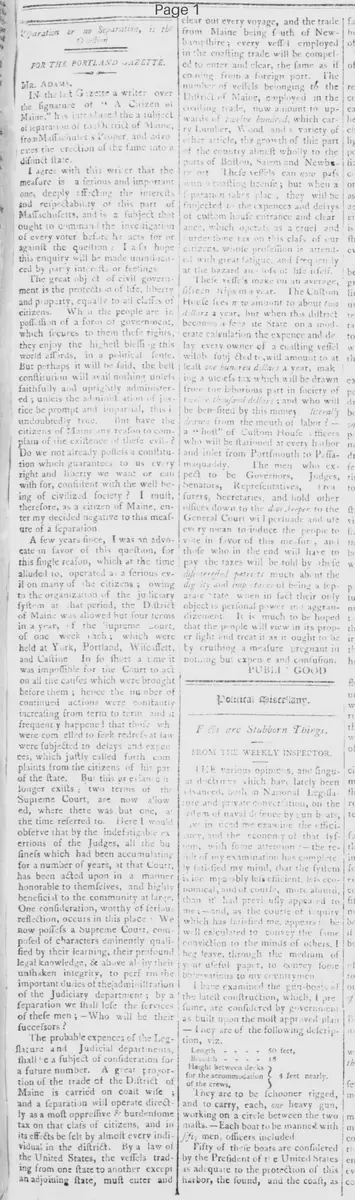
MR. ADAMS.
In the last Gazette a writer over the signature of "A Citizen of Maine," has introduced the subject of separation of the district of Maine from Massachusetts proper, and advocates the erection of the same into a distinct state.
I agree with this writer that the measure is a serious and important one, deeply affecting the interest and respectability of this part of Massachusetts, and is a subject that ought to command the investigation of every voter, before he acts for or against the question: I also hope this enquiry will be made uninfluenced by party interest, or feelings.
The great object of civil government is the protection of life, liberty and property, equally to all classes of citizens. When the people are in possession of a form of government, which secures to them their rights, they enjoy the highest blessing this world affords, in a political sense.
But perhaps it will be said, the best constitution will avail nothing unless faithfully and uprightly administered; unless the administration of justice be prompt and impartial, this undoubtedly true. But have the citizens of Maine any reason to complain of the existence of these evils?
Do we not already possess a constitution which guarantees to us every right and liberty we want or can wish for, consistent with the well being of civilized society? I must, therefore, as a citizen of Maine, enter my decided negative to this measure of a separation.
A few years since, I was an advocate in favor of this question, for this single reason, which at the time alluded to, operated as a serious evil on many of the citizens; owing to the organization of the judiciary system at that period, the District of Maine was allowed but four terms in a year, of the Supreme court, of one week each; which were held at York, Portland, Wiscasset and Castine. In so short a time it was impossible for the Court to act on all the causes which were brought before them: hence the number of continued actions were constantly increasing from term to term and it frequently happened that those who were compelled to seek redress at law were subjected to delays and expenses, which justly called forth complaints from the citizens of this part of the state. But this grievance no longer exists; two terms of the Supreme Court, are now allowed, where there was but one, at the time referred to. Here I would observe that by the indefatigable exertions of the Judges, all the business which had been accumulating for a number of years, at that Court, has been acted upon in a manner honorable to themselves, and highly beneficial to the community at large.
One consideration, worthy of serious reflection, occurs in this place. We now possess a Supreme Court, composed of characters eminently qualified by their learning, their profound legal knowledge, & above all by their unshaken integrity, to perform the important duties of the administration of the Judiciary department; by a separation we shall lose the services of these men; - Who will be their successors?
The probable expenses of the Legislature and Judicial departments, shall be a subject of consideration for a future number. A great proportion of the trade of the District of Maine is carried on coastwise: and a separation will operate directly as a most oppressive & burdensome tax on that class of citizens, and in its effects be felt by almost every individual in the district. By a law of the United States, the vessels trading from one state to another except an adjoining state, must enter and clear out every voyage, and the trade from Maine being south of New-Hampshire; every vessel employed in the coasting trade will be compelled to enter and clear, the same as if coming from a foreign port. The number of vessels belonging to the District of Maine, employed in the coasting trade, now amount to upwards of five hundred, which carry lumber, wood and a variety of other articles, the growth of this part of the country almost wholly to the ports of Boston, Salem and Newburyport. These vessels can now pass with a coasting license; but when a separation takes place, they will be subjected to the expenses and delays of custom house entrance and clearance, which operate as a cruel and burdensome tax on this class of our citizens, whose profession is attended with great fatigue, and frequently at the hazard and loss of life itself.
These vessels make on an average, fifteen trips in a year. The Custom House fees now amount to about two dollars a year. but when this district becomes a separate State on a moderate calculation the expense and delay every owner of a coasting vessel will be subjected to, will amount to at least one hundred dollars a year, making a direct tax which will be drawn from the laborious part in society of ten thousand dollars; and who will be benefited by this money literally wrung from the mouth of labor? - a host of Custom House officers who will be stationed at every harbor and inlet from Portsmouth to Passamaquoddy.
The men who expect to be Governors, Judges, Senators, Representatives, Treasurers, Secretaries, and hold other offices down to the door keeper to the General Court will persuade and use every mean to induce the people to vote in favor of this measure; and those who in the end will have to pay the taxes will be told by those disinterested patriots much about the dignity and importance of being a separate state when in fact their only object is personal power and aggrandizement. It is much to be hoped that the people will view it in its proper light and treat it as it ought to be by crushing a measure pregnant in nothing but expense and confusion.
PUBLIC GOOD
What sub-type of article is it?
What themes does it cover?
What keywords are associated?
What entities or persons were involved?
Letter to Editor Details
Author
Public Good
Recipient
Mr. Adams.
Main Argument
the separation of maine from massachusetts should be opposed because the current government adequately protects rights and liberties, past judicial delays have been resolved, qualified judges would be lost, and it would impose burdensome customs fees on coastal trade, ultimately benefiting only self-interested office-seekers while increasing expenses and confusion for citizens.
Notable Details