Thank you for visiting SNEWPapers!
Sign up free
New York Daily Tribune
New York, New York County, New York
What is this article about?
Overview of South Carolina's political evolution from 1765 to 1848, emphasizing colonial leaders, Constitution support, electoral history favoring Democrats, and current Whig resurgence against Calhoun and Van Buren, with calls for organization to back Clay in upcoming elections. (248 characters)
Merged-components note: table of presidential electoral votes is continuation of South Carolina politics article; sequential reading_order 13-14
Clipping
OCR Quality
Full Text
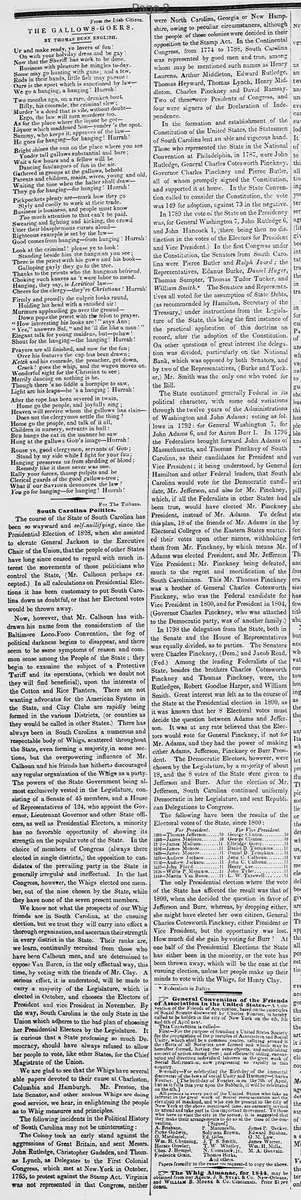
South Carolina Politics.
The course of the State of South Carolina has been so wayward and self-nullifying, since the Presidential Election of 1828, when she assisted to elevate General Jackson to the Executive Chair of the Union, that the people of other States have long since ceased to regard with much interest the movements of those politicians who control the State, (Mr. Calhoun perhaps excepted.) In all calculations on Presidential Elections it has been customary to put South Carolina down as doubtful, or that her Electoral votes would be thrown away.
Now, however, that Mr. Calhoun has withdrawn his name from the consideration of the Baltimore Loco-Foco Convention, the fog of political darkness begins to disappear, and there seem to be some symptoms of reason and common sense among the People of the State; they begin to examine the subject of a Protective Tariff and its operations, (which we doubt not they will find beneficial), upon the interests of the Cotton and Rice Planters. There are not wanting advocates for the American System in the State, and Clay Clubs are rapidly being formed in the various Districts, (or counties as they would be called in other States.) There has always been in South Carolina a numerous and respectable body of Whigs, scattered throughout the State, even forming a majority in some sections, but the overpowering influence of Mr. Calhoun and his friends has hitherto discouraged any regular organization of the Whigs as a party. The powers of the State Government being almost exclusively vested in the Legislature, consisting of a Senate of 45 members, and a House of Representatives of 124, who appoint the Governor, Lieutenant Governor and other State officers, as well as Presidential Electors, a minority has no favorable opportunity of showing its strength on the popular vote of the State. In the choice of members of Congress (always there elected in single districts,) the opposition to candidates of the prevailing party in the State is generally irregular and ineffectual. In the last Congress, however, the Whigs elected one member, out of the nine chosen by the State, while they have none of the seven present members.
We know not what the prospects of our Whig friends are in South Carolina, at the ensuing election, but we trust they will carry into effect a thorough organization, and ascertain their strength in every district in the State. Their ranks are, we learn, continually recruited from those who have been Calhoun men, and are determined to oppose Van Buren, in the only effectual way, this time, by voting with the friends of Mr. Clay. A serious effort, it is understood, will be made to carry a majority of the Legislature, which is elected in October, and chooses the Electors of President and Vice President in November. By the way, South Carolina is the only State in the Union which adheres to the bad plan of choosing her Presidential Electors by the Legislature. It is curious that a State professing so much Democracy, should have always refused to allow her people to vote, like other States, for the Chief Magistrate of the Union.
We are glad to see that the Whigs have several able papers devoted to their cause at Charleston, Columbia and Hamburgh. Mr. Preston, the late Senator, and other zealous Whigs are doing good service, we hear, in enlightening the people as to Whig measures and principles.
The following incidents in the Political History of South Carolina may not be uninteresting:
The Colony took an early stand against the aggressions of Great Britain, and sent Messrs. John Rutledge, Christopher Gadsden, and Thomas Lynch, as Delegates to the First Colonial Congress, which met at New-York in October, 1765, to protest against the Stamp Act. Virginia was not represented in that Congress, neither were North Carolina, Georgia or New Hampshire, owing to peculiar circumstances, although the people of those colonies were decided in their opposition to the Stamp Act. In the Continental Congress, from 1774 to 1783, South Carolina was represented by good men and true, among whom may be mentioned such names as Henry Laurens, Arthur Middleton, Edward Rutledge, Thomas Heyward, Thomas Lynch, Henry Middleton, Charles Pinckney and David Ramsay. Two of these were Presidents of Congress, and four were signers of the Declaration of Independence.
In the formation and establishment of the Constitution of the United States, the Statesmen of South Carolina lent an able and vigorous hand. Those who represented the State in the National Convention at Philadelphia, in 1787, were John Rutledge, General Charles Cotesworth Pinckney, Governor Charles Pinckney and Pierce Butler, all of whom promptly signed the Constitution, and supported it at home. In the State Convention called to consider the Constitution, the vote was 149 for adoption, against 73 in the negative.
In 1789 the vote of the State on the Presidency was, for General Washington 7, John Rutledge 6, and John Hancock 1, (there being then no distinction in the votes of the Electors for President and Vice President.) In the first Congress under the Constitution, the Senators from South Carolina were Pierce Butler and Ralph Izard; the Representatives, Edanus Burke, Daniel Huger, Thomas Sumter, Thomas Tudor Tucker, and William Smith. The Senators and Representatives all voted for the assumption of State Debts, (as recommended by Hamilton, Secretary of the Treasury,) under instructions from the Legislature of the State, this being the first instance of the practical application of this doctrine on record, after the adoption of the Constitution. On other questions of great interest the delegation was divided, particularly on the National Bank, which was opposed by both Senators, and by two of the Representatives, (Burke and Tucker,) Mr. Smith was the only one who voted for the Bill.
The State continued generally Federal in its political character, with some odd variations through the twelve years of the Administrations of Washington and John Adams; voting as follows in 1792: for General Washington 7, for John Adams 6, and for Aaron Burr 1. In 1796 the Federalists brought forward John Adams of Massachusetts, and Thomas Pinckney of South Carolina, as their candidates for President and Vice President; it being understood, by General Hamilton and other Federal leaders, that South Carolina would vote for the Democratic candidate, Mr. Jefferson, and also for Mr. Pinckney, which, if all the Federalists in other States had been true, would have elected Mr. Pinckney President, instead of Mr. Adams. To defeat this plan, 18 of the friends of Mr. Adams in the Electoral Colleges of the Eastern States scattered their votes upon other names, withholding them from Mr. Pinckney, by which means Mr. Adams was elected President, and Mr. Jefferson Vice President; Mr. Pinckney being defeated, much to the regret and mortification of the South Carolinians. This Mr. Thomas Pinckney was a brother of General Charles Cotesworth Pinckney, who was the Federal candidate for Vice President in 1800, and for President in 1804, (Governor Charles Pinckney, who was attached to the Democratic party, was of another family.)
In 1798 the delegation from the State, both in the Senate and the House of Representatives was equally divided, as to parties. The Senators were Charles Pinckney, (Dem.) and Jacob Read, (Fed.) Among the leading Federalists of the State, besides the brothers Charles Cotesworth Pinckney and Thomas Pinckney, were, the Rutledges, Robert Goodloe Harper, and William Smith. Great interest was felt as to the course of the State at the Presidential election in 1800, as it was known that her 8 Electoral votes must decide the question between Adams and Jefferson. It was at any rate believed that the Electors would vote for General Pinckney, if not for Mr. Adams, and they had the power of making either Adams, Jefferson, Pinckney or Burr President. The Democratic Electors, however, were chosen by the Legislature, by a majority of about 18, and the 8 votes of the State were given to Jefferson and Burr. After the election of Mr. Jefferson, South Carolina continued uniformly Democratic in her Legislature, and sent Republican Delegations to Congress.
The following have been the results of the Electoral votes of the State, since 1800 :
The only Presidential election where the vote of the State has affected the result was that of 1800, when she decided the question in favor of Jefferson and Burr, whereas, by dropping either, she might have elected her own citizen, General Charles Cotesworth Pinckney, either President or Vice President, but the opportunity was lost. How much did she gain by voting for Burr? At one half of the Presidential Elections the State has either been in the minority, or the vote has been thrown away, which will be the case at the ensuing election, unless her people make up their minds to vote with the Whigs, for Henry Clay.
| For President. | For Vice President. |
| 1804—Thomas Jefferson. | 10 George Clinton. |
| 1808—James Madison. | 10 George Clinton. |
| 1812—James Madison. | 11 Elbridge Gerry. |
| 1816—James Monroe. | 11 Daniel D. Tompkins. |
| 1820—James Monroe. | 11 Daniel D. Tompkins. |
| 1824—Andrew Jackson. | 11 John C. Cathoun. |
| 1828—Andrew Jackson. | 11 John C. Cathoun. |
| 1832—John Floyd. | 11 Henry Lee. |
| 1836—Willie P. Mangum. | 11 John Tyler. |
| 1848—Martin Van Buren. | 11 L. W. Tazwell. |
What sub-type of article is it?
What keywords are associated?
What entities or persons were involved?
Where did it happen?
Domestic News Details
Primary Location
South Carolina
Key Persons
Outcome
historical electoral votes from 1804 to 1848 listed; whigs elected one member to last congress; push for whig majority in october legislature election to influence november electors.
Event Details
Article reviews South Carolina's political history from colonial resistance to British Stamp Act in 1765, through Continental Congress, Constitution ratification, early federal period, to Democratic dominance post-1800. Discusses current Whig organization, Clay Clubs formation, opposition to Calhoun and Van Buren, support for protective tariff and American System among cotton and rice planters. Notes legislature appoints electors; urges Whig effort in upcoming elections.