Thank you for visiting SNEWPapers!
Sign up free
Letter to Editor
March 30, 1805
Alexandria Daily Advertiser
Alexandria, Virginia
What is this article about?
A sarcastic letter to the editor critiques President Jefferson's second inaugural address, mocking his claimed consistency with prior principles and alleging favoritism toward Republicans over Federalists in appointments and impeachments.
Clipping
OCR Quality
95%
Excellent
Full Text
MR. EDITOR,
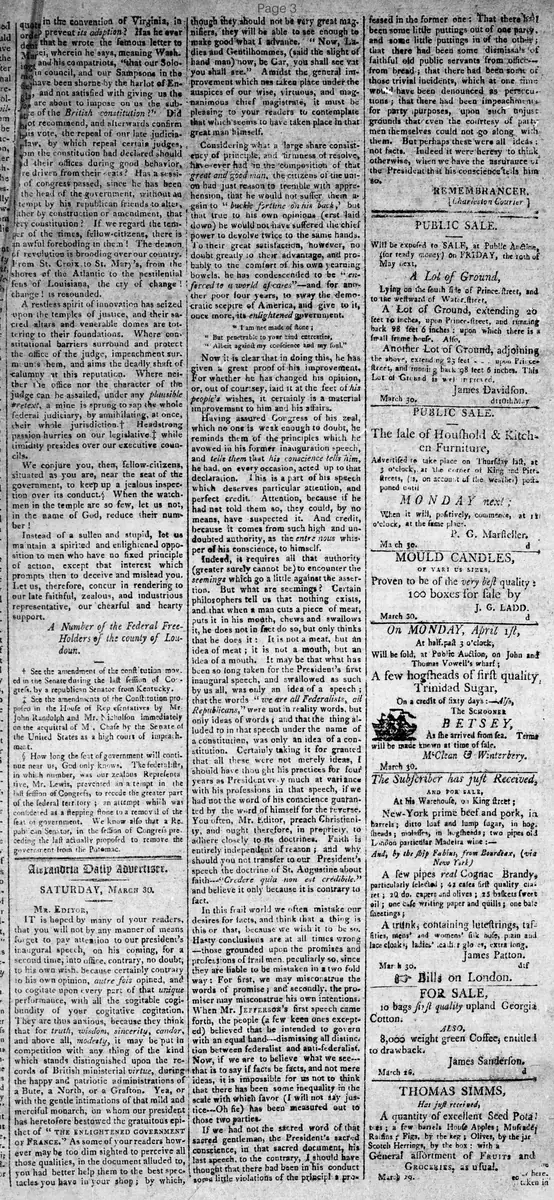
IT is hoped by many of your readers, that you will not by any manner of means forget to pay attention to our president's inaugural speech, on his coming, for a second time, into office. contrary, no doubt, to his own wish. because certainly contrary to his own opinion, autre fois opined, and to cogitate upon every part of that unique performance, with all the sagitable cogibundity of your cogitative cogitation. They are thus anxious. because they think that for truth, wisdom, sincerity, candor, and above all, modesty, it may be put in competition with any thing of the kind which stands distinguished upon the records of British ministerial virtue, during the happy and patriotic administrations of a Bute, a North, or a Grafton. Yea, or with the gentle intimations of that mild and merciful monarch, on whom our president has heretofore bestowed the gratuitous epithet of "THE ENLIGHTENED GOVERNMENT of France." As some of your readers however may be too dim sighted to perceive all those qualities, in the document alluded to. you had better help them to the best spectacles you have in your shop; by which, though they should not be very great magnifiers they will be able to see enough to make good what I advance, "Now, Ladies and Gentlemen, (said the slight of hand man) now, be Gad, you shall see vat you shall see." Amidst the general improvement which has taken place under the auspices of our wise, virtuous; and magnanimous chief magistrate, it must be pleasing to your readers to contemplate that which seems to have taken place in that great man himself. Considering what a large share consistency of principle, and firmness of resolve. however had in the composition of that great and good man. the citizens of the union had just reason to tremble with apprehension, that he would not suffer them a-gain to ".buckle the sword on his back,. but that true to his own opinions (erst laid down) he would not have suffered the chief power to devolve twice to the same hands. To their great satisfaction, however, no doubt greatly to their advantage, and probably to the comfort of his own yearning bowels. he has condescended to be "enforced to a world of cares"--and for another poor four years, to sway the democratic sceptre of America, and give to it, once more, its enlightened government.
"I am not made of stone;
" But penetrable to your kind entreaties:
" Albeit against my conscience and my soul."
Now it is clear that in doing this, he has given a great proof of his improvement. For whether he has changed his opinion, or, out of courtesy, laid it at the feet of his people's wishes, it certainly is a material improvement to him and his affairs. Having assured Congress of his zeal, which no one is weak enough to doubt, he reminds them of the principles which he avowed in his former inauguration speech, and tells them that his conscience tells him. he had, on every occasion, acted up to that declaration. This is a part of his speech which deserves particular attention, and perfect credit. Attention, because if he had not told them so, they could, by no means, have suspected it. And credit, because it comes from such high and undoubted authority, as the intra nos whisper of his conscience, to himself. Indeed, it requires all that authority (greater surely cannot be) to encounter the seemings which go a little against the assertion. But what are seemings? Certain philosophers tell us that nothing exists, and that when a man cuts a piece of meat, puts it in his mouth, chews and swallows it, he does not in act do so, but only thinks that he does it : It is not a meat, but an idea of meat; it is not a mouth, but an idea of a mouth. It may be that what has been so long taken for the President's first inaugural speech, and swallowed as such by us all, was only an idea of a speech ; that the words " we are all Federalists, all Republicans," were not in reality words, but only ideas of words ; and that the thing alluded to in that speech under the name of a constitution, was only an idea of a constitution. Certainly taking it for granted that all these were not merely ideas, I should have thought his practices for four years as President very much at variance with his professions in that speech, if we had not the word of his conscience guaranteed by the word of himself for the reverse. You often, Mr. Editor, preach Christianity, and ought therefore, in propriety, to adhere closely to its doctrines. Faith is entirely independent of reason ; and why should you not transfer to our President's speech the doctrine of St. Augustine about faith--"Credere quia non est credibile." and believe it only because it is contrary to fact. In this frail world we often mistake our desires for facts, and think that a thing is this or that, because we wish it to be so. Hasty conclusions are at all times wrong -those grounded upon the promises and professions of frail men. peculiarly so, since they are liable to be mistaken in a two fold way: For first, we may misconstrue the words of promise; and secondly. the promiser may misconstrue his own intentions. When Mr. Jefferson's first speech came forth, the people (a few keen ones excepted) believed that he intended to govern with an equal hand---dismissing all distinction between federalist and anti-federalist. Now, if we are to believe what we see--- that is to say if facts be facts, and not mere ideas, it is impossible for us not to think that there has been some inequality in the scale with which favor (I will not say justice--Oh fie) has been measured out to those two parties. If we had not the sacred word of that sacred gentleman; the President's sacred conscience, in that sacred document, his last speech, to the contrary, I should have thought that there had been in his conduct some little violations of the principles professed in the former one: That there had been some little puttings out of one party. and some little puttings in of the other ; that there had been some dismissals 'of faithful old public servants from office--- from bread ; that there had been some of those trivial incidents, which at one time would have been denounced as persecutions ; that there had been impeachments for party purposes, upon such unjust grounds that-even the courtesy of party men themselves could not go along with them. But perhaps these were all ideas ; not facts. Indeed it were heresy to think otherwise, when we have the assurance of the President that his conscience tells him so.
IT is hoped by many of your readers, that you will not by any manner of means forget to pay attention to our president's inaugural speech, on his coming, for a second time, into office. contrary, no doubt, to his own wish. because certainly contrary to his own opinion, autre fois opined, and to cogitate upon every part of that unique performance, with all the sagitable cogibundity of your cogitative cogitation. They are thus anxious. because they think that for truth, wisdom, sincerity, candor, and above all, modesty, it may be put in competition with any thing of the kind which stands distinguished upon the records of British ministerial virtue, during the happy and patriotic administrations of a Bute, a North, or a Grafton. Yea, or with the gentle intimations of that mild and merciful monarch, on whom our president has heretofore bestowed the gratuitous epithet of "THE ENLIGHTENED GOVERNMENT of France." As some of your readers however may be too dim sighted to perceive all those qualities, in the document alluded to. you had better help them to the best spectacles you have in your shop; by which, though they should not be very great magnifiers they will be able to see enough to make good what I advance, "Now, Ladies and Gentlemen, (said the slight of hand man) now, be Gad, you shall see vat you shall see." Amidst the general improvement which has taken place under the auspices of our wise, virtuous; and magnanimous chief magistrate, it must be pleasing to your readers to contemplate that which seems to have taken place in that great man himself. Considering what a large share consistency of principle, and firmness of resolve. however had in the composition of that great and good man. the citizens of the union had just reason to tremble with apprehension, that he would not suffer them a-gain to ".buckle the sword on his back,. but that true to his own opinions (erst laid down) he would not have suffered the chief power to devolve twice to the same hands. To their great satisfaction, however, no doubt greatly to their advantage, and probably to the comfort of his own yearning bowels. he has condescended to be "enforced to a world of cares"--and for another poor four years, to sway the democratic sceptre of America, and give to it, once more, its enlightened government.
"I am not made of stone;
" But penetrable to your kind entreaties:
" Albeit against my conscience and my soul."
Now it is clear that in doing this, he has given a great proof of his improvement. For whether he has changed his opinion, or, out of courtesy, laid it at the feet of his people's wishes, it certainly is a material improvement to him and his affairs. Having assured Congress of his zeal, which no one is weak enough to doubt, he reminds them of the principles which he avowed in his former inauguration speech, and tells them that his conscience tells him. he had, on every occasion, acted up to that declaration. This is a part of his speech which deserves particular attention, and perfect credit. Attention, because if he had not told them so, they could, by no means, have suspected it. And credit, because it comes from such high and undoubted authority, as the intra nos whisper of his conscience, to himself. Indeed, it requires all that authority (greater surely cannot be) to encounter the seemings which go a little against the assertion. But what are seemings? Certain philosophers tell us that nothing exists, and that when a man cuts a piece of meat, puts it in his mouth, chews and swallows it, he does not in act do so, but only thinks that he does it : It is not a meat, but an idea of meat; it is not a mouth, but an idea of a mouth. It may be that what has been so long taken for the President's first inaugural speech, and swallowed as such by us all, was only an idea of a speech ; that the words " we are all Federalists, all Republicans," were not in reality words, but only ideas of words ; and that the thing alluded to in that speech under the name of a constitution, was only an idea of a constitution. Certainly taking it for granted that all these were not merely ideas, I should have thought his practices for four years as President very much at variance with his professions in that speech, if we had not the word of his conscience guaranteed by the word of himself for the reverse. You often, Mr. Editor, preach Christianity, and ought therefore, in propriety, to adhere closely to its doctrines. Faith is entirely independent of reason ; and why should you not transfer to our President's speech the doctrine of St. Augustine about faith--"Credere quia non est credibile." and believe it only because it is contrary to fact. In this frail world we often mistake our desires for facts, and think that a thing is this or that, because we wish it to be so. Hasty conclusions are at all times wrong -those grounded upon the promises and professions of frail men. peculiarly so, since they are liable to be mistaken in a two fold way: For first, we may misconstrue the words of promise; and secondly. the promiser may misconstrue his own intentions. When Mr. Jefferson's first speech came forth, the people (a few keen ones excepted) believed that he intended to govern with an equal hand---dismissing all distinction between federalist and anti-federalist. Now, if we are to believe what we see--- that is to say if facts be facts, and not mere ideas, it is impossible for us not to think that there has been some inequality in the scale with which favor (I will not say justice--Oh fie) has been measured out to those two parties. If we had not the sacred word of that sacred gentleman; the President's sacred conscience, in that sacred document, his last speech, to the contrary, I should have thought that there had been in his conduct some little violations of the principles professed in the former one: That there had been some little puttings out of one party. and some little puttings in of the other ; that there had been some dismissals 'of faithful old public servants from office--- from bread ; that there had been some of those trivial incidents, which at one time would have been denounced as persecutions ; that there had been impeachments for party purposes, upon such unjust grounds that-even the courtesy of party men themselves could not go along with them. But perhaps these were all ideas ; not facts. Indeed it were heresy to think otherwise, when we have the assurance of the President that his conscience tells him so.
What sub-type of article is it?
Satirical
Persuasive
Provocative
What themes does it cover?
Politics
Morality
What keywords are associated?
Jefferson Inaugural
Political Inconsistency
Federalists Republicans
Presidential Conscience
Partisan Appointments
Impeachments
Satirical Critique
What entities or persons were involved?
Mr. Editor
Letter to Editor Details
Recipient
Mr. Editor
Main Argument
the letter sarcastically questions president jefferson's consistency between his inaugural speeches and actions, alleging partisan favoritism toward republicans and violations of impartial governance principles.
Notable Details
References To British Ministers Bute, North, Grafton
Quotes Shakespeare: 'I Am Not Made Of Stone...'
Philosophical Skepticism On Reality Vs. Ideas
Mentions St. Augustine: 'Credere Quia Non Est Credibile'
Critiques Jefferson's First Inaugural: 'We Are All Federalists, All Republicans'