Thank you for visiting SNEWPapers!
Sign up free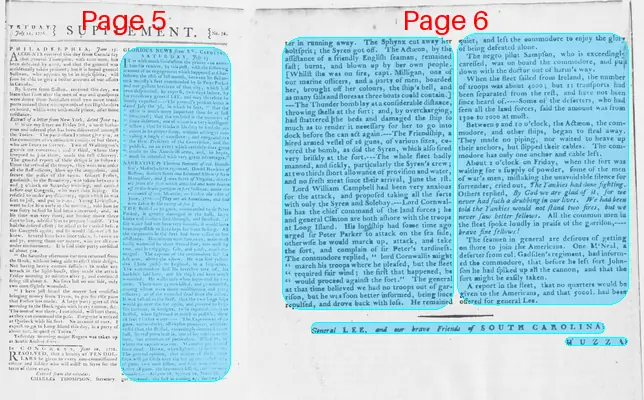
The Virginia Gazette
Williamsburg, Virginia
What is this article about?
Account of the British naval defeat at Fort Sullivan, Charleston, on June 28, 1776, where American forces under Col. Moultrie repelled Sir Peter Parker's fleet, as reported by deserters and General Lee.
Merged-components note: Merged continuation of the detailed narrative account of the battle at Charleston across pages; unified label to story as it is a full narrative article; includes the final exclamatory headline.
Clippings
1 of 2
OCR Quality
Full Text
SATURDAY, July 13.
It is with much satisfaction the printer can entertain his readers, by this post, with the following account of an engagement which happened at Charleston the 28th of last month, between his Britannick majesty's fleet commanded by sir Peter Parker and our gallant brethren of that city; which had been dispatched, by express, two days before, by his excellency general LEE, and may therefore be hourly expected.----The general's present letter is dated July the 3d, in which he says, "that the affair is much more important than he at first imagined; that the enclosed is the narrative of some deserters, one of whom is a very intelligent fellow; that he thinks it his duty to send the account in its proper form, without adding or curtailing a single circumstance; and congratulates the Hon. President of the Convention, and the publick, on an event which certainly does great credit to the American arms, and, he hopes, must be attended with very great advantages."
NARRATIVE by Thomas Bennett of col. Danielson's Massachusetts regiment, Daniel Hawkins of Bolton, Robert Scott and Edmond Alston of New Hampshire, and James Scott of Virginia, deserters from the fleet which attacked and were beaten off by the brave garrison in fort Sullivan, under the command of col. Moultrie, on Friday the 28th of June, 1776.---[They are all Americans, and had been taken by the enemy at Sea.]
The Bristol of 50 guns, commanded by sir Peter Parker, is greatly damaged in the hull, large knees and timbers shot through, and smashed. If the water had not been very smooth, it would have been impossible to have kept her from sinking. All the carpenters in the fleet had been called to her assistance.
Her mizzen-mast shot away, main mast badly wounded by three several shot, fore mast by two, and her rigging, sails, and yards, much damaged.
The captain of the commodore lost his left arm, above the elbow. He was sent yesterday (June 30th) to England, in a brigantine.
The commodore had his breeches tore off, his backside laid bare, and his thigh and knee much wounded.
He walks only when supported by two men.
There were 44 men killed, and 30 wounded, among whom were many midshipmen and petty officers; 20 of the wounded dead since the action.
It was talked in the fleet, that the two large ships would go over the bar again, and proceed to English harbour, in Antigua, to be repaired.-----The Bristol, when lightened as much as possible, drew 18 feet 7 inches water.----The Experiment of 50 guns, on two decks, all twelve-pounders, a lighter vessel than the Bristol, exceedingly damaged in her hull, several ports beat in, one of her mizzen-masts hurt, but uncertain of particulars. Killed 57, of whom the captain was one. Wounded 30; several since dead.
Draws, when lightened, 17 feet water.
The general opinion, that neither of these large ships will go safely over the bar again.-----Solebay, 28 guns, two men killed, and four wounded.----Active 28 guns, the lieutenant killed, and four men wounded.----Actaeon 28, Sphinx 20, Syren 28, all got aground; the first in coming up, the two last in running away.
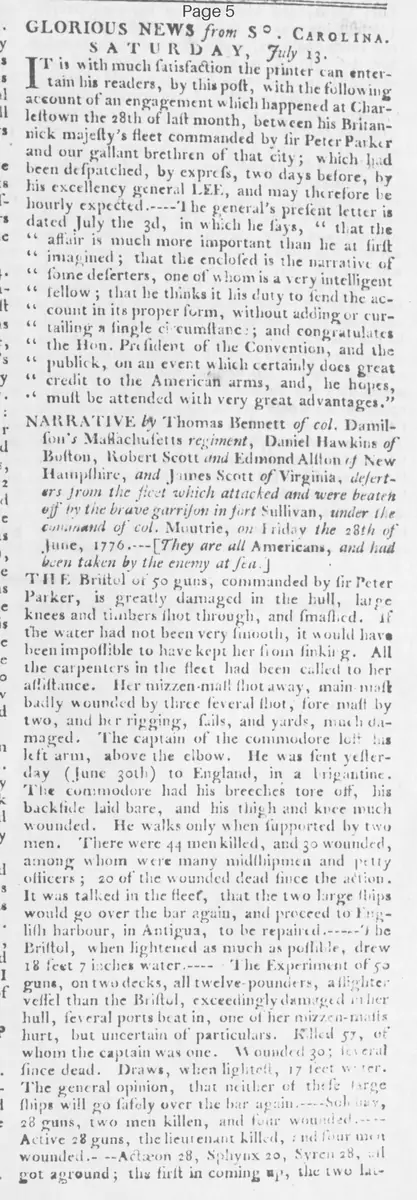
The Sphynx cut away her boltprit; the Syren got off.
The Actæon, by the assistance of a friendly English seaman, remained fast; burnt, and blown up by her own people.
[Whilst she was on fire, capt. Milligan, one of our marine officers and a party of men, boarded as many sails and stores as three boats could contain.]
her, brought off her colours, the ship's bell, and ---
The Thunder bomb lay at a considerable distance, throwing shells at the fort : and, by overcharging, had shattered the beds and damaged the ship so much as to render it necessary for her to go into dock before she can act again.---The Friendship, a hired armed vessel of 26 guns, of various sizes, covered the bomb, as did the Syren, which also fired manned, and sickly, particularly the Syron's crew ; very briskly at the fort.---The whole fleet badly at two thirds short allowance of provision and water, and no fresh meat since their arrival, June the 1st.
Lord William Campbell had been very anxious for the attack, and proposed taking all the forts with only the Syren and Solebay.---Lord Cornwallis has the chief command of the land forces; he and general Clinton are both ashore with the troops at Long Island.
His lordship had some time ago urged Sir Peter Parker to a attack on the east side, otherwise he would march up, attack, and take the fort, and complain of Sir Peter's tardiness.
The commodore replied, that lord Cornwallis might march his troops where he pleased, but the fleet required fair wind : the first that happened, he would proceed against the fort."
The general at that time believed we had no troops out of garrison, but he was soon better informed, being since repulsed, and drove back with loss.
He remained
quiet, and left the commodore to enjoy the glory of being defeated alone.
The negro pilot Sampson, who is exceedingly caressed, was on board the commodore, and put down with the doctor out of harm's way.
When the fleet sailed from Ireland, the number of troops was about 4000; but 11 transports had been separated from the rest, and have not been since heard of.----Some of the deserters, who had seen all the land forces, said the amount was from 1300 to 2000 at most.
Between 9 and 10 o'clock, the Actæon, the commodore, and other ships, began to steal away.
They made no piping, nor waited to heave up their anchors, but slipped their cables.
The commodore has only one anchor and cable left.
About 2 o'clock on Friday, when the fort was waiting for a supply of powder, some of the men of war's men; mistaking the unavoidable silence for surrender, cried out, The Yankies had done fighting.
Others replied.
By God we are glad of it, for we never had such a drubbing in our lives. We had been told the Yankees would not stand two fires, but we never saw better fellows.
All the common men in the fleet spoke loudly in praise of the garrison,---- brave fine fellows!
The seamen in general are desirous of getting on shore to join the Americans.
One M'Neal a deserter from col. Gadsden's regiment, had informed the commodore, that before he left Fort Johnson he had spiked up all the cannon, and that the fort might be easily taken.
A report in the fleet, that no quarters would be given to the Americans, and that 5000l. had been offered for general Lee.
General LEE, and our brave Friends of SOUTH CAROLINA!
HUZZA!
What sub-type of article is it?
What themes does it cover?
What keywords are associated?
What entities or persons were involved?
Where did it happen?
Story Details
Key Persons
Location
Fort Sullivan, Charleston, South Carolina
Event Date
June 28, 1776
Story Details
Deserters' narrative details the British fleet's failed attack on Fort Sullivan, severe damage to ships like Bristol and Experiment, high casualties, retreat, and praise for American defenders' bravery.