Thank you for visiting SNEWPapers!
Sign up free
Port Tobacco Times, And Charles County Advertiser
Port Tobacco, Charles County, Maryland
What is this article about?
A conference in Baltimore, representing Maryland counties, convenes to address threats to the Union. They affirm loyalty, endorse the Crittenden compromise, oppose coercion, and resolve to seek a popular vote on calling a state convention.
Merged-components note: Sequential reading order and text continuation of Conference Convention report.
Clipping
OCR Quality
Full Text
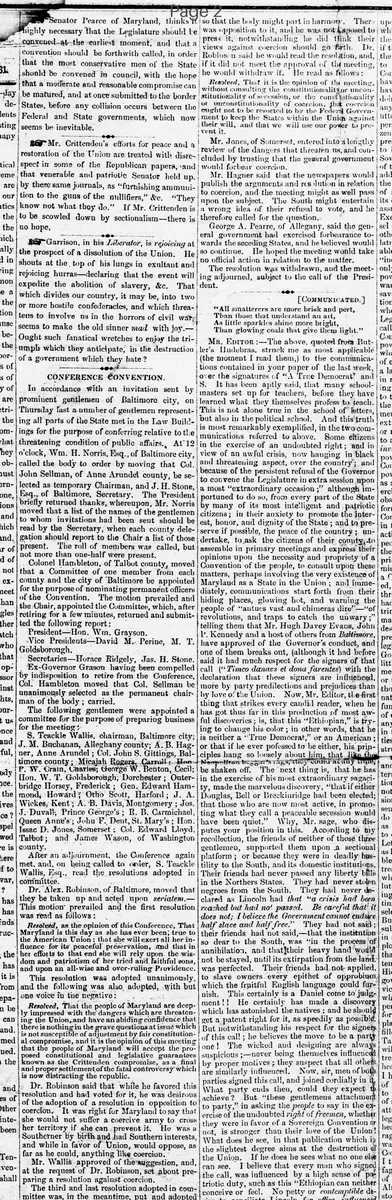
In accordance with an invitation sent by prominent gentlemen of Baltimore city, on Thursday last a number of gentlemen representing all parts of the State met in the Law Buildings for the purpose of conferring relative to the threatening condition of public affairs. At 12 o'clock, Wm. H. Norris, Esq., of Baltimore city, called the body to order by moving that Col. John Sellman, of Anne Arundel county, be selected as temporary Chairman, and J. H. Stone, Esq., of Baltimore, Secretary. The President briefly returned thanks, whereupon Mr. Norris moved that a list of the names of the gentlemen to whom invitations had been sent should be read by the Secretary, when each county delegation should report to the Chair a list of those present. The roll of members was called, but not more than one-half were present.
Colonel Hambleton, of Talbot county, moved that a Committee of one member from each county and the city of Baltimore be appointed for the purpose of nominating permanent officers of the Convention. The motion prevailed and the Chair appointed the Committee, which, after retiring for a few minutes, returned and submitted the following report:
President-Hon. Wm. Grayson.
Vice Presidents-David M. Perine, M. T. Goldsborough.
Secretaries-Horace Ridgely, Jas. H. Stone
Ex-Governor Grason having been compelled by indisposition to retire from the Conference, Col. Hambleton moved that Col. Sellman be unanimously selected as the permanent chairman of the body: carried.
The following gentlemen were appointed a committee for the purpose of preparing business for the meeting:
S. Teackle Wallis, chairman, Baltimore city; J. M. Buchanan, Allegany county; A. B. Hagner, Anne Arundel; Col. John S. Gittings, Baltimore county; Micajah Rogers, Carroll; Hon. P. W. Crain, Charles; George W. Benton, Cecil; Hon. W. T. Goldsborough, Dorchester; Outerbridge Horsey, Frederick; Gen. Edward Hammond, Howard; Otho Scott, Harford; J. A. Wickes, Kent; A. B. Davis, Montgomery; Jos. J. Duvall, Prince George's; R. B. Carmichael, Queen Anne's; John F. Dent, St. Mary's; Hon. Isaac D. Jones, Somerset; Col. Edward Lloyd, Talbot; and James Wason, of Washington county.
After an adjournment, the Conference again met, and, on being called to order, S. Teackle Wallis, Esq., read the resolutions adopted in committee.
Dr. Alex. Robinson, of Baltimore, moved that they be taken up and acted upon seriatim. This motion prevailed and the first resolution was read as follows:
Resolved, as the opinion of this Conference, That Maryland is this day as she has ever been; true to the American Union; that she will exert all her influence for its peaceful preservation, and that in her efforts to that end she will rely upon the wisdom and patriotism of her tried and faithful sons, and upon an all-wise and over-ruling Providence.
This resolution was adopted unanimously and the following was also adopted, with but one voice in the negative:
Resolved, That the people of Maryland are deeply impressed with the dangers which are threatening the Union, and have an abiding confidence that there is nothing in the grave questions at issue which is not susceptible of adjustment by fair constitutional compromise, and it is the opinion of this meeting that the people of Maryland will accept the proposed constitutional and legislative guarantees known as the Crittenden compromise, as a final and proper settlement of the fatal controversy which is now distracting the republic.
Dr. Robinson said that while he favored this resolution and had voted for it, he was desirous of the adoption of a resolution in opposition to coercion. It was right for Maryland to say that she would not suffer a coercive army to cross her territory if she can prevent it. He was a Southerner by birth and had Southern interests, and while in favor of Union, would oppose, as far as he could, anything like coercion.
Mr. Wallis approved of the suggestion, and at the request of Dr. Robinson, set about preparing a resolution against coercion.
The third and last resolution adopted in committee was, in the meantime, put and adopted unanimously. It is as follows:
Resolved, That a committee of six be appointed by the President of this Conference, to solicit the Governor, in the name of this meeting, to issue his proclamation inviting the people of this State to assemble, on the last Monday of January, inst., at their usual places of meeting, and during the usual hours of voting, and determine by their votes whether they desire, or do not desire, that a State Convention shall be called. And in case a majority of the people, at such election, shall determine in favor of calling the same, that the Governor shall then, by proclamation, appoint the second Monday of February next, for the election of delegates to such Convention, to assemble at the seat of government, at the earliest practicable period thereafter.
The Chair named the following gentlemen as the committee to communicate the purport of the resolutions to the Governor, and request him to act in accordance therewith: Hon. R. B. Carmichael, Ross Winans, Wm. T. Goldsborough, A. B. Hagner, John Contee, A. Bowie Davis.
Hon. John Brown, of Queen Anne's, moved that a copy of the resolutions be sent to the Maryland Senators and Representatives in Congress. Adopted.
Wm. H. Norris said that he was opposed to any effort of coercion on the part of the general government, but thought the resolution proposed to be submitted might as well lay over, as the Convention might possibly meet on the second Monday of February, and then the voice of that body would have some effect. He did not think the federal government would care about or heed any expression against coercion, though it were passed by thirty thousand citizens mass meeting assembled, but they would care if expressed by the sovereign voice of the State in opposition.
Mr. Wallis thought the resolution might be withdrawn, so that the body might part in harmony. There was opposition to it, and he was not disposed to press it, notwithstanding he did think their views against coercion should go forth. Dr. Robinson said he would read the resolution, and if it did not meet the approval of the meeting, he would withdraw it. He read as follows:
Resolved, That it is the opinion of the meeting, without consulting the constitutionality or unconstitutionality of secession, or the constitutionality or unconstitutionality of coercion, that coercion ought not to be resorted to by the Federal Government to keep the States within the Union against their will, and that we will use our power to prevent it.
Mr. Jones, of Somerset, entered into a lengthy review of the dangers that threaten us, and concluded by trusting that the general government would forbear coercion.
Mr. Hagner said that the newspapers would publish the arguments and resolution in relation to coercion, and the meeting might as well pass upon the subject. The South might entertain a wrong idea of their refusal to vote, and he therefore called for the question.
George A. Pearre, of Allegany, said the general government had exercised forbearance towards the seceding States, and he believed would so continue. He hoped the meeting would take no official action in relation to the matter.
The resolution was withdrawn, and the meeting adjourned, subject to the call of the President.
What sub-type of article is it?
What themes does it cover?
What keywords are associated?
What entities or persons were involved?
Where did it happen?
Story Details
Key Persons
Location
Baltimore City, Law Buildings, Maryland
Event Date
Thursday Last; Last Monday Of January, Inst.; Second Monday Of February Next
Story Details
Gentlemen from Maryland counties convene in Baltimore to discuss threats to the Union. They elect officers, adopt resolutions affirming loyalty to the Union, supporting the Crittenden compromise, and calling for a vote on a state convention. A proposed anti-coercion resolution is withdrawn after debate.