Thank you for visiting SNEWPapers!
Sign up free
Story
February 13, 1874
The Sun
New York, New York County, New York
What is this article about?
Analysis of Henry Ward Beecher's eloquent influence unifying Plymouth Church against investigating the Tilton scandal, contrasting with Rev. Dr. Storrs's congregation. Discusses pastoral magnetism and ministers' temptations from over-fond women.
Clipping
OCR Quality
98%
Excellent
Full Text
The Potency of Eloquence.
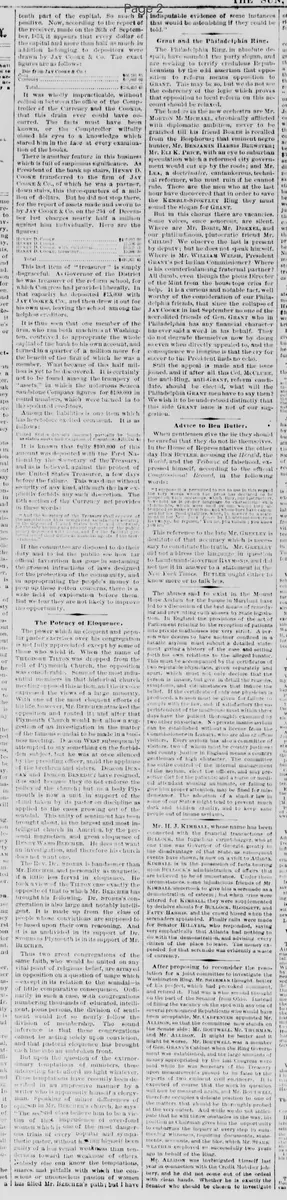
The power which an eloquent and popular pastor exercises over his congregation is not fully appreciated except by some of those who wield it. When the name of Theodore Tilton was dropped from the roll of Plymouth Church, the opposition was considerable. Some of the most influential members in that historical church meeting opposed this action, and their voice expressed the views of a large minority. With one of the most eloquent efforts of his life however, Mr. Beecher attacked the opposition and routed it; and after that Plymouth Church would not allow a suggestion of an investigation in the matter of the famous scandal to be made in a business meeting. Deacon West subsequently attempted to say something on the forbidden subject, but he was at once silenced by the presiding officer, amid the applause of the brethren and sisters. Deacon Duscan and Deacon Benedict have resigned, it is said because they do not endorse the policy of the church; but as a body Plymouth is now a unit in support of the stand taken by its pastor on discipline as applied to the cases growing out of the scandal. This unity of sentiment has been brought about, in the largest and most intelligent church in America, by the personal magnetism and great eloquence of Henry Ward Beecher. He does not want an investigation, and therefore his church does not want one.
The Rev. Dr. Storrs is handsomer than Mr. Beecher, and personally as magnetic, if a little less fervid in eloquence. He took a view of the Tilton case exactly the opposite of that to which Mr. Beecher has brought his following. Dr. Storrs's congregation is also large and notably intelligent. It is made up from the class of people whose convictions are supposed to be based upon their own reasoning. And it is as undivided in its support of Dr. Storrs as Plymouth is in its support of Mr. Beecher.
Thus two great congregations of the same faith, who would be united on any vital point of religious belief, are arrayed in opposition on a question of usage which—except in its relation to the scandal—is of little comparative consequence. Ordinarily in such a case, with congregations numbering thousands of educated, intelligent, pious persons, the division of sentiment would not so nearly follow the division of membership. The sound inference is that these congregations cannot be acting solely upon conviction, and that pastoral eloquence has brought each line into an unbroken front.
But upon the question of the extraordinary temptations of ministers, these interesting facts afford no light whatever. These temptations have recently been described in an impressive manner by a writer who is apparently himself a clergyman. Speaking of minor differences of opinion in Mr. Beecher's church, he says: "The second class believe him to be a victim of that imprudence of over-fond women which is one of the most dangerous trials of every popular and sympathetic pastor, without his having himself been guilty of a less venial weakness than tenderness toward the weakness of others. Nobody else can know the temptations, snares, and pitfalls with which the conscious or unconscious passion of women has filled Mr. Beecher's path: but I have indisputable evidence of some instances that would be astonishing if they could be told."
The power which an eloquent and popular pastor exercises over his congregation is not fully appreciated except by some of those who wield it. When the name of Theodore Tilton was dropped from the roll of Plymouth Church, the opposition was considerable. Some of the most influential members in that historical church meeting opposed this action, and their voice expressed the views of a large minority. With one of the most eloquent efforts of his life however, Mr. Beecher attacked the opposition and routed it; and after that Plymouth Church would not allow a suggestion of an investigation in the matter of the famous scandal to be made in a business meeting. Deacon West subsequently attempted to say something on the forbidden subject, but he was at once silenced by the presiding officer, amid the applause of the brethren and sisters. Deacon Duscan and Deacon Benedict have resigned, it is said because they do not endorse the policy of the church; but as a body Plymouth is now a unit in support of the stand taken by its pastor on discipline as applied to the cases growing out of the scandal. This unity of sentiment has been brought about, in the largest and most intelligent church in America, by the personal magnetism and great eloquence of Henry Ward Beecher. He does not want an investigation, and therefore his church does not want one.
The Rev. Dr. Storrs is handsomer than Mr. Beecher, and personally as magnetic, if a little less fervid in eloquence. He took a view of the Tilton case exactly the opposite of that to which Mr. Beecher has brought his following. Dr. Storrs's congregation is also large and notably intelligent. It is made up from the class of people whose convictions are supposed to be based upon their own reasoning. And it is as undivided in its support of Dr. Storrs as Plymouth is in its support of Mr. Beecher.
Thus two great congregations of the same faith, who would be united on any vital point of religious belief, are arrayed in opposition on a question of usage which—except in its relation to the scandal—is of little comparative consequence. Ordinarily in such a case, with congregations numbering thousands of educated, intelligent, pious persons, the division of sentiment would not so nearly follow the division of membership. The sound inference is that these congregations cannot be acting solely upon conviction, and that pastoral eloquence has brought each line into an unbroken front.
But upon the question of the extraordinary temptations of ministers, these interesting facts afford no light whatever. These temptations have recently been described in an impressive manner by a writer who is apparently himself a clergyman. Speaking of minor differences of opinion in Mr. Beecher's church, he says: "The second class believe him to be a victim of that imprudence of over-fond women which is one of the most dangerous trials of every popular and sympathetic pastor, without his having himself been guilty of a less venial weakness than tenderness toward the weakness of others. Nobody else can know the temptations, snares, and pitfalls with which the conscious or unconscious passion of women has filled Mr. Beecher's path: but I have indisputable evidence of some instances that would be astonishing if they could be told."
What sub-type of article is it?
Historical Event
Biography
What themes does it cover?
Moral Virtue
Justice
What keywords are associated?
Beecher Scandal
Plymouth Church
Pastoral Eloquence
Tilton Case
Minister Temptations
Church Unity
What entities or persons were involved?
Henry Ward Beecher
Theodore Tilton
Deacon West
Deacon Duscan
Deacon Benedict
Rev. Dr. Storrs
Where did it happen?
Plymouth Church
Story Details
Key Persons
Henry Ward Beecher
Theodore Tilton
Deacon West
Deacon Duscan
Deacon Benedict
Rev. Dr. Storrs
Location
Plymouth Church
Story Details
Henry Ward Beecher uses eloquence to unify Plymouth Church against investigating the Tilton scandal, silencing opposition and leading to resignations; contrasted with Dr. Storrs's unified but opposing congregation; highlights pastoral temptations from women's affections.