Thank you for visiting SNEWPapers!
Sign up free
Lynchburg Daily Virginian
Lynchburg, Virginia
What is this article about?
In the U.S. Senate, Senator Douglas criticized Gen. Cass's resolution reaffirming the Monroe Doctrine, arguing it fails to address past violations like the Clayton-Bulwer Treaty and British actions in the Bay Islands. An exchange ensued between Douglas and Cass on enforcement, existing rights, and filibustering implications. Commentary from Richmond Whig on Southern Whig press and a quote from Mr. Clemens' earlier speech highlight the debate's tensions.
Clipping
OCR Quality
Full Text
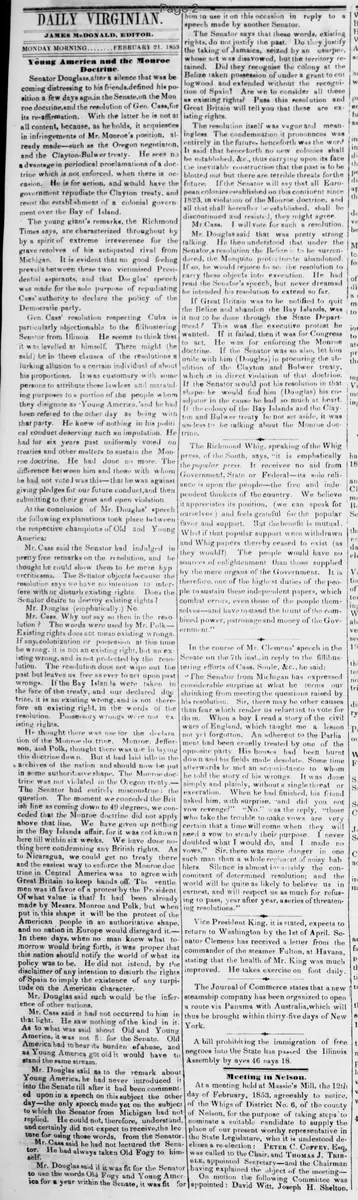
Young America and the Monroe Doctrine.
Senator Douglas, after a silence that was becoming distressing to his friends, defined his position a few days ago, in the Senate, on the Monroe doctrine, and the resolution of Gen. Cass, for its re-affirmation. With the latter he is not at all content, because, as he holds, it acquiesces in infringements of Mr. Monroe's position already made—such as the Oregon negotiation, and the Clayton-Bulwer treaty. He sees no advantage in periodical proclamations of a doctrine which is not enforced, when there is occasion. He is for action, and would have the government repudiate the Clayton treaty, and resist the establishment of a colonial government over the Bay Islands.
The young giant's remarks, the Richmond Times says, are characterized throughout by a spirit of extreme irreverence for the grave resolves of his antiquated rival from Michigan. It is evident that no good feeling prevails between these two victimised Presidential aspirants, and that Douglas' speech was made for the sole purpose of repudiating Cass' authority to declare the policy of the Democratic party.
Gen. Cass' resolution respecting Cuba is particularly objectionable to the filibustering Senator from Illinois. He seems to think that it was levelled at himself. There might (he said) be in these clauses of the resolutions a lurking allusion to a certain individual of about his proportions. It was customary with some persons to attribute these lawless and marauding purposes to a portion of the people whom they designate as 'Young America,' and he had been referred to the other day as being with that party. He knew of nothing in his political conduct deserving such an imputation. He had for six years past uniformly voted on treaties and other matters to sustain the Monroe doctrine. He had done no more. The difference between him and those with whom he had not voted was this—that he was against giving pledges for our future conduct, and then submitting to their gross and open violation.
At the conclusion of Mr. Douglas' speech the following explanations took place between the respective champions of Old and Young America:
Mr. Cass said the Senator had indulged in pretty free remarks on the resolution, and he thought he could show them to be mere hypocrisy. The Senator objects because the resolution says we have no intention to interfere with or disturb existing rights. Does the Senator desire to destroy existing rights?
Mr. Douglas (emphatically.) No.
Mr. Cass. Why not say so then in the resolution? The words were used by Mr. Polk—Existing rights does not mean existing wrongs. If any colonization or possession at this time be wrong, it is not an existing right, but an existing wrong, and is not protected by the resolution. The resolution does not wipe out the past but leaves us free as ever to act upon past wrongs. If the Bay Islands were taken in the face of the treaty, and our declared doctrine, it is an existing wrong, and is not therefore an existing right, in the words of the resolution. Possessory wrongs were not existing rights.
He thought there was use for the declaration of the Monroe doctrine. Monroe, Jefferson, and Polk, thought there was use in laying this doctrine down. But it had laid idle in the archives of the nation and should now be put in some authoritative shape. The Monroe doctrine was not violated in the Oregon treaty. The Senator had entirely misconstrued the question. The moment we conceded the British line as coming down to 49 degrees, we conceded that the Monroe doctrine did not apply above that line. We have given up nothing in the Bay Islands affair, for it was not known here till within six weeks. We have done nothing here condemning any British rights. As to Nicaragua, we could get no treaty there and the easiest way to enforce the Monroe doctrine in Central America was to agree with Great Britain to keep hands off. The gentleman was in favor of a protest by the President. Of what value is that? It had been already made by Messrs. Monroe and Polk, but when put in this shape it will be the protest of the American people in an authoritative shape, and no nation in Europe would disregard it. In these days, when no man knew what to-morrow would bring forth, it was proper that this nation should notify the world of what its policy was to be. He did not intend, by the disclaimer of any intention to disturb the rights of Spain to imply the existence of any turpitude on the American character.
Mr. Douglas said such would be the inference of other nations.
Mr. Cass said it had not occurred to him in that light. He saw nothing of the kind in it. As to what was said about Old and Young America, it was not fit for the Senate. Old America had to bear its burden of abuse, and as Young America got old it would have to stand the same stream.
Mr. Douglas said as to the remark about Young America, he had never introduced it into the Senate till after it had been commented upon in a speech on this subject the other day—the only speech made yet on the subject to which the Senator from Michigan had not replied. He could not, therefore, understand, and certainly did not expect to receive, the lecture on using those words, from the Senator.
Mr. Cass said he had not lectured the Senator. He had always taken Old Fogy to himself.
Mr. Douglas said if it was fit for the Senator to use the words Old Fogy and Young America for a year within the Senate, it was fit for him to use it on this occasion in reply to a speech made by another Senator.
The Senator says that these words, existing rights, do not justify the past. Do they justify the taking of Jamaica, seized by an usurper, whose act was disavowed, but the territory retained. Did they recognise the colony at the Belize taken possession of under a grant to cut logwood, and extended without the recognition of Spain? Are we to consider all these existing rights? Pass this resolution and Great Britain will tell you that these are existing rights.
The resolution itself was vague and meaningless. The condemnation it pronounces was entirely in the future. Henceforth was the word. It said that henceforth no new colonies shall be established, &c., thus carrying upon its face the inevitable construction that the past is to be blotted out but there are terrible threats for the future. If the Senator will say that all European colonies established on this continent since 1823, in violation of the Monroe doctrine, and all that shall hereafter be established, shall be discontinued and resisted, they might agree.
Mr. Cass. I will vote for such a resolution.
Mr. Douglas said that was pretty strong talking. He then understood that under the Senator's resolution the Belize is to be surrendered, the Mosquito protectorate abandoned. If so, he would rejoice to see the resolution to carry these objects into execution. He had read the Senator's speech, but never dreamed he intended his resolution to extend so far. If Great Britain was to be notified to quit the Belize and abandon the Bay Islands, was it not to be done through the State Department? This was the executive protest he wanted. If it failed, then it was for Congress to act. He was for enforcing the Monroe doctrine. If the Senator was so also, let him unite with him (Douglas) in procuring the abolition of the Clayton and Bulwer treaty, which is in direct violation of that doctrine. If the Senator would put his resolution in that shape he would find him (Douglas) his coadjutor in the cause he had so much at heart. If the colony of the Bay Islands and the Clayton and Bulwer treaty be not set aside, it was useless to be talking about the Monroe doctrine.
The Richmond Whig, speaking of the Whig press of the South, says, "it is emphatically the popular press. It receives no aid from Government, State or Federal—its sole reliance is upon the people—the free and independent thinkers of the country. We believe it appreciates its position, (we can speak for ourselves) and feels grateful for the popular favor and support. But the benefit is mutual. What if that popular support were withdrawn and Whig papers thereby ceased to exist (as they would?) The people would have no sources of enlightenment than those supplied by the mere organs of the Government. It is therefore, one of the highest duties of the people to sustain these independent papers, which combat errors, even those of the people themselves—and have to stand the brunt of the combined power, patronage and money of the Government."
In the course of Mr. Clemens' speech in the Senate on the 7th inst., in reply to the filibustering efforts of Cass, Soule, &c., he said:
"The Senator from Michigan has expressed considerable surprise at what he terms our shrinking from meeting the questions raised by his resolution. Sir, there may be other causes than fear which render us reluctant to vote for them. When a boy I read a story of the civil wars of England, which taught me a lesson not yet forgotten. An adherent to the Parliament had been cruelly treated by one of the opposite party. His houses had been burnt down and his fields made desolate. Some time afterwards he met an acquaintance to whom he told the story of his wrongs. It was done simply and plainly, without a single threat or execration. When he had finished, his friend asked him, with surprise, 'and did you not vow revenge?' 'No.' was the reply, 'those who take the trouble to make vows are very certain that a time will come when they will need a vow to steady their purpose. I never doubted what I would do, and I made no vows.' Sir, there was more danger in one such man than a whole regiment of noisy babblers. Silence is almost invariably the concomitant of determined resolution; and the world will be quite as likely to believe us in earnest, and will respect us as much for refusing to pass, year after year, a series of threatening resolutions."
What sub-type of article is it?
What keywords are associated?
What entities or persons were involved?
Where did it happen?
Domestic News Details
Primary Location
U.S. Senate
Event Date
February 1853
Key Persons
Event Details
Senator Douglas critiqued Gen. Cass's resolution on the Monroe Doctrine in the Senate, arguing it ignores past violations like the Clayton-Bulwer Treaty and British colonies in the Bay Islands and Belize. Douglas advocated for action to repudiate treaties and resist new establishments rather than mere proclamations. An exchange followed where Cass defended the resolution as protecting against future infringements while allowing action on existing wrongs. Douglas pressed for stronger language against all violations since 1823. Cass agreed to vote for such a resolution. The debate touched on Cuba, filibustering, and 'Young America' vs. 'Old America.' A quote from Mr. Clemens' earlier speech emphasized resolve over repeated resolutions.