Thank you for visiting SNEWPapers!
Sign up free
Editorial
September 29, 1840
The New Hampshire Gazette
Portsmouth, Rockingham County, New Hampshire
What is this article about?
Editorial defends President Van Buren against Mr. Cutter's accusations of duplicity regarding his approval of Mr. Poinsett's militia plan outline, noting Whig papers' praise and Cutter's suppression of explanations, while criticizing Cutter's lack of candor.
Clipping
OCR Quality
88%
Good
Full Text
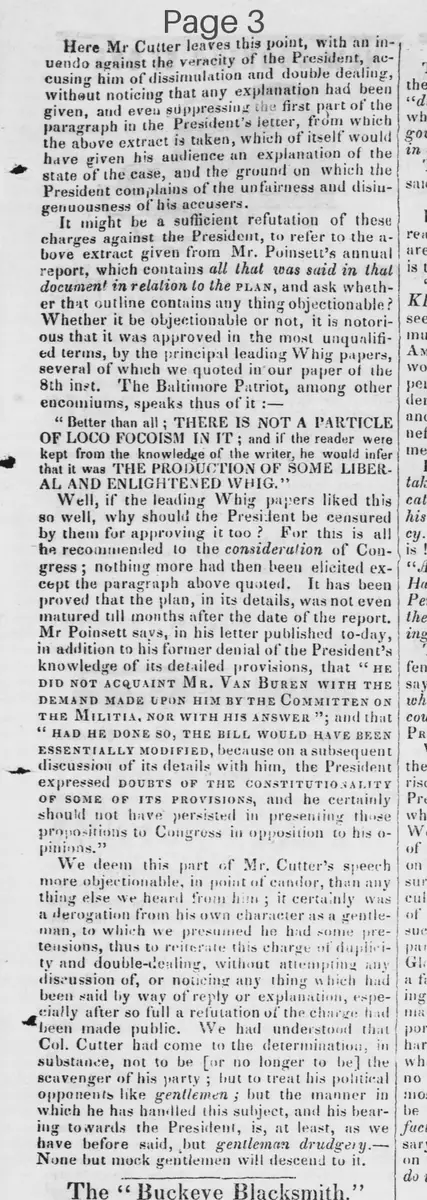
Here Mr. Cutter leaves this point, with an innuendo against the veracity of the President, accusing him of dissimulation and double dealing, without noticing that any explanation had been given, and even suppressing the first part of the paragraph in the President's letter, from which the above extract is taken, which of itself would have given his audience an explanation of the state of the case, and the ground on which the President complains of the unfairness and disingenuousness of his accusers.
It might be a sufficient refutation of these charges against the President, to refer to the above extract given from Mr. Poinsett's annual report, which contains all that was said in that document in relation to the Plan, and ask whether that outline contains any thing objectionable? Whether it be objectionable or not, it is notorious that it was approved in the most unqualified terms, by the principal leading Whig papers, several of which we quoted in our paper of the 8th inst. The Baltimore Patriot, among other encomiums, speaks thus of it:-
"Better than all; THERE IS NOT A PARTICLE OF LOCO FOCOISM IN IT; and if the reader were kept from the knowledge of the writer, he would infer that it was THE PRODUCTION OF SOME LIBERAL AND ENLIGHTENED WHIG."
Well, if the leading Whig papers liked this so well, why should the President be censured by them for approving it too? For this is all he recommended to the consideration of Congress; nothing more had then been elicited except the paragraph above quoted. It has been proved that the plan, in its details, was not even matured till months after the date of the report. Mr. Poinsett says, in his letter published to-day, in addition to his former denial of the President's knowledge of its detailed provisions, that "HE Did not Acquaint MR. Van Buren With the DeMaNd Made UPON HiM BY ThE COMMITTEE on THE MILITIA, NOR WITH HIS ANSWER"; and thAt "HAD HE DONE SO, THE BILL WOULD HAVE BEEN ESSENTIALLY MODIFIED, beCaUSe ON a SUbSequent discussiou of its details with him, the President EXpRESSEd DOUBTS OF THE CONSTITUTIONALITY Of soME oF ITS PRovisIoNs, and he certainly should not have persisted in presenting those propositions to Congress io opposition to his o-pinions."
We deem this part of Mr. Cutter's speech more objectionable, in point of candor, than any thing else we heard from him; it certainly was a derogation from his own character as a gentleman, to which we presumed he had some pretensions, thus to reiterate this charge of duplicity and double-dealing, without attempting any discussion of, or noticing any thing which had been said by way of reply or explanation, especially after so full a refutation of the charge had been made public. We had understood that Col. Cutter had come to the determination, in substance, not to be [or no longer to be] the scavenger of his party: but to treat his political opponents like gentlemen; but the manner in which he has handled this subject, and his bearing towards the President, is, at least, as we have before said, but gentleman drudgery.-
None but mock gentlemen will descend to it.
It might be a sufficient refutation of these charges against the President, to refer to the above extract given from Mr. Poinsett's annual report, which contains all that was said in that document in relation to the Plan, and ask whether that outline contains any thing objectionable? Whether it be objectionable or not, it is notorious that it was approved in the most unqualified terms, by the principal leading Whig papers, several of which we quoted in our paper of the 8th inst. The Baltimore Patriot, among other encomiums, speaks thus of it:-
"Better than all; THERE IS NOT A PARTICLE OF LOCO FOCOISM IN IT; and if the reader were kept from the knowledge of the writer, he would infer that it was THE PRODUCTION OF SOME LIBERAL AND ENLIGHTENED WHIG."
Well, if the leading Whig papers liked this so well, why should the President be censured by them for approving it too? For this is all he recommended to the consideration of Congress; nothing more had then been elicited except the paragraph above quoted. It has been proved that the plan, in its details, was not even matured till months after the date of the report. Mr. Poinsett says, in his letter published to-day, in addition to his former denial of the President's knowledge of its detailed provisions, that "HE Did not Acquaint MR. Van Buren With the DeMaNd Made UPON HiM BY ThE COMMITTEE on THE MILITIA, NOR WITH HIS ANSWER"; and thAt "HAD HE DONE SO, THE BILL WOULD HAVE BEEN ESSENTIALLY MODIFIED, beCaUSe ON a SUbSequent discussiou of its details with him, the President EXpRESSEd DOUBTS OF THE CONSTITUTIONALITY Of soME oF ITS PRovisIoNs, and he certainly should not have persisted in presenting those propositions to Congress io opposition to his o-pinions."
We deem this part of Mr. Cutter's speech more objectionable, in point of candor, than any thing else we heard from him; it certainly was a derogation from his own character as a gentleman, to which we presumed he had some pretensions, thus to reiterate this charge of duplicity and double-dealing, without attempting any discussion of, or noticing any thing which had been said by way of reply or explanation, especially after so full a refutation of the charge had been made public. We had understood that Col. Cutter had come to the determination, in substance, not to be [or no longer to be] the scavenger of his party: but to treat his political opponents like gentlemen; but the manner in which he has handled this subject, and his bearing towards the President, is, at least, as we have before said, but gentleman drudgery.-
None but mock gentlemen will descend to it.
What sub-type of article is it?
Partisan Politics
What keywords are associated?
Van Buren
Poinsett
Cutter
Militia Plan
Whig Papers
Duplicity Charges
Constitutional Doubts
Political Candor
What entities or persons were involved?
Mr. Cutter
President Van Buren
Mr. Poinsett
Baltimore Patriot
Whig Papers
Editorial Details
Primary Topic
Defense Against Charges Of Presidential Duplicity On Militia Plan
Stance / Tone
Strongly Supportive Of President Van Buren, Critical Of Mr. Cutter's Candor
Key Figures
Mr. Cutter
President Van Buren
Mr. Poinsett
Baltimore Patriot
Whig Papers
Key Arguments
Cutter Suppresses Explanatory Parts Of President's Letter
Poinsett's Plan Outline Approved By Leading Whig Papers
President Only Recommended The Outline, Not Details
Poinsett Did Not Inform President Of Committee Demands Or His Answer
President Expressed Constitutional Doubts On Some Provisions
Cutter Reiterates Charges Without Addressing Refutations, Lacking Candor