Thank you for visiting SNEWPapers!
Sign up free
New York Daily Tribune
New York, New York County, New York
What is this article about?
A French writer claims Louis Philippe, ex-King of France, was not a Bourbon but the son of an Italian jailer, swapped at birth with Philippe Egalité's daughter to secure male heirs. The supposed true daughter, Marie Stella Petronilla, discovers her origins and seeks recognition in France but faces rejection and persecution.
Clipping
OCR Quality
Full Text
From Eliza Cook's Journal.
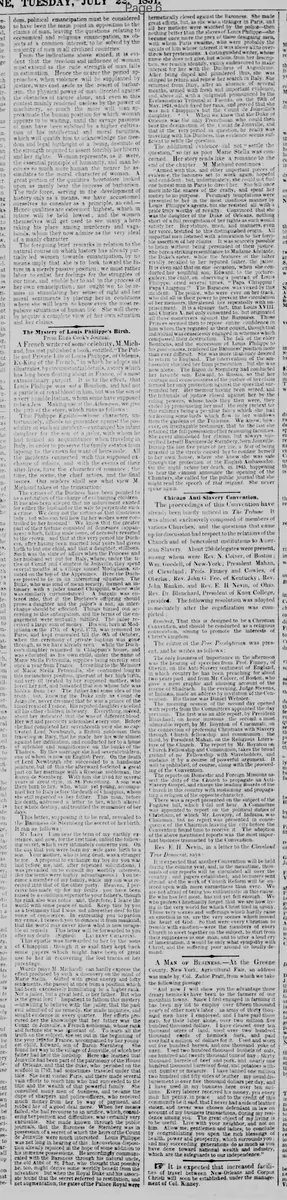
A French writer of some celebrity, M. Michaud, has just published a book, entitled, "The Public and Private Life of Louis Philippe, of Orleans, Ex-King of the French," in which he adopts and illustrates, by circumstantial details, a story which has long been floating about in France, of a most extraordinary purport. It is to the effect, that Louis Philippe was not a Bourbon, and had not a particle of royal blood in him, but was the son of a very humble Italian, whom some have supposed to be a Jew. Making use of the Atheneum, we give the pith of the story, which runs as follows:
That Philippe Egalité—whose character, unfortunately, affords no guarantee against the possibility of such an incident—exchanged his infant daughter for the son of a jailor, with whom he had formed an acquaintance when traveling in Italy, in order to preserve the family estates from lapsing to the crown for want of heirs male. All the incidents connected with this supposed exchange of infants, and with the events of their after-lives, have the character of romance—the time, the scene, the chief actors, and the final issues. Our readers shall see what view M. Michaud takes of the transaction:
The virtues of the Duchess have been pointed to as a refutation of the charge of exchanging children. It has also been alleged that no inducement existed for either the husband or the wife to perpetrate such a crime. We deny not the virtues of that illustrious lady, but who can tell how far her wishes were controlled by her husband? We know that the greater part of their fortune consisted of demesnes (appanages) which, failing male issue, of necessity reverted to the crown; and that at this very period the Duchess, after having been married four years, had given birth to but one child, and that a daughter, stillborn.
Such was the state of affairs when the Princess and her husband set out for Italy, where, under the titles of Count and Countess de Joinville, they spent several months at a village named Modigliana, situated on the top of the Apennines. Here the Duchess proved to be in an interesting situation. The Duke, who was fond of mean society, formed an intimacy with a jailer named Chiappini, whose wife was similarly circumstanced. A bargain was entered into, that if the Duchess's offspring should prove a daughter and the jailor's a son, an interchange should be effected. "Things turned out according to this anticipation, and the terms of the engagement were mutually fulfilled. The jailer received a large sum of money. His son, born at Modigliana on the 6th of April, 1773, was removed to Paris, and kept concealed till the 6th of October, when the ceremony of private baptism was gone through, as we have already seen, while the Duchess's daughter remained in Chiappini's house, and was educated as his own child, under the name of Marie Stella Petronilla, supplies being secretly sent once a year from France. According to the Memoirs of Marie Stella Petronilla, she continued long in this melancholy position, ignorant of her high birth, and very ill treated by her supposed mother, who loved her not, and lamented that son whose fate was hidden from her. The father had some idea of the truth, but, knowing the Duke only as Count de Joinville, never dreamed that he was a prince of the blood royal of France. His reputed daughter excelled all his other children in beauty. Everything, indeed, about her indicated that she was of different blood. Her wit and precocity astonished every one. Before she had completed her seventeenth year she so captivated Lord Newburgh, a British nobleman then traveling in Italy, that he made her his wife almost against her inclination, and conducted her to a home of splendor and magnificence on the banks of the Thames. By this marriage she had several children, one of whom is now an English Peer. On the death of Lord Newburgh she succeeded to a handsome jointure, but of this she afterward forfeited a great part on her marriage with a Russian nobleman, the Baron de Sternberg. With him she lived for several years in great style, in St. Petersburg. A son was there born to her, who, while yet young, accompanied her to Italy before the death of Chiappini, whom she still regarded as her father. This man, before his death, addressed a letter to her, which altered her whole destiny, and troubled the remainder of her days.
This letter, supposing it to be real, revealed to the Baroness de Sternberg the secret of her birth. It ran as follows:
"My Lady—I am near the term of my earthly existence, and now, for the first time, unfold the following secret, which very intimately concerns you. On the day that you were born my wife gave birth to a son. Your mother, who is long dead, was a stranger to me. A proposal to exchange my boy for you was laid before me, and, after repeated solicitations, I was prevailed on to consult my worldly interests, (for the terms were highly advantageous.) You became a member of my family, while my son was received into that of the other party. Heaven, I perceive has made up for my faults, you have been raised to a condition superior to your father's, though his rank also was noble; and, therefore, I leave the world with some peace of mind. Keep this by you as a testimony that I was not altogether deaf to the voice of conscience. In entreating you to pardon my crime, I beseech you to conceal it from mankind, that the world may never know what is now incapable of remedy. This letter will be forwarded to you after my death. (Signed) LAURENT CHIAPPINI."
This epistle was forwarded to her by the sons of Chiappini: though it is said they kept back some papers which might have been of great use to her in recovering the lost traces of her parentage.
Words (says M. Michaud) can hardly express the effect produced by such a discovery on the mind of Marie Stella. Gifted with great energy and lofty sentiments, she passed at once from a position which had been excessively humiliating to a higher rank. Not a jailor's, but a great lord's, is her father. But who is the great lord? Impatient to fathom this mystery—unwilling to believe with the jailor, that the past evil admitted of no remedy, she made inquiries, and sought evidence in every quarter. Her efforts procured her the knowledge that her father was the Count de Joinville, a French nobleman, whose rank and fortune she was ignorant of. To learn all the truth on the subject, she set out in the beginning of the year 1824 for France, accompanied by her youngest child, Edward, son of Baron Sternberg. She found her way to the village of Joinville, of which her father had held the lordship. Here she learned that Joinville had been part of the patrimony of the House of Orleans, and that the duke, who perished on the scaffold in 1793, had sometimes traveled under that title. She next visited Paris, and there made several vain efforts to reach him who had succeeded to the title and the wealth of that powerful family. She consulted many men of business, and became the dupe of sharpers and police-officers, who received much money from her by way of payment, and robbed her of a good deal more. When her means failed, she had recourse to an artifice, which, considering her position and difficulties, was certainly very excusable. She made known through the public journals, that the Baroness de Sternberg was in possession of a secret of which the heirs of the Count de Joinville were much interested. Louis Philippe was not long in hearing of this, his covetous disposition already rejoiced in the hope of some addition to his immense possessions. He accordingly communicated with the Baroness through his natural uncle, the old Abbé of St. Phar, who thought that possibly he, too, might derive some worldly benefit from the adventure; but when the Royal Duke and his associate found that the secret referred to restitution, and not augmentation, the gates of the Palais Royal were hermetically closed against the Baroness. She made great efforts, but, as she was a stranger in Paris, and all her motions were watched by the police—then nothing better than the slaves of Louis Philippe—she became once more the prey of those designing men, with whom Paris swarms, who were probably the agents of him whose interest it was above all to overthrow her pretensions. A distinguished writer, whose name she does not give, but whom, from her description, we readily identify, vainly endeavored to make interest for her with the Duchess of Angoulême.
After being duped and plundered thus, she was obliged to return and renew her search in Italy. She returned from Italy, after an absence of several months, armed with fresh and important evidence, and, above all, with a judgment pronounced by the Ecclesiastical Tribunal at Faenza, on the 29th of May, 1824, which fixed her rank, and proved that she was not Chiappini's but the Count de Joinville's daughter. * * * * When we know that the Duke of Orleans was the only Frenchman who could then bear the designation of the Count de Joinville, and that at the very period in question, he really was traveling with his Duchess, this evidence seems sufficient to settle the question.
The additional evidence did not "settle the question," so far as poor Marie Stella was concerned. Her story reads like a romance to the end of the chapter. M. Michaud continues:
"Armed with this, and other important pieces of evidence, the baroness set to work again, hopeful and confident; but, unfortunately, she could not find one honest man in Paris to direct her. She fell once more into the snares of the crafty, and spent her money to no purpose. Pecuniary temptations were presented to her in the most insidious manner by Louis Philippe's agents, but she resisted all with a pride truly worthy of royalty. Convinced that she was the daughter of the Duke of Orleans, nothing short of a full recognition of her rights as such would satisfy her. Her stature, mien, and manners, even her voice, testified to this distinguished origin. All impartial men listened with admiration to her forcible assertion of her claims. It was scarcely possible to listen without being persuaded of their justice. She bore a striking resemblance to Madame Adelaide, the Duke's sister, while the features of the latter vividly recalled to her reputed father, the jailor. It is even said that on one occasion, when she conducted her youthful son, Edward, to the picture-gallery, the child, on observing a portrait of Louis Philippe, cried several times, "Papa Chiappini! Papa Chiappini!" The Baroness was vexed by this incident. The police, who were ever on her track, who did all in their power to prevent the circulation of her memoirs, threatened her repeatedly with imprisonment. It is a strange fact, that Louis XVIII. and Charles X. not only consented to, but originated all those maneuvers against the Baroness. Those Princes seemed then to repose entire confidence in him whom they regarded as their cousin, though that individual was ceaselessly engaged in schemes which compassed their destruction. The fall of the elder Bourbons, and the succession of Louis Philippe to his good cousins, rendered the Baroness' position more than ever difficult. She was more than once desired to return to England. The intervention of the ambassador shielded her from persecution but she was now alone. The Baron de Sternberg had conducted her favorite son, Edward, to Russia, so that her courage and consciousness of the justice of her claim formed her only protection against the spies that surrounded her. Her memoir having been seized, and the tribunals of justice closed against her by the ruling powers, whose tools they then were, they ended by pronouncing her mad—the only pretext for this calumny being a peculiar fancy which she had for feeding some birds which flew to her windows from the gardens of the Tuileries. We know, however, on irrefragable testimony, that to the last she retained the full possession of her reasoning faculties. She never abandoned her claims, but always subscribed herself Baroness de Sternberg, born Joinville. During the last five years of her life, a fear of being arrested in the streets caused her to confine herself to her own house, where she knew she was safe through the protection of the English Ambassador. On the night before her death, in 1845, happening to hear the cannon announce the opening of the Chambers, she called for the public journal that she might read the speech of that brigand. She never spoke again."
What sub-type of article is it?
What themes does it cover?
What keywords are associated?
What entities or persons were involved?
Where did it happen?
Story Details
Key Persons
Location
Modigliana, Italy; Paris, France; Joinville, France; St. Petersburg, Russia
Event Date
6th Of April, 1773; Beginning Of The Year 1824; 29th Of May, 1824; 1845
Story Details
Philippe Egalité swaps his newborn daughter with jailer Chiappini's son in Italy to secure male heirs. The son becomes Louis Philippe. The daughter, raised as Marie Stella Petronilla, learns her true origins via a deathbed letter, seeks recognition in France, but faces rejection, deception, and persecution until her death.