Thank you for visiting SNEWPapers!
Sign up free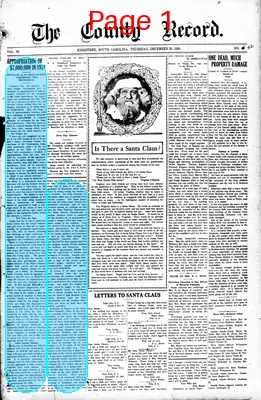
Story
December 23, 1920
The County Record
Kingstree, Williamsburg County, South Carolina
What is this article about?
South Carolina's State Budget Commission recommends $7M appropriation for 1921 state operations, a $2.5M cut from estimates, implying a 14-mill tax levy on $448-450M valuation. Governor Cooper plans reductions except for schools and a possible bond issue for improvements. Article analyzes taxation burdens from counties, cities, and state functions.
Clipping
OCR Quality
98%
Excellent
Full Text
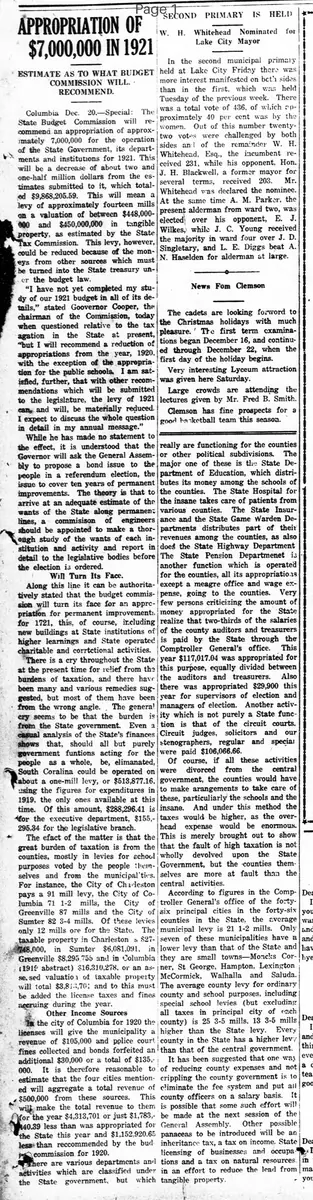
APPROPRIATION OF $7,000,000 IN 1921
ESTIMATE AS TO WHAT BUDGET COMMISSION WILL RECOMMEND.
Columbia, Dec. 20.-Special: The State Budget Commission will recommend an appropriation of approximately $7,000,000 for the operation of the State Government, its departments and institutions for 1921. This will be a decrease of about two and one-half million dollars from the estimates submitted to it, which totaled $9,868,205.59. This will mean a levy of approximately fourteen mills on a valuation of between $448,000,000 and $450,000,000 in tangible property, as estimated by the State Tax Commission. This levy, however, could be reduced because of the moneys from other sources which must be turned into the State treasury under the budget law.
"I have not yet completed my study of our 1921 budget in all of its details," stated Governor Cooper, the chairman of the Commission, today when questioned relative to the tax agitation in the State at present, "but I will recommend a reduction of appropriations from the year 1920, with the exception of the appropriation for the public schools. I am satisfied, further, that with other recommendations which will be submitted to the legislature, the levy of 1921 can, and will, be materially reduced. I expect to discuss the whole question in detail in my annual message."
While he has made no statement to the effect, it is understood that the Governor will ask the General Assembly to propose a bond issue to the people in a referendum election, the issue to cover ten years of permanent improvements. The theory is that to arrive at an adequate estimate of the wants of the State along permanent lines, a commission of engineers should be appointed to make a thorough study of the wants of each institution and activity and report in detail to the legislative bodies before the election is ordered.
Along this line it can be authoritatively stated that the budget commission will turn its face for an appropriation for permanent improvements for 1921, this, of course, including new buildings at State institutions of higher learning and State operated charitable and correctional activities.
There is a cry throughout the State at the present time for relief from the burdens of taxation, and there have been many and various remedies suggested, but most of them have been from the wrong angle. The general cry seems to be that the burden is from the State government. Even a casual analysis of the State's finances shows that, should all but purely government functions acting for the people as a whole, be eliminated, South Carolina could be operated on about a one-mill levy, or $513,877.16, using the figures for expenditures in 1919, the only ones available at this time. Of this amount, $288,296.41 is for the executive department, $155,295.34 for the legislative branch.
The fact of the matter is that the great burden of taxation is from the counties, mostly in levies for school purposes voted by the people themselves and from the municipalities. For instance, the City of Charleston pays a 91 mill levy, the City of Columbia 71 1-2 mills, the City of Greenville 87 mills and the City of Sumter 82 3-4 mills. Of these levies only 12 mills are for the State. The taxable property in Charleston is $27,480,000, in Sumter $6,081,091, in Greenville $8,295,755 and in Columbia (1919 abstract) $16,310,278, or an assessed valuation of taxable property will total $3,818,701 and to this must be added the license taxes and fines accruing during the year.
Other Income Sources
In the city of Columbia for 1920 the licenses will give the municipality a revenue of $105,000 and police court fines collected and bonds forfeited an additional $30,000 or a total of $135,000. It is therefore reasonable to estimate that the four cities mentioned will aggregate a total revenue of $500,000 from these sources. This will make the total revenue to them for the year $4,313,701 or just $1,783,403.39 less than was appropriated for the State this year and $1,152,920.65 less than recommended by the budget commission for 1920.
There are various departments and activities which are classified under the State government, but which really are functioning for the counties or other political subdivisions. The major one of these is the State Department of Education, which distributes its money among the schools of the counties. The State Hospital for the insane takes care of patients from various counties. The State Insurance and the State Game Warden Departments distribute part of their revenues among the counties, as also does the State Highway Department. The State Pension Department is another function which is operated for the counties, all its appropriations except a meagre office and wage expense, going to the counties. Very few persons criticizing the amount of money appropriated for the State realize that two-thirds of the salaries of the county auditors and treasurers is paid by the State through the Comptroller General's office. This year $117,017.04 was appropriated for this purpose, equally divided between the auditors and treasurers.
Also there was appropriated $29,900 this year for supervisors of election and managers of election. Another activity which is not purely a State function is that of the circuit courts. Circuit judges, solicitors and our stenographers, regular and special were paid $106,066.66.
Of course, if all these activities were divorced from the central government, the counties would have to make arrangements to take care of these, particularly the schools and the insane. And under this method the taxes would be higher, as the overhead expense would be enormous.
This is merely brought out to show that the fault of high taxation is not wholly devolved upon the State Government, but the counties themselves are more at fault than the central activities.
According to figures in the Comptroller General's office of the forty-six principal cities in the forty-six counties in the State, the average municipal levy is 21 1-2 mills. Only seven of these municipalities have a lower levy than that of the State and they are small towns - Moncks Corner, St George, Hampton, Lexington, McCormick, Walhalla and Saluda.
The average county levy for ordinary county and school purposes, including special school levies (but excluding all taxes in principal city of each county) is 25 3-5 mills, 13 3-5 mills higher than the State levy. Every county in the State has a higher levy than that of the central government.
It has been suggested that one way of reducing county expenses and not crippling the county government is to eliminate the fee system and put all county officers on a salary basis. It is possible that some such effort will be made at the next session of the General Assembly. Other possible panaceas to be introduced will be an inheritance tax, a tax on income, State licensing of businesses and occupations and a tax on natural resources in an effort to reduce the load from tangible property.
ESTIMATE AS TO WHAT BUDGET COMMISSION WILL RECOMMEND.
Columbia, Dec. 20.-Special: The State Budget Commission will recommend an appropriation of approximately $7,000,000 for the operation of the State Government, its departments and institutions for 1921. This will be a decrease of about two and one-half million dollars from the estimates submitted to it, which totaled $9,868,205.59. This will mean a levy of approximately fourteen mills on a valuation of between $448,000,000 and $450,000,000 in tangible property, as estimated by the State Tax Commission. This levy, however, could be reduced because of the moneys from other sources which must be turned into the State treasury under the budget law.
"I have not yet completed my study of our 1921 budget in all of its details," stated Governor Cooper, the chairman of the Commission, today when questioned relative to the tax agitation in the State at present, "but I will recommend a reduction of appropriations from the year 1920, with the exception of the appropriation for the public schools. I am satisfied, further, that with other recommendations which will be submitted to the legislature, the levy of 1921 can, and will, be materially reduced. I expect to discuss the whole question in detail in my annual message."
While he has made no statement to the effect, it is understood that the Governor will ask the General Assembly to propose a bond issue to the people in a referendum election, the issue to cover ten years of permanent improvements. The theory is that to arrive at an adequate estimate of the wants of the State along permanent lines, a commission of engineers should be appointed to make a thorough study of the wants of each institution and activity and report in detail to the legislative bodies before the election is ordered.
Along this line it can be authoritatively stated that the budget commission will turn its face for an appropriation for permanent improvements for 1921, this, of course, including new buildings at State institutions of higher learning and State operated charitable and correctional activities.
There is a cry throughout the State at the present time for relief from the burdens of taxation, and there have been many and various remedies suggested, but most of them have been from the wrong angle. The general cry seems to be that the burden is from the State government. Even a casual analysis of the State's finances shows that, should all but purely government functions acting for the people as a whole, be eliminated, South Carolina could be operated on about a one-mill levy, or $513,877.16, using the figures for expenditures in 1919, the only ones available at this time. Of this amount, $288,296.41 is for the executive department, $155,295.34 for the legislative branch.
The fact of the matter is that the great burden of taxation is from the counties, mostly in levies for school purposes voted by the people themselves and from the municipalities. For instance, the City of Charleston pays a 91 mill levy, the City of Columbia 71 1-2 mills, the City of Greenville 87 mills and the City of Sumter 82 3-4 mills. Of these levies only 12 mills are for the State. The taxable property in Charleston is $27,480,000, in Sumter $6,081,091, in Greenville $8,295,755 and in Columbia (1919 abstract) $16,310,278, or an assessed valuation of taxable property will total $3,818,701 and to this must be added the license taxes and fines accruing during the year.
Other Income Sources
In the city of Columbia for 1920 the licenses will give the municipality a revenue of $105,000 and police court fines collected and bonds forfeited an additional $30,000 or a total of $135,000. It is therefore reasonable to estimate that the four cities mentioned will aggregate a total revenue of $500,000 from these sources. This will make the total revenue to them for the year $4,313,701 or just $1,783,403.39 less than was appropriated for the State this year and $1,152,920.65 less than recommended by the budget commission for 1920.
There are various departments and activities which are classified under the State government, but which really are functioning for the counties or other political subdivisions. The major one of these is the State Department of Education, which distributes its money among the schools of the counties. The State Hospital for the insane takes care of patients from various counties. The State Insurance and the State Game Warden Departments distribute part of their revenues among the counties, as also does the State Highway Department. The State Pension Department is another function which is operated for the counties, all its appropriations except a meagre office and wage expense, going to the counties. Very few persons criticizing the amount of money appropriated for the State realize that two-thirds of the salaries of the county auditors and treasurers is paid by the State through the Comptroller General's office. This year $117,017.04 was appropriated for this purpose, equally divided between the auditors and treasurers.
Also there was appropriated $29,900 this year for supervisors of election and managers of election. Another activity which is not purely a State function is that of the circuit courts. Circuit judges, solicitors and our stenographers, regular and special were paid $106,066.66.
Of course, if all these activities were divorced from the central government, the counties would have to make arrangements to take care of these, particularly the schools and the insane. And under this method the taxes would be higher, as the overhead expense would be enormous.
This is merely brought out to show that the fault of high taxation is not wholly devolved upon the State Government, but the counties themselves are more at fault than the central activities.
According to figures in the Comptroller General's office of the forty-six principal cities in the forty-six counties in the State, the average municipal levy is 21 1-2 mills. Only seven of these municipalities have a lower levy than that of the State and they are small towns - Moncks Corner, St George, Hampton, Lexington, McCormick, Walhalla and Saluda.
The average county levy for ordinary county and school purposes, including special school levies (but excluding all taxes in principal city of each county) is 25 3-5 mills, 13 3-5 mills higher than the State levy. Every county in the State has a higher levy than that of the central government.
It has been suggested that one way of reducing county expenses and not crippling the county government is to eliminate the fee system and put all county officers on a salary basis. It is possible that some such effort will be made at the next session of the General Assembly. Other possible panaceas to be introduced will be an inheritance tax, a tax on income, State licensing of businesses and occupations and a tax on natural resources in an effort to reduce the load from tangible property.
What sub-type of article is it?
Historical Event
What themes does it cover?
Misfortune
Justice
What keywords are associated?
Budget Appropriation
Tax Levy
South Carolina
Governor Cooper
State Finances
Taxation Burden
Bond Issue
What entities or persons were involved?
Governor Cooper
Where did it happen?
South Carolina, Columbia
Story Details
Key Persons
Governor Cooper
Location
South Carolina, Columbia
Event Date
1921
Story Details
State Budget Commission recommends $7M for 1921 operations, reducing from estimates; Governor Cooper plans cuts except schools and bond issue for improvements; analysis shows main tax burdens from counties and cities, not state.