Thank you for visiting SNEWPapers!
Sign up free
The Camden Journal
Camden, Kershaw County, South Carolina
What is this article about?
Synopsis from the Edgefield Advertiser of Senator Butler's speech at a dinner, critiquing the growth of anti-slavery sentiment in the North, failed compromises, and threats to Southern institutions, urging unity and defense of constitutional rights against free soil aggression.
Clipping
OCR Quality
Full Text
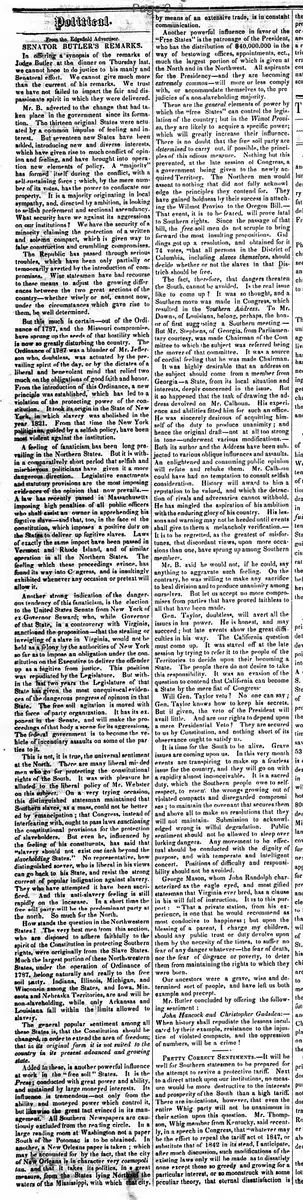
From the Edgefield Advertiser
SENATOR BUTLER'S REMARKS.
In offering a synopsis of the remarks of Judge Butler at the dinner on Thursday last, we cannot hope to do justice to his manly and Senatorial effort. We cannot give much more than the current of his remarks. We trust we have not failed to impart the fair and dispassionate spirit in which they were delivered.
Mr. B. adverted to the change that had taken place in the government since its formation. The thirteen original States were actuated by a common impulse of feeling and interest. But seventeen new States have been added, introducing new and diverse interests, which have given rise to much conflict of opinion and feeling, and have brought into operation new elements of policy. A "majority" has formed itself during the conflict, with a self-sustaining force; which, by the mere number of its votes, has the power to confiscate our property. It is a majority originating in local sympathy, and, directed by ambition, is looking to selfish preferment and sectional ascendancy.
What security have we against its aggressions on our institutions? We have the security of a minority claiming the protection of a written and solemn compact, which is given way to false construction and crumbling compromises.
The Republic has passed through serious troubles, which have been only partially or temporarily averted by the introduction of compromises. Wise statesmen have had recourse to these means to adjust the growing differences between the two great sections of the country—whether wisely or not, cannot now, under the circumstances which gave rise to them, be well determined.
But this much is certain—out of the Ordinance of 1787, and the Missouri compromise, have sprung up the seeds of that hostility which is now so greatly disturbing the country. The Ordinance of 1787 was a blunder of Mr. Jefferson who, doubtless, was actuated by the prevailing spirit of the day, or by the dictates of a liberal and benevolent mind that relied too much on the obligations of good faith and honor.
From the introduction of this Ordinance, a new principle was established, which has led to a violation of the protecting power of the constitution. It took its origin in the State of New York, in which slavery was abolished in the year 1821. From that time the New York politicians, guided by a selfish policy, have been most violent against the institution.
A feeling of fanaticism has been long prevailing in the Northern States. But it is within a comparatively short period that selfish and mischievous politicians have given it a more dangerous direction. Legislative enactments and statutory provisions are the most imposing evidences of the opinion that now prevails.
A law has recently passed in Massachusetts imposing high penalties on all public officers who shall assist an owner in apprehending his fugitive slave—and that, too, in the face of the constitution, which imposes a positive duty on the States to deliver up fugitive slaves. Laws of exactly the same import have been passed in Vermont and Rhode Island, and of similar operation in all the Northern States. The feeling which these proceedings evince, has found its way into Congress, and is insultingly exhibited whenever any occasion or pretext will allow it.
Another strong indication of the dangerous tendency of this fanaticism, is the election to the United States Senate from New York of ex-Governor Seward; who, while Governor of that State, in a controversy with Virginia, sanctioned the proposition—that the stealing or inveigling of a slave in Virginia, would not be held as a felony by the authorities of New York so far as to impose an obligation under the constitution on the Executive to deliver the offender up as a fugitive from justice. This position was repudiated by the Legislature, But within the last two years the Legislature of that State has given the most unequivocal evidences of the dangerous progress of opinion in that State. The free soil agitation is moved with the force of party organization. It has its exponent in the Senate, and will make the proceedings of that body a scene for its aggressions.
The federal government is to become the vehicle of incendiary assaults on some of the parties to it.
This is not, it is true, the universal sentiment at the North. There are many liberal-minded men who go for protecting the constitutional rights of the South. It was with pleasure he alluded to the liberal policy of Mr. Webster on this subject. On a very trying occasion this distinguished statesman maintained that Southern slaves, as a mass, could not be bettered by emancipation; that Congress, instead of interfering, ought to pass laws sanctioning the constitutional provisions for the protection of slaveholders. But even he, influenced by the feeling of his constituents, has said that "slavery should not exist one inch beyond the slaveholding States." No representative, how distinguished soever, who is liberal in his views can go back to his State, and resist the strong current of popular indignation against slavery.
They who have attempted it have been sacrificed. And this anti-slavery feeling is still rapidly on the increase. In a short time the free soil party will be the predominant party at the North. So much for the North.
How stands the question in the Northwestern States? The very best men from this section, who are disposed to adhere faithfully to the spirit of the Constitution in protecting Southern rights, were originally from the Slave States. Much the largest portion of these North-western States, under the operation of Ordinance of 1787, belong naturally and really to the free soil party. Indiana, Illinois, Michigan, and Wisconsin among the States, and Iowa, Minnesota and Nebraska Territories, are and will be non-slaveholding, while only Arkansas and Louisiana all within the limits allowed to slavery.
The general popular sentiment among all these States is, that the Constitution should be changed, in order to extend the area of freedom: that in its original form it is not suited to the country in its present advanced and growing state.
Added to these, is another powerful influence at work in the "free soil" States. It is the Press; conducted with great power and ability, and sustained by large moneyed interests. Its influence is tremendous—not only from the ability and moneyed power which control it, but likewise the great tact evinced in its management. All Southern Newspapers are cautiously excluded from the reading circle. In a large reading room at Washington not a paper South of the Potomac is to be obtained. In another, a New Orleans paper is taken; which may be accounted for by the fact, that the city of New Orleans is in character very cosmopolitan, and that it takes its politics, in a great measure, from the States lying North of the waters of the Mississippi, with which that city, by means of an extensive trade, is in constant communication.
Another powerful influence in favor of the "Free States" is the patronage of the President, who has the distribution of $40,000,000 in the way of bestowing offices, appointments, etc., much the largest portion of which is given at the North and in the Northwest. All aspirants for the Presidency—and they are becoming extremely common—will more or less comply with, or accommodate themselves to, the prejudices of a non-slaveholding majority.
These are the general elements of power by which the "free States" can control the legislation of the country; but in the Wilmot Proviso, they are likely to acquire a specific power: which will greatly increase their influence. There is no doubt that the free soil party are determined to carry out, if possible, the principles of this odious measure. Nothing but this prevented, at the late session of Congress, a government being given to the newly acquired Territory. The Northern men would assent to nothing that did not fully acknowledge the principles they contend for. They have gained boldness by their success in attaching the Wilmot Proviso to the Oregon Bill. That event, it is to be feared, will prove fatal to Southern rights. Since the passage of that bill, the free soil men do not scruple to bring forward the most insulting propositions. Giddings got up a resolution, and obtained for it 74 votes, "that all persons in the District of Columbia, including slaves themselves, should decide whether or not the slaves in that District should be free."
The fact, therefore, that dangers threaten the South, cannot be avoided. Is the real issue like to come up? It was so thought, and a Southern move was made in Congress, which resulted in the Southern Address. To Mr. Downs, of Louisiana, belong, perhaps, the honor of first suggesting a Southern meeting. But Mr. Stephens, of Georgia, from Parliamentary courtesy, was made Chairman of the Committee to which the subject was referred being the mover of that committee. It was a source of cordial feeling that he was made Chairman. It was highly desirable that an address on the subject should come from a member from Georgia—a State, from its local situation and interests, deeply concerned in the issue, But it so happened that the task of drawing the address devolved on Mr. Calhoun. His experience and abilities fitted him for such an office. He was sincerely desirous of acquitting himself of the duty to produce unanimity; and hence the original draft—not at all too strong in tone—underwent various modifications. Both its author and the Address have been subjected to various oblique influences and assaults. An enlightened and consuming public opinion will refute and rebuke them. Mr. Calhoun could have had no temptation to consult selfish consideration. History will award to him a reputation to be valued, and which the detraction of rivals and adversaries cannot withhold. He has mingled the aspiration of his ambition with the enduring glory of his country. His lessons and warning may not be heeded until events shall give to them a melancholy verification.
It is to be regretted, as the greatest of misfortunes, that discordant views, upon more occasions than one, have sprung up among Southern members.
Mr. B. said he would not, if he could, say anything to aggravate such feeling. On the contrary, he was willing to make any sacrifice to heal division and to produce unanimity among ourselves. But let us accept no more compromises from parties that have proved faithless to all that have been made.
Gen. Taylor, doubtless, will avert all the issues in his power. He is honest, and may succeed; but late events show the great difficulties in his way. The California question must come up. It was staved off at the late session by trying to refer it to the people of the Territories to decide upon their becoming a State. The people there do not desire to take this responsibility. It was an evasion of the question to contend that California can become a State by the mere fiat of Congress.
Will Gen. Taylor veto? No one can say; Gen. Taylor knows how to keep his secrets. But if given, the veto of the President will avail little. And are our rights to depend upon a mere Presidential Veto? They are secured to us by Constitution, and nothing short of its observance ought to satisfy us.
It is time for the South to be alive. Grave issues are coming upon us. In this very month events are transpiring to make up a fearless issue for the country, and they will go on with a rapidity almost inconceivable. It is a sacred duty, which the Southern people owe to self-respect, to resent the wrongs growing out of violated compacts and disregarded compromises; to maintain the covenant that secures them and above all to make no resolutions that they will not maintain. Submission to acknowledged wrong is wilful degradation. Public sentiment should not be allowed to sleep over lurking dangers. Any movement to be effectual should be conducted with the dignity of purpose, and with temperate and intelligent concert. Positions of difficulty and responsibility should not be avoided.
George Mason, whom John Randolph characterized as the eagle eyed, and most gifted statesman that Virginia ever bred, has a clause in his will full of instruction. It is to this purport: "That a private station, from his experience, is one that he would recommend as most conducive to happiness; but upon the blessing of a parent, I charge my children, should any public trust or duty devolve upon them by the necessity of the times, to suffer no fear of any danger whatever—the fear of death, nor the fear of disgrace or poverty, to deter them from maintaining the rights to which they were born."
Our ancestors were a grave, wise and determined sort of people, and have left us both example and precept.
Mr. Butler concluded by offering the following sentiment:
John Hancock and Christopher Gadsden:—When history shall repudiate the lessons inculcated by their example, resistance to the injustice of violated compacts, and the oppression of numbers, will be a crime!
What sub-type of article is it?
What themes does it cover?
What keywords are associated?
What entities or persons were involved?
Where did it happen?
Story Details
Key Persons
Location
United States
Story Details
Synopsis of Judge Butler's remarks at a dinner, addressing changes in the U.S. government since its formation, the rise of sectional conflicts over slavery due to new states and compromises like the Ordinance of 1787 and Missouri Compromise, Northern anti-slavery fanaticism and laws, the free soil movement, threats to Southern rights, the Southern Address by Calhoun, and a call for Southern unity and resistance to violated compacts.