Thank you for visiting SNEWPapers!
Sign up free
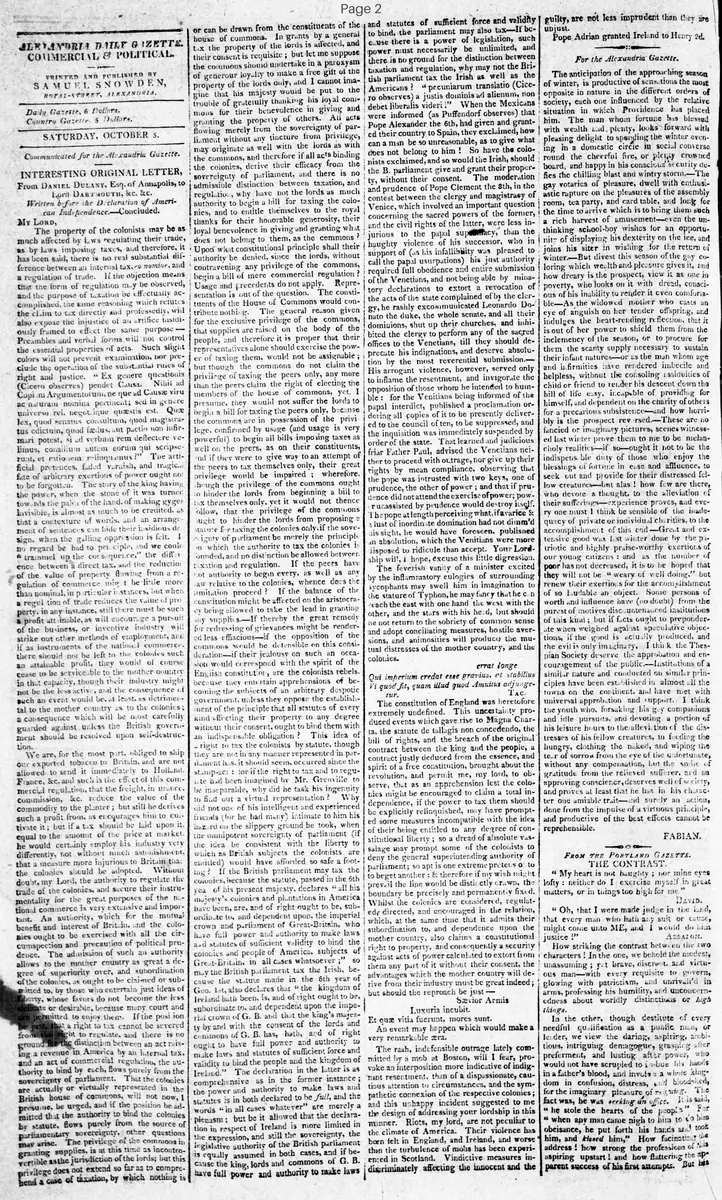
Alexandria Daily Gazette, Commercial & Political
Alexandria, Virginia
What is this article about?
A historical letter from Daniel Dulany to Lord Dartmouth argues against British taxation and trade regulations on American colonies without representation, drawing on constitutional principles, historical precedents, and comparisons to Ireland, warning of potential conflict.
Merged-components note: These components form a continuous 'INTERESTING ORIGINAL LETTER' from Daniel Dulany, split during parsing.
Clipping
OCR Quality
Full Text
INTERESTING ORIGINAL LETTER.
From Daniel Dulany, Esq. of Annapolis, to
Lord Dartmouth, &c. &c.
Written before the Declaration of American
Independence.-Concluded.
My Lord,
The property of the colonists may be as
much affected by laws regulating their trade,
as by laws imposing taxes, and therefore, it
has been said, there is no real substantial difference
between an internal tax, eo nomine, and
a regulation of trade. If the objection means
that the form of regulation may be observed,
and the purpose of taxation be effectually accomplished,
the same reasoning which refutes
the claim to tax directly and professedly, will
also expose the injustice of an artifice insidiously
framed to effect the same purpose.
Preambles and verbal forms will not control
the essential properties of acts. Such slight
colors will not prevent examination, nor preclude
the operation of the substantial rules of
right and justice. "Ex genere questionis
(Cicero observes) pendet Causa. Nihil ad
Copiam Argumentorum, neque ad Causæ vim
ac naturam nomina pertinent; sed in genere
universo rei, negotique quæstio est. Quæ
lex, quod senatus consultum, quod magistratus
edictum, quod foedus, aut pactio non infirmari
potest, si ad verbum rem deflectere velinmus,
consilium autem eorum qui scripserunt, et
rationem rei relinquamus?" The artificial
pretences, faded varnish, and tragical
fate of arbitrary exertions of power ought not
to be forgotten. The story of the king having
the power, when the stone of it was turned
towards the palm of the hand, of making Gyges
invisible, is almost as much to be credited, as
that a contexture of words, and an arrangement
of sentences can hide their insidious design,
when the galling oppression is felt. If
no regard be had to principle, and we could
"trammel up the consequence," the difference
between a direct tax, and the reduction
of the value of property flowing from a regulation
of commerce might be little more
than nominal, in particular instances, but when
a regulation of trade reduces the value of property,
in any instance, still there must be such
a profit attainable, as will encourage a pursuit
of the business, or inventive industry will
strike out other methods of employment, and
if as instruments of the national commerce.
there should not be left to the colonies such
an attainable profit, they would of course
cease to be serviceable to the mother country
in that capacity, though their industry might
not be the less active, and the consequence of
such an event would be, at least, as detrimental
to the mother country as to the colonies:
a consequence which will be most carefully
guarded against unless the British government
should be resolved upon self-destruction.
We are, for the most part, obliged to ship
our exported tobacco to Britain, and are not
allowed to send it immediately to Holland.
France, &c. and such is the effect of this commercial
regulation, that the freight, insurance.
commission, &c. reduce the value of the
commodity to the planter; but still he derives
such a profit from, as encourages him to cultivate
it; but if a tax should be laid upon it.
equal to the amount of the price at market.
he would certainly employ his industry very
differently, not without much astonishment.
that a measure more injurious to Britain than
the colonies should be adopted. Without
doubt, my Lord, the authority to regulate the
trade of the colonies, and secure their instrumentality
for the great purposes of the national
commerce is very extensive and important.
An authority, which for the mutual
benefit and interest of Britain, and the colonies
ought to be exercised with all the circumspection
and precaution of political prudence.
The admission of such an authority
allows to the mother country as great a degree
of superiority over, and subordination
of the colonies, as ought to be claimed or submitted
to, by those who entertain just ideas of
liberty, whose favors do not become the less
delicate or desirable, because many court and
core permitted to enjoy them. If the position
be just- that a right to tax cannot be severed
from the right to regulate, and there is no
ground of the distinction between an act raising
a revenue in America by an internal tax,
and an act of commercial regulation, the authority
to bind by each, flows purely from the
sovereignty of parliament. That the colonies
are actually or virtually represented in the
British house of commons, will not now, I
presume, be urged, and if the position be admitted
that the authority to bind the colonies
by statute, flows purely from the source of
parliamentary sovereignty, other questions
may arise. The privilege of the commons in
granting supplies, is at this time as incontrovertible
as the jurisdiction of the lords; but this
privilege does not extend so far as to comprehend
a case of taxation, by which nothing is
or can be drawn from the constituents of the
house of commons. In grants by a general
tax the property of the lords is affected, and
their consent is requisite; but let me suppose
the commons should undertake in a paroxysm
of generous loyalty to make a free gift of the
property of the lords only, and I cannot imagine
that his majesty would be put to the
trouble of gratefully thanking his loyal commons
for their benevolence in giving and
granting the property of others. All acts
of parliament without any tincture from privilege,
flowing merely from the sovereignty of parliament
may originate as well with the lords as with
the commons, and therefore if all acts binding
the colonies, derive their efficacy from the
sovereignty of parliament, and there is no
admissible distinction between taxation, and
regulation, why have not the lords as much
authority to begin a bill for taxing the colonies,
and to entitle themselves to the royal
thanks for their honorable generosity, their
loyal benevolence in giving and granting what
does not belong to them, as the commons?
Upon what constitutional principle shall their
authority be denied, since the lords, without
contravening any privilege of the commons,
begin a bill of mere commercial regulation?
Usage and precedents do not apply. Representation
is out of the question. The constituents
of the House of Commons would contribute
nothing. The general reason given
for the exclusive privilege of the commons,
that supplies are raised on the body of the
people, and therefore it is proper that their
representatives alone should exercise the power
of taxing them, would not be assignable;
but though the commons do not claim the
privilege of taxing the peers only, any more
than the peers claim the right of electing the
members of the house of commons, yet, I
presume, they would not suffer the lords to
begin a bill for taxing the peers only, because
the commons are in possession of the privilege,
confirmed by usage (and usage is very
powerful) to begin all bills imposing taxes as
well on the peers, as on their constituents,
and if they were to give way to an attempt of
the peers to tax themselves only, their great
privilege would be impaired; wherefore.
though the privilege of the commons ought
to hinder the lords from beginning a bill to
tax themselves only, yet it would not thence
follow, that the privilege of the commons
ought to hinder the lords from proposing a
statute for taxing the colonies only, if the sovereignty
of parliament be merely the principle
upon which the authority to tax the colonies is
founded, and no distinction be allowed between
taxation and regulation. If the peers have
not authority to begin every, as well as any
law relative to the colonies, whence does the
limitation proceed? If the balance of the
constitution might be affected on the aristocracy
being allowed to take the lead in granting
any supplies.-If thereby the great remedy
for redressing of grievances might be rendered
less efficacious-if the opposition of the
commons would be defensible on this consideration-if
their jealousy on such an occasion
would correspond with the spirit of the
English constitution, are the colonists rebels.
because they entertain apprehensions of becoming
the subjects of an arbitrary despotic
government, unless they oppose the establishment
of the principle that all statutes of every
kind affecting their property to any degree
without their consent, ought to bind them with
an indispensable obligation? This idea of
a right to tax the colonists by statute, though
they are not in any manner represented in parliament
has, it should seem, occurred since the
stamp-act: for if the right to tax and to regulate
had been imagined by Mr. Grenville to
be inseparable, why did he task his ingenuity
to find out a virtual representation? Why
did not one of his intelligent and experienced
friends (for he had many) intimate to him his
hazard on the slippery ground he took, when
the omnipotent sovereignty of parliament (if
the idea be consistent with the liberty to
which as British subjects the colonists are
entitled) would have afforded so safe a footing?
If the British parliament may tax the
colonies, because the statute, passed in the 6th
year of his present majesty, declares "all his
majesty's colonies and plantations in America
have been, are, and of right ought to be, subordinate
to, and dependent upon, the imperial
crown and parliament of Great-Britain, who
have full power and authority to make laws
and statutes of sufficient validity to bind the
colonies and people of America, subjects of
Great-Britain, in all cases whatsoever;" so
may the British parliament tax the Irish, because
the statute made in the 6th year of
Geo. I. also declares that "the kingdom of
Ireland hath been, is, and of right ought to be,
subordinate to, and dependent upon the imperial
crown of G. B. and that the king's majesty
by and with the consent of the lords and
commons of G. B. has, hath, and of right
ought to have full power and authority to
make laws and statutes of sufficient force and
validity to bind the people and the kingdom of
Ireland." The declaration in the latter is as
comprehensive as in the former instance;
the power and authority to make laws and
statutes is in both declared to be full, and the
words "in all cases whatever" are merely a
pleonasm: but be it allowed that the declaration
in respect of Ireland is more limited in
the expression, and still the sovereignty, the
legislative authority of the British parliament
is equally assumed in both cases, and if because
the king, lords and commons of G. B.
have full power and authority to make laws
and statutes of sufficient force and validity
to bind, the parliament may also tax--If because
there is a power of legislation, such
power must necessarily be unlimited, and
there is no ground for the distinction between
taxation and regulation, why may not the British
parliament tax the Irish as well as the
Americans? "pecuniarum transitio (Cicero
observes) a justis dominis ad alienum, non
debet liberalis videri!" When the Mexicans
were informed (as Pufendorf observes) that
Pope Alexander the 6th, had given and granted
their country to Spain, they exclaimed, how
can a man be so unreasonable, as to give what
does not belong to him! So have the colonists
exclaimed, and so would the Irish, should
the B. parliament give and grant their property,
without their consent. The moderation
and prudence of Pope Clement the 8th, in the
contest between the clergy and magistracy of
Venice, which involved an important question
concerning the sacred powers of the former
and the civil rights of the latter, were less injurious
to the papal supremacy, than the
haughty violence of his successor, who in
support of (as his infallibility was pleased to
call the papal usurpations) his just authority
required full obedience and entire submission
of the Venetians, and not being able by minatory
declarations to extort a revocation of
the acts of the state complained of by the clergy,
he rashly excommunicated Leonardo Donato
the duke, the whole senate, and all their
dominions, shut up their churches, and inhibited
the clergy to perform any of the sacred
offices to the Venetians, till they should deprecate
his indignations, and deserve absolution
by the most reverential submission.-
His arrogant violence, however, served only
to inflame the resentment, and invigorate the
opposition of those whom he intended to humble:
for the Venetians being informed of the
papal interdict, published a proclamation ordering
all copies of it to be presently delivered
to the council of ten, to be suppressed, and
the inquisition was immediately suspended by
order of the state. That learned and judicious
friar Father Paul, advised the Venetians neither
to proceed with outrage, nor give up their
rights by mean compliance, observing that
the pope was intrusted with two keys, one of
prudence, the other of power; and that if prudence
did not attend the exercise of power; power
unassisted by prudence would destroy itself.
The pope at length perceiving what, if avarice &
a lust of inordinate domination had not dimmed
his sight, he would have foreseen, published
an absolution, which the Venetians were more
disposed to ridicule than accept. Your Lordship
will, I hope, excuse this little digression.
The feverish vanity of a minister excited
by the inflammatory eulogies of surrounding
sycophants may swell him in imagination to
the stature of Typhon, he may fancy that he can
reach the east with one hand the west with the
other, and the stars with his head, but should
he not return to the sobriety of common sense
and adopt conciliating measures, hostile aversions,
and animosities will produce the mutual
distresses of the mother country, and the
colonies.
errat longe
Qui imperium credat esse gravius, et stabilius
Vi quod fit, quam illud quod Amicitia adjungetur.
Tac.
The constitution of England was heretofore
extremely undefined. This uncertainty produced
events which gave rise to Magna Charta,
the statute de tallagiis non concedendo, the
bill of rights, and the breach of the original
contract between the king and the people, a
contract justly deduced from the essence, and
spirit of a free constitution, brought about the
revolution, and permit me, my lord, to observe,
that as an apprehension lest the colonies
might be encouraged to claim a total independence,
if the power to tax them should
be explicitly relinquished, may have prompted
some measures incompatible with the idea
of their being entitled to any degree of constitutional
liberty; so a dread of absolute vassalage
may prompt some of the colonists to
denial the general superintending authority of
parliament; so apt is one extreme to beget another: & therefore if my wish might
prevail the line would be distinctly drawn, the
boundary be precisely and permanently fixed.
Whilst the colonies are considered, regulated;
directed, and encouraged in the relation,
which, at the same time that it admits their
subordination to, and dependence upon the
mother country, also claims a constitutional
right to property, and consequently a security
against acts of power calculated to extort from
them any part of it without their consent, the
advantages which the mother country will derive
from their industry must be great indeed;
but should the reproach be just-
Sævior Armis
Luxuria incubit
Et quæ vitia fuerunt, mores sunt.
An event may happen which would make a
very remarkable era.
The rash, indefensible outrage lately committed
by a mob at Boston, will I fear, provoke
an interposition more indicative of indignant
resentment, than of a dispassionate, cautious
attention to circumstances, and the sympathetic
connexion of the respective colonies;
and this unhappy incident suggested to me
the design of addressing your lordship in this
manner. Riots, my lord, are not peculiar to
the climate of America. Their violence has
been felt in England, and Ireland, and worse
than the turbulence of mobs has been experienced
in Scotland. Vindictive measures indiscriminately
affecting the innocent and the
guilty, are not less imprudent than they are
unjust.
Pope Adrian granted Ireland to Henry 2d.
What sub-type of article is it?
What themes does it cover?
What keywords are associated?
What entities or persons were involved?
Where did it happen?
Story Details
Key Persons
Location
American Colonies
Event Date
Before The Declaration Of American Independence
Story Details
Daniel Dulany argues in a letter to Lord Dartmouth that British Parliament's taxation and trade regulations on unrepresented colonies violate constitutional principles, equates them to direct taxation, compares to Ireland, and warns of conflict if not addressed prudently.