Thank you for visiting SNEWPapers!
Sign up free
The National Intelligencer And Washington Advertiser
Washington, District Of Columbia
What is this article about?
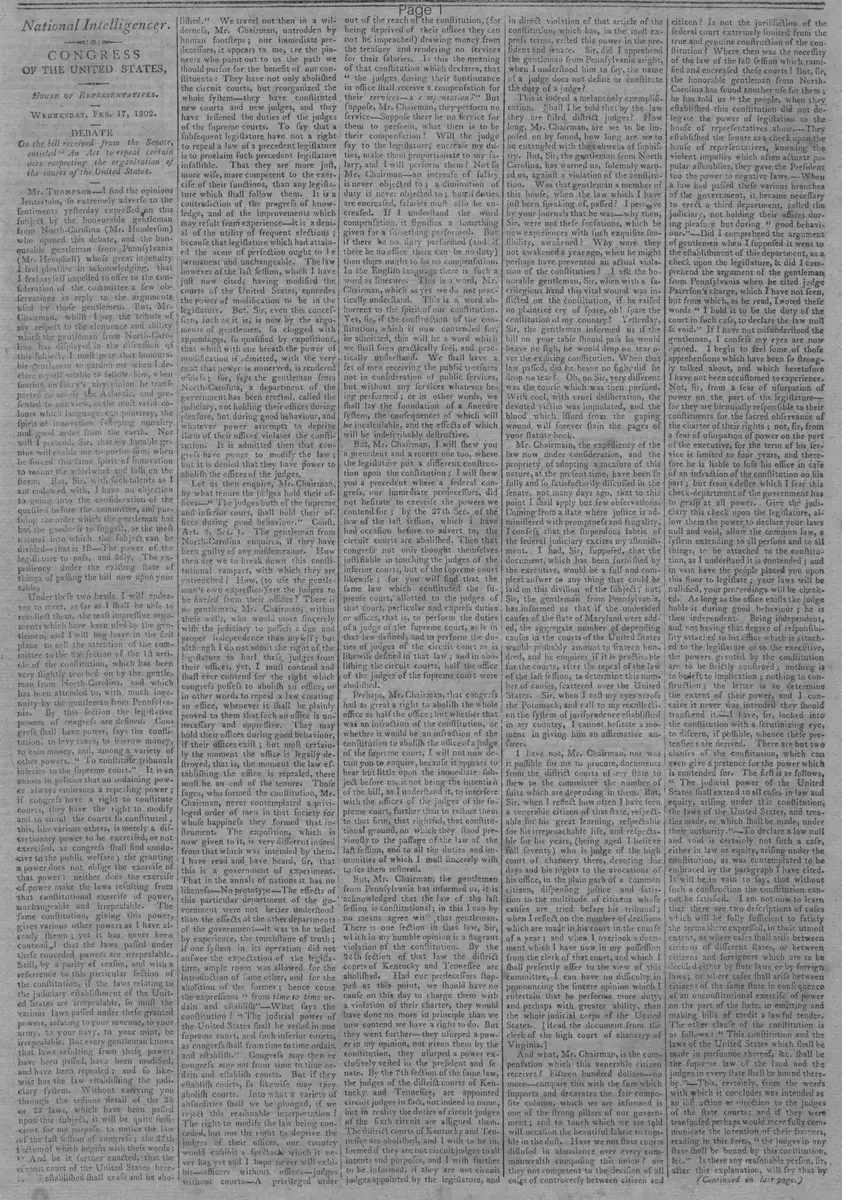
Transcript of U.S. House debate on February 17-18, 1802, over repealing the Judiciary Act of 1801, which reorganized federal courts. Speakers including Thompson, Bacon, Morris, Stanly, and Davis argue constitutionality, expediency, judicial independence, and costs, defending or opposing abolition of circuit courts.
Merged-components note: Merged across pages due to explicit continuation indicators ('Continued on next page', '[To be continued.]', '(Continued from first page.)') as this is a single coherent narrative report of the congressional debate on the judiciary bill. Label changed from 'domestic_news' for one component to 'story' as it is a full narrative article.
Clippings
1 of 4
OCR Quality
Full Text
CONGRESS OF THE UNITED STATES,
HOUSE OF REPRESENTATIVES.
WEDNESDAY, FEB. 17, 1802.
DEBATE
On the bill received from the Senate,
entitled "An Act to repeal certain
acts respecting the organisation of
the courts of the United States."
Mr. Thompson—I find the opinions
I entertain, so extremely adverse to the
sentiments yesterday expressed on this
subject by the honourable gentleman
from North-Carolina (Mr. Henderson)
who opened this debate, and the hon-
ourable gentleman from Pennsylvania
(Mr. Hemphill) whose great ingenuity
I feel pleasure in acknowledging, that
I feel myself impelled to offer to the con-
sideration of the committee a few ob-
servations in reply to the arguments
used by those gentlemen. But, Mr.
Chairman, whilst I pay the tribute of
my respect to the eloquence and ability
which the gentleman from North-Caro-
linah has displayed in the discussion of
this subject, I must pray that honoura-
ble gentleman to pardon me when I de-
clare myself unable to follow him, when
floating on fancy's airy pinion he trans-
ported us across the Atlantic, and pre-
sented to our view, in the most vivid co-
lours which language can portray, the
spirit of innovation weeping morality
and good order from the earth. Nor
will I pretend, Sir, that my humble ge-
nius will enable me to pursue him, when
he forced thus same Spirit of innovation
to mount the whirlwind and lash on the
storm. But, Sir, with such talents as I
am endowed with, I have no objection
to going into the consideration of the
question before the committee, and pur-
suing the order which the gentleman has
had the goodness to suggest, as the most
natural into which the subject can be
divided—that is 1st— The power of the
legislature to pass, and 2dly, The ex-
pediency under the existing state of
things of passing the bill now upon your
table.
Under these two heads I will endea-
vor to meet, as far as I shall be able to
recollect them in, the most impressive argu-
ments which have been used by the gen-
tlemen, and I will beg leave in the first
place to call the attention of the com-
mittee to the 8th section of the 1st arti-
cle of the constitution, which has been
very slightly touched on by the gentle-
man from North-Carolina, and which
has been attended to, with much inge-
nuity by the gentleman from Pennylva-
nia. By this section the legislative
powers of congress are defined. Congress
shall have power, says the consti-
tution, to levy taxes, to borrow money,
to coin money, and, among a variety of
other powers, "To constitute tribunals
inferior to the supreme court." It is an
axiom in politics that an ordaining pow-
er always embraces a repealing power;
if congress have a right to constitute
courts, they have the right to modify
and to annul the courts so constituted,
this, like various others, is merely a dis-
cretionary power to be exercised, or not
exercised, as congress shall find condu-
cive to the public welfare; the granting
a power does not oblige the exercise of
that power: neither does the exercise
of power make the laws resulting from
that constitutional exercise of power,
unchangeable and irrepealable. The
same constitution, giving this power,
gives various other powers as I have al-
ready shewn; yet it has never been
contended that the laws passed under
these conceded powers are irrepealable.
Still, by a parity of reason, and with a
reference to this particular section of
the constitution, if the laws relating to
the judiciary establishment of the Unit-
ed States are irrepealable, so must the
various laws passed under these granted
powers, relating to your revenue, to your
army, to your navy, to your mint, be
irrepealable. But every gentleman knows
that laws resulting from these powers
have been passed, have been modified,
and have been repealed; and so like-
wise has the law establishing the judi-
ciary system. Without carrying you
through the tedious detail of the 26
or 27 laws, which have been passed
upon this subject, it will be quite sufi-
cient for my purpose to notice the law
of the last session of congress; the 27th
section of which begins with these words:
"And be it further enacted, that the
circuit court of the United States here-
established shall cease and be abo-
lis hed." We travel not then in a wil-
derness, Mr. Chairman, untrodden by
human footsteps; our immediate pre-
decessors, it appears to me, are the pio-
neers who point out to us the path we
should pursue for the benefit of our con-
stituents: They have not only abolished
the circuit courts, but reorganized the
whole system—they have constituted
new courts and new judges, and they
have lessened the duties of the judges
of the supreme courts. To say that a
subsequent legislature have not a right
to repeal a law of a precedent legislature
is to proclaim such precedent legislature
infallible. That they are more just,
more wise, more competent to the exer-
cise of their functions, than any legisla-
ture which shall follow them. It is a
contradiction of the progress of know-
ledge, and of the improvements which
may result from experience—it is a deni-
al of the utility of frequent elections;
because that legislature which had attain-
ed the acme of perfection ought to be
permanent and unchangeable. The law
however of the last session, which I have
just now cited; having modified the
courts of the United States, concedes
the power of modification to be in the
legislature. But, Sir, even this conces-
sion, such as it is, is now by the argu-
ments of gentlemen, so clogged with
appendages, so qualified by expositions,
that whilst with one breath the power of
modification is admitted, with the very
next that power is unnerved, is rendered
useless; for, says the gentleman from
North-Carolina, a department of the
government has been created, called the
judiciary, not holding their offices during
pleasure, but during good behaviour, and
whatever power attempts to deprive
them of their offices violates the consti-
tution. It is admitted then that con-
gress have power to modify the law;
but it is denied that they have power to
abolish the offices of the judges.
Let us then enquire, Mr. Chairman,
by what tenure the judges hold their of-
fices? "The judges both of the supreme
and inferior court, shall hold their of-
fices during good behaviour." Const.
Art. 3, Sec. 1. The gentleman from
North-Carolina enquires, if they have
been guilty of any misdemeanor. How
then are we to break down this consti-
tutional rampart, with which they are
entrenched? How, (to use the gentle-
man's own expression) are the judges to
be hurled from their offices? There is
no gentleman, Mr. Chairman, within
these walls, who would more sincerely
wish the judiciary to possess a due and
proper independence than myself; but
although I do not admit the right of the
legislature to hurl these judges from
their offices, yet, I must contend and
shall ever contend for the right which
congress possesses to abolish an office, or
in other words to repeal a law creating
an office, whenever it shall be plainly
proved to them that such an office is un-
necessary and oppressive. They may
hold their offices during good behaviour.
if their offices exist; but most certain-
ly the moment the office is legally de-
stroyed, that is, the moment the law es-
tablishing the office is repealed, there
must be an end of the tenure. Those
sages, who formed the constitution, Mr.
Chairman, never contemplated a privi-
leged order of men in that society for
whose happiness they formed that in-
strument. The exposition, which is
now given to it, is very different indeed
from that which was intended by them.
I have read and have heard, sir, that
this is a government of experiment.
That in the annals of nations it has no
likeness—No prototype—The effects of
this particular department of the go-
vernment were not better understood
than the effects of the other departments
of the government—it was to be tested
by experience, the touchstone of truth;
if one system in its operation did not
answer the expectation of the legisla-
ture, ample room was allowed for the
introduction of some other, and for the
abolition of the former; hence come
the expressions "from time to time or-
dain and establish"—What says the
constitution? "The judicial power of
the United States shall be vested in one
supreme court, and such inferior courts,
as congress shall from time to time ordain
and establish." Congress may then or
congress may not from time to time or-
dain and establish courts. But if they
establish courts, so likewise may they
abolish courts. Into what a variety of
absurdities shall we be plunged, if we
reject this reasonable interpretation?
The right to modify the law being con-
ceded, but not the right to deprive the
judges of their offices, our country
would exhibit a spectacle which it ne-
ver has yet and I hope never will exhi-
bit—officers without offices—judges
without courts—A privileged order
out of the reach of the constitution, (for
being deprived of their offices they can
not be impeached) drawing money from
the treasury and rendering no services
for their salaries. Is this the meaning
of that constitution which declares, that
"the judges during their Continuance
in office shall receive a compensation for
their services—a compensation?" But
suppose, Mr. Chairman, they perform no
service—Suppose there be no service for
them to perform, what then is to be
their compensation? Will the judge
say to the legislature, increase my du-
ties, make them proportionate to my sa-
lary, and I will perform them? Not so
Mr. Chairman—an increase of salary
is never objected to; a diminution of
duty is never objected to: but if duties
are increased, salaries must also be in-
creased. If I understand the word
compensation, it signifies a something
given for a something performed. But
if there be no duty performed (and if
there be no office there can be no duty)
then there ought to be no compensation.
In the English language there is such a
word as sinecure. This is a word, Mr.
Chairman, which as yet we do not prac-
tically understand. This is a word ab-
horrent to the spirit of our constitution.
Yet, sir, if the construction of the con-
stitution, which is now contended for.
be admitted, this will be a word which
we shall soon practically feel, and prac-
tically understand. We shall have a
set of men receiving the public treasures
not in consideration of public services,
but without any services whatever be-
ing performed; or in other words, we
shall lay the foundation of a sinecure
system, the consequences of which will
be incalculable, and the effects of which
will be indescribably destructive.
But, Mr. Chairman, I will shew you
a precedent and a recent one too, where
the legislature put a different construc-
tion upon the constitution; I will shew
you a precedent where a federal con-
gress, our immediate predecessors, did
not hesitate to exercise the powers we
contend for; by the 27th Sec. of the
law of the last session, which I have
had occasion before to advert to, the
circuit courts are abolished. Then that
congress not only thought themselves
justifiable in touching the judges of the
inferior courts, but of the supreme court
likewise; for you will find that the
same law which constituted the su-
preme court, allotted to the judges of
that court, particular and express duties
or offices, that is, to perform the duties
of a judge of the supreme court, as is in
that law defined, and to perform the du-
ties of judges of the circuit court as is
likewise defined in that law: and in abo-
lishing the circuit courts, half the office
of the judges of the supreme court were
abolished.
Perhaps, Mr. Chairman, that congress
had as great a right to abolish the whole
office as half the office; but whether that
was an infraction of the constitution, or
whether it would be an infraction of the
constitution to abolish the office of a judge
of the supreme court, I will not now de-
tain you to enquire, because it appears to
bear but little upon the immediate sub-
ject before us, it not being the intention
of the bill, as I understand it, to interfere
with the offices of the judges of the su-
preme court, further than to restore them
to that firm, that rightful, that constitu-
tional ground, on which they stood pre-
viously to the passage of the law of the
last session, and to all the duties and im-
munities of which I most sincerely wish
to see them restored.
But, Mr. Chairman, the gentleman
from Pennsylvania has informed us, it is
acknowledged that the law of the last
session is constitutional; in this I can by
no means agree with that gentleman.
There is one section in that law, Sir,
which in my humble opinion is a flagrant
violation of the constitution. By the
44th section of that law the district
courts of Kentucky and Tennessee are
abolished. Had our predecessors stop-
ped at this point, we should have no
cause on this day to charge them with
a violation of their charter, they would
have done no more in principle than we
now contend we have a right to do. But
they went further—they usurped a pow-
er in my opinion, not given them by the
constitution, they usurped a power ex-
clusively vested in the president and se-
nate. By the 7th section of the same law,
the judges of the district courts of Ken-
tucky and Ten-
nessee, are appointed
circuit judges in fact, not indeed in name,
but in reality the duties of circuit judges
of the sixth circuit are assigned them.
The district courts of Kentucky and Ten-
nessee are abolished, and I wish to be in-
formed if they are not circuit judges to all
intents and purposes, and I wish further
to be informed, if they are not circuit
judges appointed by the legislature, and
in direct violation of that article of the
constitution, which has, in the most ex-
press terms, vested this power in the pre-
sident and senate. Sir, did I apprehend
the gentleman from Pennsylvania aright,
when I understood him to say, the name
of a judge does not define or constitute
the duty of a judge?
This is indeed a melancholy exemplifi-
cation. Shall I be told that by the law
they are styled district judges? How
long, Mr. Chairman, are we to be im-
posed on by sound, how long are we to
be entangled with the cobwebs of sophis-
try. But, Sir, the gentleman from North
Carolina, has warned us, solemnly warn-
ed us, against a violation of the constitu-
tion. Was that gentleman a member of
this house, when the law which I have
just been speaking of, passed? I perceive
by your journals that he was—why then,
Sir, were not these sensations, which he
now experiences with such exquisite sen-
sibility, awakened? Why were they
not awakened a year ago, when he might
perhaps have prevented an actual viola-
tion of the constitution? I ask the ho-
nourable gentleman, Sir, when with a sa-
crilegious hand this vital wound was in-
flicted on the constitution, if he raised
no plaintive cry of spare, oh! spare the
constitution of my country? Yesterday.
Sir, the gentleman informed us if the
bill on your table should pass he would
heave no sigh, he would drop no tear o-
ver the expiring constitution. When that
law passed, did he heave no sigh,—did he
drop no tear? Oh, no Sir, very different
was the course which was then pursued.
With cool, with cruel deliberation, the
devoted victim was immolated, and the
blood which issued from the gaping
wound will forever stain the pages of
your statute book.
Mr. Chairman, the expediency of the
law now under consideration, and the
propriety of adopting a measure of this
nature, at the present time, have been so
fully and so satisfactorily discussed in the
senate, not many days ago, that to this
point I shall apply but few observations.
Coming from a state where justice is ad-
ministered with promptness and frugality,
I confess that the stupendous fabric of
the federal judiciary excites my astonish-
ment. I had, Sir, supposed, that the
document, which has been furnished by
the executive, would be a full and com-
plete answer to any thing that could be
said on this division of the subject; but,
Sir, the gentleman from Pennsylvania,
has informed us that if the undecided
causes of the state of Maryland were add-
ed, the aggregate number of depending
causes in the courts of the United States
would probably amount to sixteen hun-
dred, and he enquires if it is practicable
for the courts, after the repeal of the law
of the last session, to determine this num-
ber of causes, scattered over the United
States. Sir, when I cast my eyes across
the Potomac, and call to my recollecti-
on the system of jurisprudence established
in my country, I cannot hesitate a mo-
ment in giving him an affirmative an-
swer.
I have not, Mr. Chairman, nor was
it possible for me to procure, documents
from the district courts of my state to
shew to the committee the number of
suits which are depending in them. But.
Sir, when I reflect how often I have seen
a venerable citizen of that state, respect-
able for his great learning, respectable
for his irreproachable life, and respecta-
ble for his years, (being aged I believe
full seventy) who is judge of the high
court of chancery there, devoting his
days and his nights to the avocations of
his office, in the plain garb of a common
citizen, dispensing justice and satis-
faction to the multitude of citizens whose
causes are tried before his tribunal:
when I reflect on the number of decisions
which are made in his court in the course
of a year; and when I overlook a docu-
ment which I have now in my possession
from the clerk of that court, and which I
shall presently offer to the view of this
committee, I can have no difficulty in
pronouncing the sincere opinion which I
entertain that he performs more duty,
and perhaps with greater ability, than
the whole judicial corps of the United
States. [Read the document from the
clerk of the high court of chancery of
Virginia.]
And what, Mr. Chairman, is the com-
pensation which this venerable citizen
receives? Fifteen hundred dollars—no
more—compare this with the sum which
supports and decorates the fair compo-
site column, which we are informed is
one of the strong pillars of our govern-
ment: and to touch which we are told
will occasion the beautiful fabric to tum-
ble in the dust. Have we not state courts
diffused in abundance over every com-
monwealth composing this union? are
they not competent to the decision of all
cases of controversy between citizen and
citizen? Is not the jurisdiction of the
federal court extremely limited from the
true and genuine construction of the con-
stitution? Where then was the necessity
of the law of the last session which rami-
fied and increased these courts? But, sir.
the honorable gentleman from North-
Carolina has found another use for them:
he has told us "the people, when they
established this constitution did not de-
legate the power of legislation to the
house of representatives alone.—They
established the senate as a check upon the
house of representatives, knowing the
violent impulses which often actuate po-
pular assemblies, they gave the President
too the power to negative laws.—When
a law had passed these various branches
of the government, it became necessary
to erect a third department, called the
judiciary, not holding their offices dur-
ing pleasure but during "good behavi-
our."—Did I comprehend the argument
of gentlemen when I supposed it went to
the establishment of this department, as a
check upon the legislature, & did I com-
prehend the argument of the gentleman
from Pennsylvania when he cited judge
Paterson's charge, which I have not seen,
but from which, as he read, I noted these
words "I hold it to be the duty of the
court in such case, to declare the law null
& void." If I have not misunderstood the
gentleman, I confess my eyes are now
opened. I begin to feel some of those
apprehensions which have been so strong-
ly talked about, and which heretofore
I have not been accustomed to experience.
Not, sir, from a fear of usurpation of
power on the part of the legislature—
for they are biennially responsible to their
constituents for the sacred observance of
the charter of their rights; not, sir, from
a fear of usurpation of power on the part
of the executive, for the term of his ser-
vice is limited to four years, and there-
fore he is liable to lose his office in case
of an infraction of the constitution on his
part; but from a desire which I fear this
check-department of the government has
to grasp at all power. Give the judi-
ciary this check upon the legislature, al-
low them the power to declare your laws
null and void, allow the common law, a
system extending to all persons and to all
things, to be attached to the constitu-
tion, as I understand it is contended; and
in vain have the people placed you upon
this floor to legislate; your laws will be
nullified, your proceedings will be check-
ed. As long as the office exists the judge
holds it during good behaviour; he is
then independent. Being independent,
and not having that degree of responsibility attached to his office which is attach-
ed to the legislature or to the executive,
the powers granted by the constitution
are to be strictly construed; nothing is
to be set to implication; nothing to con-
struction; the letter is to determine
the extent of their power, and I con-
ceive it never was intended they should
transcend it. I have, sir, looked into
the constitution with a scrutinizing eye,
to discern, if possible, whence these pre-
tensions are derived. There are but two
clauses of the constitution, which can
even give a pretence for the power which
is contended for. The first is as follows,
"The judicial power of the United
States shall extend to all cases in law and
equity, arising under this constitution,
the laws of the United States, and trea-
ties made, or which shall be made under
their authority." To declare a law null
and void is certainly not such a case.
either in law or equity, arising under the
constitution, as was contemplated to be
embraced by the paragraph I have cited.
It will be in vain to say, that without
such a construction the constitution can-
not be satisfied. I am not now to learn
that there are two descriptions of cases
which will be fully sufficient to satisfy
the terms there expressed, in their utmost
extent, as where cases shall arise between
citizens of different states, or between
citizens and foreigners which are to be
decided either by state laws or by foreign
laws; or where cases shall arise between
citizens of the same state in consequence
of an unconstitutional exercise of power
on the part of the state. in emitting and
making bills of credit a lawful tender.
The other clause of the constitution is
as follows: "This constitution and the
laws of the United States which shall be
made in pursuance thereof, &c. shall be
the supreme law of the land and the
judges in every state shall be bound there-
by." This, certainly, from the words
with which it concludes was intended as
an instruction or direction to the judges
of the state courts; and if they were
transposed perhaps would more fully com-
municate the intention of their framers,
reading in this form, "the judges in any
state shall be bound by this constitution,
&c." Is there any reasonable person, sir,
after this explanation, will say that by
(Continued on next page.)
(Continued from previous)
...rate disadvantage. We doubtless have the power of repealing. The intention in giving powers to Congress is, they shall have power to 'provide for the common defence and general welfare of the United States.' In another place it says, 'Congress shall have power to make all laws which shall be necessary and proper to carry into effect the foregoing powers.' These powers are to provide for the general welfare. Now we think, to provide for the general welfare, we ought to make a law declaring the late judiciary law repealed. Again it has often been said, that our government depends very much on the opinion of the people. This government is divided into three distinct departments. A late ruling party finding their power about to be wrested from their hands by the people who elect the representatives—and the states who elect the senators, in the last moments of power pass a law by which they completely take hold of one entire branch of our government, and fill it with men whose politics are at war with the people—there a majority does not rule the minority in defiance of the majority hold one branch. I ask, if this is compatible with general opinion, or the settled principles of our government. The honorable member from Pennsylvania, Mr. Hemphill, in his argument, puts me in mind of the boy who fights his shadow; he raised arguments for us and then combated them—the man who runs by himself is sure to win, so the gentleman was sure to triumph, because he took for us the weakest ground, and for himself the strongest. Those who read his speech will suppose the arguments he combated had been advanced on this floor, but the fact is otherwise, he was the third who spoke, and all who heard know that the ground he took and called ours, was not occupied by any of us. Is this a fair and candid manner of acting? He tells us that besides the judiciary laws there are other laws that Congress cannot repeal. That a state is admitted into the Union by law, and that there is no power can repeal that law—that a man is admitted to citizenship by law, and no repeal of that law can affect the citizen. The reason is obvious. If a law admits a state into the Union, and the State comes in according to the provisions of the law—the law having had its effect, having discharged its functions, it becomes dead and cannot be repealed. But if Congress should now say the N. W. Territory should, in the year 1806, be admitted into the Union as a state, at any time before the law takes effect, the repeal is in the power of Congress—the same may be said as to citizenship. I found my opinion of the expediency of repealing the judiciary law, on another reason in addition to that of the courts being unnecessary, I mean the power they declare they have in the language of Judge Paterson to 'declare a law null and void.' Never can I subscribe to that opinion. Never can I believe the judiciary paramount to both branches of the legislature—it if is, I have yet to learn it—there is an end to legislation—a knave or a fool can make void your best and most wholesome laws. In the present state of things how will it affect us. The minority possessing one department of government, completely frustrates the views of the other two, and governs the nation against the will of the people and the legislative and executive power. I am willing to admit the judiciary to be co-ordinate with the legislature in this respect, to wit—that judges thinking a law unconstitutional are not bound to execute it; but not to declare it null and void. That power rests alone with the legislature. But we are told this judiciary is necessary to check this house and the senate, and to protect the people against their worst enemies. This is saying to the people you are incapable of governing yourselves—your representatives are incapable of doing it—'tis in the judiciary alone you find a safe deposit for your liberties; and saying all that the judiciary is the vitals of the nation, wherein all power, all safety dwells—that the legislature is subordinate thereto, and a mere nominal thing, a shadow without substance—its acts perfectly within the control of the judiciary. I tremble at such ideas. The sooner we put men out of power who we find determined to act in this manner the better; by doing so we preserve the power of the legislature, and save our nation from the ravages of an uncontrolled judiciary.
Mr. BACON.—In this bill two important enquiries are involved.
I. Is it consistent with the constitution?
2. Is it expedient to repeal those acts?
Before I proceed to speak directly to either of those questions, I must take the liberty to advert to an important observation made yesterday, by the gentleman from Pennsylvania, (Mr. Hemphill.) In his very decent and ingenious speech with which he then favored the committee, he gave an explanation of the terms Office, and Court. Indeed very much depends, as I conceive, on fixing accurate ideas to the particular terms. Until this is done, that part of the constitution which applies to the present subject, must remain in a great measure unintelligible, to me at least. Fixing the true meaning of these terms will I conceive, go far towards solving any doubt that may exist relative to the constitutionality the present bill. This idea, there is reason to believe, did not escape the discerning mind (that worthy gentleman, when he observed—'Offices consist in certain power, jurisdiction, and authority, conferred on a person, requiring certain duties. The Court, the name of the institution wherein that office is to be exercised. The name of the court may be changed, should also the place where it is holden, and the office to be exercised in another place.' Those were the words which he used.
I fully accede to his explanation of the term Offices, but very much doubt the correctness of his explanation of the terms Court, as it is used in the constitution. And I am not certain but that the question of Constitutionality will very much depend upon the idea that is affixed to this identical term. I believe the term Court, as it is used in that instrument, means something more than a mere name—Although I will not undertake to give an authoritative and perfectly accurate explanation of the term, yet I may venture to say, that, as used in the constitution, and in the law proposed to be repealed, it seems to convey the idea of an institution ordained and established for the legal administration of justice. Those things termed courts in the Constitution, are vested with power, and are to exercise jurisdiction, original and appellate. These are attributes which, to my mind, indicate something more than what is merely nominal. I have considered Courts as being composed of persons vested with power jurisdiction and authority, and of whom certain duties are required, that is, as being composed, or consisting of officers, particularly of judges. And I am apprehensive that it would be not less difficult to conceive of a court, in the meaning of the Constitution, as existing without officers, than it would to conceive of a legislature without legislators, or of an officer without an office. If this is not a true, and the only explanation of the term Court, as used in the constitution, and in the act referred to in the present bill, I shall wish to hear it otherwise explained. If the explanation is just, I believe it will be found in the sequel of debate to go far towards a determination of the question relative to the constitutionality of the bill now under consideration.
I will now, Sir, proceed to speak directly to the subject of the bill: and will consider in the first place, the constitutionality of repealing the acts therein referred to.
If it should be found to be unconstitutional to repeal those acts, no consideration of expediency ought to have the least weight. As to the mere unconstitutionality of the measure, I am apprehensive this will be found not to be a question of vast intricacy and inexplicable doubt, unless we are disposed to make it such.
There are some things relating to this question, and which may tend in some measure to illustrate the subject about which there can be no reasonable doubt. It will probably be admitted that the constitution does not require the legislature to furnish business sufficient to employ the time and talents of all the judges, of all the courts of the United States, let their number be ever so great. It will probably be also admitted that the legislature are not restricted by the constitution from amending and altering the laws from time to time, as may, on the one hand, tend to diminish, and on the other, to increase the business to be transacted in our judiciary courts respectively, nor they restricted from transferring business from one judiciary court to another. And if the legislature may, by way of transfer, or otherwise, diminish, or withdraw one part of the business from a judiciary court, they may on the same general principles withdraw another, unless specially restricted by the constitution. Consequently, they may, if they see fit, withdraw the whole in the same way.
All this, it is believed, will not only be readily admitted; but that precedents, or the actual exercise of the power of the legislature which is here mentioned, are abundantly furnished in the act itself which it is proposed to repeal. And a better authority, in this particular case, cannot possibly exist than what is furnished by this act. It is an authority which, as it applies to this particular case, is not inferior to the constitution itself. It is an authority which can neither be explained away, nor misunderstood. It may with propriety be said, that in this particular case, it is an authority instar omnium—it is indeed equal to all others; because, if I am not mistaken, it absolutely and unequivocally determines the question relative to the constitutionality of the present bill. I should be willing for myself, to rest the issue entirely on this ground.—This is the principal ground that I shall take.
By sec. 10, of this law, the powers in general which, by the late law, were vested in the former circuit courts, are transferred from those courts to the circuit courts which are established by the present law.
By sec. 20, it is expressly provided that 'All actions, suits, process, pleadings, and other proceedings, of what nature or kind soever, depending or existing in any of the present circuit courts of the United States, or in any of the present district courts of the United States, acting as circuit courts, shall be, and hereby are, continued over to those circuit courts established by this act.'
By sec. 10, it is provided that the circuit courts established by this act shall have cognizance of a great number of causes which were not in like manner cognizable before the former circuit courts, viz. 'of all actions cognizable by the judicial authority of the United States, where the matter in dispute is between four and five hundred dollars.'
By the 24th sec. it is 'enacted that the District Courts of the United States, in and for the districts of Tennessee and Kentucky' in particular, 'shall be, and hereby are abolished.'
By the 27th sec. 'it is further enacted,' generally, 'That the circuit courts of the United States, heretofore established, shall cease and be abolished.'
Here we have a precedent for abolishing by a single legislative act, all the judicial courts of a certain description throughout the United States.
In short, Sir, the present circuit courts are not only vested with powers different from the former circuit courts, but they are composed of different men; and that, while the former judges of these courts are still living—during their good behaviour, and without their resignation, impeachment, or conviction.
All former circuit courts are, by the law in question, ipso facto, abolished. If the circuit courts established by the law in question are constitutional courts, as I take for granted they are, then the former circuit courts do not now exist. If, as some gentlemen contend, it is a violation of the constitution for the legislature to abolish a judicial court, the law itself which it is in contemplation to repeal, must be an unconstitutional law. And I should not suppose it to be a violation of the constitution or the legislature to repeal an unconstitutional law.
The act in question, by which the late circuit courts were abolished and the present circuit courts established, either is, or is not, a constitutional act. If it is a constitutional act, then it was not a violation of the Constitution for the last Congress to pass it. And if it was not a violation of the constitution for the last Congress, to pass the act by which they abolished the circuit courts which then were, & they established those which now are; it cannot be any more a violation of the constitution for the present Congress, by repealing that act, to abolish the circuit courts which now are, and to establish new ones.—If on the contrary, the act in question is an unconstitutional act, I should suppose, that of itself was a sufficient reason for repealing it, and that the constitution, instead of forbidding, demands a repeal of it. So that, whether it is, or is not, a constitutional act, the result must be the same—to repeal it cannot be a violation of the constitution.
I am not disposed to play upon terms, nor would I knowingly descend to a train of mere metaphysical quibbling on this serious and important subject—I may be mistaken—But I feel as if the argument was not only rational but absolutely conclusive. If it is fallacious, let it be fairly met, and the fallacy will easily be detected. The sentiments which I now express, are not the cursory thoughts of a moment, which have occurred on the spur of the occasion. Whether right or wrong, they are the result of serious and mature reflection. If they are not sound, if they are not salutary, if they are not predicated on those principles of the constitution which are to be considered as immovable by any authority short of that by which they were first established, let them be rejected with all that abhorrence which the tongue of man can express, or the human mind conceive. For, I readily admit, that the effects resulting from a violation of the constitution by the legislature, are not less but, if possible, infinitely more to be dreaded than what any gentleman has described.
Questions of this nature, Sir, are not to be determined by mere popular declamation, by a flood of metaphors, nor yet, by the least attractive force of opprobrious terms. It is ardently to be desired that nothing of this kind may ever be suffered to tarnish the deliberations of this house. The subject before us is such as merits the most impartial, candid, firm, and liberal attention. And such, I hope, it will receive.—Admitting that the law in question was passed 'in a gust of passion'—'at a midnight hour' and even with views hostile to the equal rights of a free people; still it ought to be met, if met at all, on principle directly the reverse of all these. Otherwise the remedy applied may prove to be infinitely worse than the disorder itself of which we complain.
It ought, I think, to be agreed by all, that the judges both of the supreme, and of 'such inferior courts, as Congress may from time to time ordain, and establish,' shall hold their offices during good behaviour; because this is expressly provided for in the constitution. But, Sir, I conceive, that to abolish an office and to remove an officer from an office while that office exists, are in the meaning of the constitution, as well as in common speech, distinct acts; however one of those acts may affect the other. To justify a distinction of this kind, I need only to refer again to the act proposed to be repealed. Is that an act for removing from office a number of judges, who by the constitution, are entitled to hold their offices during good behaviour? If it is, I will agree with gentlemen on the other side, that it is an unconstitutional act: and I shall expect, that for this reason alone, if there was no other, they will agree with me, that it ought to be repealed. And not only so, but that it is the indispensable duty of the legislature to repeal it, and to restore those courts which have been thus wantonly abolished, together with the judges who have been thus unconstitutionally removed from office. But even without the aid of the act in question, I believe the distinction between removing an officer and abolishing an office, will be found to be a real and obvious one.
Congress are undoubtedly vested with constitutional power to repeal the act for laying and collecting internal taxes; and in doing this, to abolish all the offices, that have been instituted for that purpose. But it will not be pretended, that congress have power, by a legislative act, either to appoint to, or remove from office, a single officer in that department. A power then to abolish an office, and a power to remove an officer from office, are in their nature distinct powers. Admitting therefore, as I readily do, that congress are not, in the meaning of the constitution, vested with power to remove an officer from office (whether judiciary or executive it matters not), it will by no means follow, that they have not power to repeal the law instituting that office. Should a resolution be brought forward for repealing the law laying duties of excise on stills &c.; would any gentleman who might be opposed to such a resolution, venture to ground his opposition on the unconstitutionality of the measure, from this consideration, that it would in effect, abolish three-fourths of the offices in the revenue department of the government, and in this indirect way, deprive a host of officers of the offices which the constitution has placed as much without the power and control of the legislature, as it has those of the judiciary department? Sir, I believe not.
The argument however would be neither more nor less conclusive in one case than in the other. It is urged within doors and without, that to repeal the law, would be no other than an indirect way of removing judicial officers from office, and of destroying that legal tenure by which they hold their offices.
This argument, if such it may be called, and if I understand it, takes for granted the principal, if not the only matter in dispute, viz. That every judicial officer has such a tenure in his office, as cuts the office itself entirely beyond the power and influence of the legislature; so that when the legislature have, by their own legislative act, once instituted such an office, they can never afterwards abolish, or touch that office without violating the constitution under which they act. This, Sir, is a doctrine abhorrent from the principles of all free governments—it is abhorrent from what has been demonstrated, as I conceive to be consonant to the principles of the constitution of the United States—it is abhorrent from the even and uniform practice of the legislature, ever since our government was established—it is more especially abhorrent from the express provisions of the act itself, the repeal of which is now in contemplation.
But, Sir, permit me to ask, what would be the consequence of adopting the sentiment of our opponents? Would not this be a cunning and indirect way of tying up the hands of the legislature, and of restricting that body in the exercise of those powers which the constitution has vested them with for the satisfaction and welfare of the community at large? Would it not be a cunning and indirect way of fixing an immovable and intolerable burden on the honest and industrious citizens of the United States, for the private emolument of court favorites, and idle sycophants, and useless ceremonies? And would conduct like this in representatives evince a becoming and sacred regard to the spirit of the constitution, and to the trust reposed in them by their constituents? Or, would it not rather furnish a melancholy instance of the betrayal of both? Let candor, let common sense, let solid learning, let sound policy decide these solemn queries.
A decision grounded on all, or on any one of these principles, is such as we wish to abide. And I mean not to suggest a doubt but, that our opponents are equally disposed to abide the same impartial test. By what I have now said, I mean no more than to express that clear conviction which exists in my own mind, that the principle for which our opponents contend has a natural and direct tendency to such a state of things as I have mentioned; however pure their views may be who contend for it.
Whether the judges will be entitled to retain their offices and to receive their salaries, provided the act should be repealed, is, as I conceive, a question entirely distinct from that which is now before the committee. It may perhaps hereafter be made a question, either before the legislature, or before a judicial court. Whenever this shall happen, then will be the proper time to consider it. If from a fair and candid examination of the subject, it appears, as I think it does, that there is nothing in the constitution which, in the least degree, militates against the repeal of the acts, then the only question which remains to be considered is, whether it is expedient to repeal them?
With respect to this question, I will not go into a minute discussion of it. I will only observe in general, that from the documents which we are furnished with, and from the present situation and state of the nation in general, it does not appear necessary to retain all the courts which by that law have been constituted. It does not appear but that, to say the least, the business of these courts may be transacted equally well by a less number. And as it is in itself, not only imprudent, but unjust, to lay unnecessary burdens on our constituents for the private advantage of individuals—as this would have a natural and most direct tendency to weaken the government by destroying the confidence of the citizens in it, and alienating their affections from it, I am for myself, fully convinced, that these laws ought to be repealed, and, with my present views of the subject, I shall give my vote accordingly; although I confess I am not entirely satisfied with the act proposed to be revived. And I will here take occasion to say, I should for myself, wish to add two or three more judges to the supreme court, and to strike out of that act the sum of five-hundred dollars, and insert a much larger sum. Perhaps something like this may take place, either as an amendment to the present bill, or at some future day. If such an amendment might be obtained, I should be much better pleased with it than I am at present.
Mr. T. Morris—I did flatter myself when the honourable gentleman from Virginia (Mr. Thompson) detailed to this committee the mode of administering justice in the state which he represents, that he would also have added, what the decisions and opinions of the courts of that state have been, on questions analogous to those which we are called upon to decide. But, Sir, since that honourable gentleman has thought proper to refer to his own state as far only as arguments drawn from thence could answer his purpose, and has not communicated information which might have been adduced from the same quarter and which more applicable to the present question, I hope that it will not be deemed presumptuous in me to do it. There is not, Sir, a state in the union where the independence of the judiciary has been more highly valued than in Virginia. There is no part of America where a commission during good behaviour has been construed to confer a more independent official tenure on a judge, than in the state to which I have alluded. The constitution, Sir, which my friends and myself are now contending for, is more fully and completely established by the opinions and decisions of the Virginia judges than it is by those of any other part of the union. And, Sir, if I am entitled to form an opinion from the evidence I hold in my hand of the decisions which have at different times been made by the judges of that state, if I am permitted to draw any conclusion from the universal acquiescence which they have met with from its citizens, I must believe, that if a bill similar to the one before us was introduced into the Virginia assembly that so far from meeting with the countenance at that body it would be hooted out of it with indignation. Having made these observations I must entreat the patience of the committee, while I read the opinions to which I have alluded.
[Here Mr. Randolph asked from what book these opinions were quoted.
Mr. Morris replied from a 'Friend to the Constitution,' and added, that he believed that they were published with a view to this question, that they had been the subject of much examination and conversation, but that he had never heard their authenticity doubted.
Mr. Morris then read the following extracts:
'The constitution of Virginia declares, that 'both houses of assembly shall, by joint ballot, appoint judges of the supreme court of appeals, and general court, judges in chancery, judges of admiralty, secretary and attorney-general, to be commissioned by the governor, and continue in office during good behaviour.'
The Supreme court of appeals in Virginia consisted of the judges of the court of chancery, general court, and court of admiralty, who were by law declared to constitute a court of appeals. The legislature found the system inconvenient and determined to change it.
'In 1787, this subject was taken up by the legislature; a system of circuit courts was adopted, and it was enacted that the judges of the court of appeals should perform the duty of circuit judges. This law the judges refused to execute as unconstitutional, and agreed unanimously, Edmund Pendleton, George Wythe, John Blair, Paul Carrington, Peter Lyons, William Fleming, Henry Tazewell, Richard Cary, James Henry and John Tyler being present, on a remonstrance, from which will be extracted such parts as are deemed applicable to the present enquiry.'
'In deciding the act the judges declare that the constitution and the act are in opposition and cannot exist together; and that the former must control the operation of the latter.'
'The propriety and necessity of the independence of the judges is evident in reason and the nature of the office; since they are to decide between government and the people, as well as between contending citizens; and if they be dependent on either, corrupt influence may be apprehended, sacrificing the innocent to popular prejudice, and subjecting the poor to oppression and persecution by the rich. And this applies more forcibly to exclude dependence on the legislature, a branch of whom in cases of impeachment is itself a party.'
'The people, continues the court of appeals, have in their form of government 'declared that the judges should hold their offices during good behaviour. Their dependence would have been rendered complete by fixing the quantum of their salaries.'
'On a subsequent occasion a contest not very different in principle arose in the same state between the legislative and judicial departments, in which the point in controversy was again yielded by the legislature.
'In 1794, it was enacted that the judges of the district courts, who are also judges of the general court, should so far exercise chancery jurisdiction as to grant injunctions to their own judgments, and decree finally, in cases of an equitable nature which originated by way of injunction.'
'It will be recollected that by the constitution of Virginia, the two houses of assembly, 'by joint ballot appoint judges of the supreme court of appeals and general court, judges in chancery, &c.'
'Under the act just stated, an application was made to the district court at Dumfries for an injunction, which was referred to the general court, and on solemn consideration, was unanimously rejected on the principles that the law was unconstitutional. In giving their opinions some of the judges stated reasons entirely applicable to the subject we are now considering.
'Judge Roane observed—Though a judge is interested privately in preserving his independence, yet it is the right of the people which should govern him; who in their sovereign character have provided that the judges should be independent: so that in fact, it is a contest between the people and the legislature.'
Verify between the legislature and the people, tho' perhaps the judges may be privately interested. If there can be judges in chancery who have no commission during good behavior, their tenure in office is absolutely at the will of the legislature, and they consequently are not independent. The people of Virginia intended that the judiciary should be independent of the other departments; they are to judge where the legislature is a party, and therefore should be independent of it: otherwise they might judge corruptly in order to please the legislature, and be consequently continued in office. It is an acknowledged principle in all countries that no man shall be judge in his own cause; but it is nearly the same thing where the tribunal of justice is under the influence of a party. If the legislature can transfer from constitutional to legislative courts all judicial powers, these dependent tribunals, being the creatures of the legislature itself, will not dare to oppose an unconstitutional law.
Judge Tyler.
The constitution says that judges in chancery shall be appointed by joint ballot of both houses of assembly and commissioned by the governor during good behavior; and for the most valuable purpose—to secure the independence of the judiciary. Contrary to this express direction, which admits of no doubt, implication or nice construction, that banes to political freedom, the legislature has made the appointment by an act mandatory to the judges, leaving them not at liberty to accept or refuse the office conferred, which is a right every citizen enjoys in every other case—a right too sacred to be yielded to any power on earth: but were I willing to do it as relates to myself, as a judge I ought not, because it would frustrate that important object before mentioned, intended by the constitution to be kept sacred for the wisest and best of purposes; to wit, that justice and the law be done to all manner of persons without fear or reward. For how would the right of individuals stand when brought in contest with the public, or even an influential character, if the judges may be removed from office by the same power who appointed them, to wit, by a statute appointment as in this case, and by a statute disappointment as was the case in the court of appeals.—Might not danger be apprehended from this source when future times shall be more corrupt? Let me now compare the law with the constitution in another point; that of the want of a commission during good behavior, and the reasons will fully or forcibly apply. When I receive the commission, I see the ground on which I stand—I see that my own integrity is that ground, and no opinions but such as are derived from base motives can be sufficient to remove me from office in which case whensoever an appeal is made to me by an injured citizen, I will do him justice as far as my mental powers will enable me to discover it, without any apprehensions of an unjust attack.
Judge Tucker, in a very elaborate opinion, which will do credit to his talents as long as it shall be read, thus expresses himself.
The independence of the judiciary results from the tenure of their office which the constitution declares shall be during good behavior. The offices which they are to fill must therefore be permanent as the constitution itself, and not liable to be discontinued or annihilated by any other branch of the government. Hence the constitution has provided that the judiciary departments should be arranged in such a manner as not to be subject to legislative control. The court of appeals, court of chancery, and general court, are tribunals expressly required by it; and in these courts the judiciary power is either immediately or ultimately vested.
These courts can neither be annihilated nor discontinued by any legislative act, nor can the judges of them be removed from their office for any cause except a breach of their good behavior. But if the legislature might at any time discontinue or annihilate either of these courts, it is plain that their tenure of office might be changed, since a judge without any breach of good behavior, might in effect be removed from office by annihilating or discontinuing the office itself.
Mr. Morris then proceeded; I have stated these opinions at full length because I conceive that they determine every principle that we are contending for. We find, Sir, the ablest judges who have graced the benches of Virginia, deliberately declaring acts of the legislature of that state unconstitutional. We find them contending for and maintaining their independence against all legislative attempts to lessen or destroy it. We find them claiming this independence from the words of a constitution, which declares that they shall be commissioned during good behaviour. We find also that in a contest on this subject between the legislature and the judiciary that the latter prevailed, from whence we have a right to infer that the public sentiment was with the judges. Why then, Mr. Chairman, are most of the gentlemen who represent that state, anxious to divest the general government of a privilege so highly valued in their own state. Is the independence of the national judiciary of less importance than that of Virginia? I trust it is not. A state judiciary according to the opinion of the Virginia judges has to protect a citizen against the government as well as to decide between citizen and citizen. What have the national tribunals to do? Why, Sir, they have not only to protect a citizen against a state government, not only to protect him also against the general government, but, Sir, they may even be called upon to decide between a state and the general government. These are the great purposes for which your constitution has vested your judiciary with powers independent of the other departments of the government, that it may effectually interpose between the meanest of your citizens and secure them against the oppression either of an arbitrary legislature or a tyrannical executive.
Sir, previous to the commitment of this bill, when an incidental question arose on it in the house an honourable gentleman from Virginia (Mr. Randolph) spoke of the present as a very favourable moment for us to determine this great constitutional question. An honourable gentleman from Kentucky has this day expressed the same sentiment. Sir, I cannot agree with either of those honourable gentlemen. I believe that this is of all moments the most unfortunate for such a determination. I believe so because such have been the fatal effects of executive persecution, that it has wrought up party spirit to its highest pitch of irritation (here there was a cry of order from different parts of the house.)
Mr. Morris observed that he did not mean to say any thing that was disorderly, but that having occasion to allude to the present state of irritation of the public mind he could not help attributing it to what he believed to be the true cause of it. Mr. Morris then proceeded—Sir, I am incapable of attributing to a majority of this house, a settled determination of violating the constitution of their country, but I do believe that if they act from the impulse of the present moment, that valuable instrument will be sacrificed at the altar of resentment. And how can this belief be resisted when you hear so respectable a gentleman as the honourable member from Kentucky so far get the better of his usual discretion as to permit himself to say in his place that with the public sentiment judges and all other officers ought to be changed, and that he would vote for the bill because in no other way can the judges be driven from their posts. Sir, such a sentiment expressed on the floor of this house is of itself convincing that gentlemen are not in a state of mind to examine this subject cooly and dispassionately, and therefore I must repeat again that it is the most unfortunate of all moments for its discussion.
Thursday, February 18, 1802.
Mr. STANLY. Mr. Chairman, the impression I feel of the importance of the question at present before us, would alone induce me to assign the reasons of the vote which I shall give; but, Sir, I am urged by another strong reason to justify that vote. The legislature of the state of North-Carolina, a part of which I have the honour to represent, has thought proper to recommend to her representatives on this floor, to use their endeavours to effect the measure contemplated by the bill on your table for the repeal of the act of the last congress, entitled 'an act for the more convenient organization of the courts of the United States.' Holding myself responsible to my constituents for the vote which I shall give on this as on every other question, I cannot admit the right of any other authority, however respectable, to control, or in any manner to influence my conduct. The high respect I feel, and which is justly due to the honourable body which has made this recommendation, has induced me to review with deliberation and caution, the opinion I had formed, and though it is painful to differ from those whom I esteem, yet my duty to my constituents compels me to do so in this instance. I owe also a duty to myself to give no vote which my conscience and my understanding do not approve. Every measure which is brought under the consideration of a legislature must first be tested by its expediency. Unfortunately in the present instance another question arises—its constitutionality. I will endeavour concisely to examine the subject on both those points. And first, as to the expediency of the measure. In order to form a correct estimate, between the present judiciary system of the courts of the United States, and that for which it was substituted, it is proper to take a comparative view of both.
Under the former system there were six judges of the supreme court of the United States, who held two sessions of the supreme court in each year at the seat of government. Those judges also held in each state a circuit court, two terms in each year, in which the judge of the district was associated with the circuit judge. The organization of the district courts having jurisdiction principally of matters affecting the revenue and admiralty causes, not being connected with the present question, need not be examined. From the errors of this system resulted, 1st, a delay of justice. The judges bound to hold courts in succession at remote parts of the continent were continually travelling—from the variety of accidents to which travellers are subject in this country, from the condition of roads and overflowing of rivers, it frequently happened that the judges failed in their attempts to get to the courts, or arrived so late that little business was done. Suitors, jurors, and witnesses were subjected to the trouble and expense of attending courts without the accomplishment of their business. Hence resulted a delay of justice. In the state to which I belong, during the few years existence of the former system, this was the case frequently.
Another great evil resulting from that system was, its tendency to lessen the character and respectability of the federal bench. Those best acquainted with the profession of the law will most readily admit, that even a life of patient study is unequal to the complete attainment of principles and rules; and that much labour and industry are necessary to preserve that which is gained. Consequently that extent of legal knowledge, correctness of judgment and respectability of character, which should designate the persons qualified for this important trust were seldom to be found, but in men far advanced in years. Men possessing these valuable qualifications, not inured to labour, are seldom equal to the fatigue of their duty; or if at the time of appointment, fat approaching to the infirmities of age, were not to be expected to relinquish their enjoyments of private life for an office, which, however honourable, subjected them to the fatigue of a day-labourer. The office with its incumbrances was, as it were, offered to the lowest bidder. And men best qualified to honour the bench were driven from it. True it is, men have been found eminently uniting virtue and talents, who have accepted the office under all its distressing circumstances, but we owe this rather to their patriotism than to the advantages of the situation. Let it also be remembered that in some instances, gentlemen who would have adorned the seat of justice of any country, were compelled to relinquish their seats, and in others refused to accept the appointment.
Another error of that system was, that the judges of the supreme court, the court in the last resort, before whom the errors of the inferior circuit courts were to be corrected, were the same men who presided in those circuit courts.
With great deference for the opinions of gentlemen who prefer that system, I pronounce my opinion, that its errors were radical; that those who justly estimated the importance to our interest and national character, of a speedy and correct administration of justice, ought to have desired a change. The present system has happily obviated these errors.—The states are divided into six circuits, in each state is appointed one judge, called a circuit judge; the judges of the states composing a circuit, ride together into the states of their circuit and together hold the court. The much smaller distance which these judges have to travel than the circuit judges under the former system, secures their due attendance, a portion of their time is left them to study & reflection, & the same persons presiding at successive terms an uniformity of decision is preserved. The six former judges hold the supreme court, with original constitutional jurisdiction in matters of the utmost national importance, and appellate jurisdiction in certain cases where the sum in dispute is 2000 dollars, they are also the court in which the errors of the circuit court are examined and corrected.
If, sir, the organization of the circuit courts could have been improved by a system preferable to the present, it is my misfortune not yet to have heard of it. I will now, sir, examine the objections which are urged against the present system, and the gentleman from Kentucky (Mr. Davis) must pardon me, if in doing so I notice some not yet advanced on this floor; which though he is pleased to term "shadows" have yet been imposed on the American people for substance. The honorable member from Virginia Mr. Thompson, has charged this system with a great increase of expense.—What, sir, is the amount of this increase of expense? The estimate from the Treasury Department informs us that the salaries of the judges created under the act of last Congress, and the addition made to the salaries of the judges of Tennessee, Kentucky and N. W. Territory, amount to 30,000 dollars.—Some contingent expenses are necessary, which cannot be estimated at more than 10,000 dollars; making together the sum of 40,000 dollars; a sum which, when compared with the magnitude of the object, or the vast revenue and resources of the country, becomes an atom, the dust of the balance. But, sir, permit me to ask, when was it discovered that the people of America were so sordid as to consider their gold their chief good? I had believed, sir, they justly estimated it the instrument by which their good might be promoted.—When we took the field for independence, did any cool calculator estimate the cost? Is our republican government, founded on and guaranteeing the equal rights of man, preferred because of its cheapness? No, sir, with the honest pride of an American I reply, they act from nobler motives.—If the purpose on which the money is bestowed be necessary, the people ought to submit to the expense, for an improvement in so valuable an institution as the judiciary, by which the weak and the poor are protected against the great and the opulent, the people will submit to it.
The President has laid before us a document exhibiting the business which has been decided in the federal courts, with a statement of what was pending when this document was taken. I shall say nothing further of the errors which have been detected in this document, than that I do not attribute them to the executive; as he received it I presume he submitted it to us. But, sir, I cannot but express my admiration of the novelty, if not the solidity of the argument, founded on this document, that courts are necessary and useful in proportion to the quantity of business before them. Can gentlemen believe that because at the time of taking these statements there was less business than there had been before, that therefore litigation would decline; that nothing would exist but peace and good will among men? If this is not believed, if commerce will continue and passion rule us, so long will there be litigation, so long will there be a necessity for courts; their existence will be beneficial though without business; they shew to the citizens and to the world, that we are prepared to punish crimes and administer justice; and it becomes our duty to establish that system which shall best promote the great objects of a speedy and correct administration of justice.—The argument drawn from this document is fallacious on another ground; the paucity of suits is owing not to the want of litigation on questions within federal jurisdiction. but because of the erroneous organization of the courts under the former system, suitors were driven into the state courts.
The same honorable member from Virginia has told us the former courts were sufficient; and to establish his point has adduced evidence from that respectable state the ancient dominion; the gentleman tells us, that in that state one venerable man has the whole extensive chancery jurisdiction of the state, the docket of which contains 2500 causes..
Without enquiring what portion of this multitude of business the judge is able to perform.
I do not hesitate to say, the fact can have no weight in establishing the gentleman's argument. We did not complain Sir, that under the former system the judges had too extensive a jurisdiction, nor that there was a multitude of causes; but that the discharge of their duty however limited their jurisdiction, however few the cases, compelled them to a perpetual travelling, leaving them no time for study, and subjecting these courts to delay, though their jurisdiction had been limited to one species of action only, and the business in court reduced to a single cause, the labour and uncertainty of travelling from N. Hampshire to Georgia was still the same.
It is objected against the act proposed to be repealed, that a dangerous patronage is created by it for the President. I shall pass over what I consider an inconsistency in this objection coming from gentlemen who profess that implicit confidence is due to the man chosen by the people. who, in his appointments, speaks not less the voice of the people than the voice of God, and examine the weight of the objection. If this apprehended patronage means the power of appointing the judiciary, that power is given by the constitution, and is the same whether the powers of the judiciary be vested in 6 or in 16 judges. If it fear an undue control over the people in favour of the executive, through the judiciary, make the judges as independent as we contend they are & ought to be, & they are placed beyond the necessity of descending to the practice of improper means to preserve executive favour.
We have been told Sir, that it is necessary the judges should ride into the states to gain a knowledge of the laws by which, in many cases. they are to decide. Until this occasion I have never heard, that the laws of a country could only be acquired in the atmosphere of that country where they are in force. Nine tenths of the decisions in our state courts and federal courts turn on questions of common law ; yet, has it ever been suggested that an American judge was incompetent to decide on common law questions, because he had not studied in England? No Sir, the knowledge in both cases may be acquired in the closet. To these observations permit me to add, that the remonstrances from the bar of Philadelphia. composed of gentlemen no less celebrated for the respectability of their private than of their professional character, who on this occasion, so interesting to the welfare of their country, have sacrificed their political prejudices. strongly expressing their decided preference of the present system to the former, is to my mind conclusive that it ought to be preferred. I am therefore of opinion that it is inexpedient to pass the present repealing bill ; and so long as my opinion is supported by the respectable authority I have just alluded to, and opposed only by the objections which I have noticed. I shall feel satisfied that opinion is correct.
[To be continued.]
(Continued from first page.)
...either or by both of these clauses a power is given to your judiciary to declare your laws null and void? They may, to be sure, for a while impede the passage of a law, by a decision against its constitutionality; yet notwithstanding, the law is in force, is not nullified, and will be acted upon whenever there is a change of opinion. The legislative, executive and judicial departments should be kept separate and distinct. This I agree to, it has become an axiom in politics that they should. Yet, I enquire, will this be the case, if you allow to the judiciary the power to annul your laws, and concede that the common law is attached to the constitution? I am persuaded you thereby concentrate all power in one department. The common law is the constitution; and the court may, if they please, declare it void. But I have not heard it explained whether the common law simply, without statutory amendments—or the common law with statutory amendments—or with what statutory amendments is to be attached to the constitution? I believe it is intended they have a right to apply such parts of it as are applicable to the constitution. The common law extends to all persons and all things. The judges have the right of adopting this law, or such parts as they deem applicable; they can annul your laws. If these powers are really contended for on the part of the judiciary, and if these powers should ever be conceded, they would without doubt possess an unlimited and uncontrollable power of legislation. I am free for my own part to declare, that I had rather live under the government of a lenient despot, than such a government of judges. And if those powers are really contended for I feel no hesitation in informing you, Mr. Chairman, that this is the tree where despotism lies concealed. And this too is the auspicious moment, when those branches should be pruned away, which of late have vegetated with extraordinary luxuriancy. But, sir, nurture it with your treasure, top not its ramifications, and suffer me seriously to enquire what will be the consequence? It will overshadow your extensive republic; your soil will become too sterile for the plant of liberty; your atmosphere will be contaminated with its poisonous effluvia, and your soaring eagle will fall dead at its root.
Mr. Davis. Mr. Chairman, I beg leave to be indulged with a few remarks on this subject, which I shall submit with great diffidence, being sensible of my incompetency to illustrate a subject of such immense importance: but as I am to give a vote, the reasons that govern that vote I think it my duty to express. I rejoice that we are called upon to decide this great national question at a time when the public mind is calm and tranquil, when uninfluenced by extrinsic circumstances, we can settle a principle of such great magnitude to our Country.
I did hope we should have taken up this subject with cool deliberation, and I have to lament that the honourable gentleman from North-Carolina (Mr. Henderson) who opened the debate, instead of appealing to our sober reflections, sounded the trump of alarm. That honourable member told us we were about to prostrate the constitution. If this really be the case, the sound of danger is proper, and we, who are about to do it, must expect to answer it to our country and to generations yet unborn. But above all, we must expect to answer for it in a day of awful reckoning. The honourable member told us "That the spirit that had rode on a whirlwind and directed the storm—the spirit that had brought twenty millions of people to bow to a single despot, had entered this house on the 7th day of December last, and with gigantic strides was bearing down all before it." When the honourable member spoke of this tremendous spirit, I was at a loss how to understand him. I thought he alluded to a spirit that a few years ago threatened to humble my parent state in dust and ashes, because her citizens refused to sing praises to the late administration and own its superior wisdom and patriotism. But when the gentleman spoke of twenty millions of people I found he alluded to the French nation. On a subject where the interest of the United States is alone concerned, and which furnishes matter for the most brilliant or diffusive genius, I wonder that gentlemen will not confine themselves to America, and not seek for occurrences among the Trans-Atlantic nations. But I ask that honourable member if he is now prepared to degrade that spirit so much approved by the great Washington of America that in addressing a late minister of that nation he spoke the following words—"To call your nation brave is but to pronounce common fame. Wonderful people." Is he prepared to degrade a spirit that resisted the union of kings and emperors against an infant republic. This as well as other remarks are foreign to the subject but deserve to be considered. The hon. member then told us that every thing that bore the majesty of the people was about to be destroyed. The excise, he says, pledged to pay the national debt is to be repealed. Has that honorable member forgotten the agitations that this excise law cost the public—has he forgotten that the prison of Philadelphia was filled with those who resisted the law—has he forgotten, that citizen was arrayed against citizen, and state against state to enforce this law, and that it was carried into execution at the point of the bayonet—does that gentleman think the majesty of the people consists in holding the law in one hand, and the sword in the other, and ruling the nation with a rod of iron. The mint, he says, is to be knocked down. Surely he does not remember that it cost us twenty-one thousand dollars per annum, and renders us no service—Does he think, the majesty of the people consists in useless expensive establishments, from which no good has, or ever will result.
The gentleman then reads the constitution, and tells us the acceptation of the office of judge, is a contract between the government and the individual who undertakes the office, the words on which he relies are "the judges of the supreme and inferior courts, shall hold their office during good behaviour," hence he infers, that the government is obliged to continue the office to the judge as long as he behaves well, whether it has any thing for him to do or not, and to take the office from him, is a violation of the contract and constitution. Let me examine this principle and see to what it leads. If it be a contract, it is equally binding on the judge and government. If the words, "shall hold his office during good behaviour" means, that the government shall continue the office during that time; it must also mean, that the judge shall fill the office during that time, and that he cannot resign without first misbehaving—which is not correct, because we know that judges have resigned, and have been removed by more eligible appointments, neither of which could be done, if the principle be a sound one; or then the contract operates unequally as the government is bound to continue an office and the judge is at liberty to vacate when he pleases. If, therefore, 'tis a contract between the judge and government, to make it equal, the government should have the right to abolish the office when it thought it inexpedient, and the judge the right to vacate it when he thought proper, and this I hold to be the proper ground. But I make a material distinction between removing a judge from office and abolishing the office—the first implies guilt, the latter that the office is useless and abolishing it imports no blame to the judge. The office is created by act of law—the appointment to fill it is by constitutional authority—to remove a judge without proper complaint would be wrong, but to abolish an office created by law, when found useless or inexpedient, would be proper. The gentleman reads further, "And shall receive for their services a compensation which shall not be diminished during their continuance in office." 'Tis worthy of remark that the word compensation is not annexed to the word office, but is attached to the word services. This evinces to my mind that the compensation is for services to be performed by the judges, and not for holding the office. Thus when we abolish the office we leave no services for him to perform; but he retains his commission which we have no power to wrest from him, and the latter words go to prove it, "shall not be diminished during their continuance in office." The word compensation being attached to the word service to complete the right to compensation; there must be an office of judge, and services rendered in that office. When this law we are about to repeal passed, this seems to have been the opinion of those who passed it. For by a legislative act they abolished the district courts in Tennessee and Kentucky, and created circuit courts in their stead, and directed the judges of the district courts to perform circuit Court services. Where, let me ask, is the difference between our abolishing courts and a former majority doing it? This I take to be the only difference, we abolish courts and do not order the judges to do services in other courts. The last Congress abolished courts and then seized the power confided by the constitution to the President and Senate, namely, the appointment of judges in certain newly created courts. But it is said the law of last session is admitted to be constitutional, and that we have no power to repeal it. Look at the second section of this law, and compare it with the constitution and no candid man will declare it constitutional. The original jurisdiction given by that section to the judges of the supreme court exceeds those intended by the constitution. [Here Mr. Davis read the law and constitution.] Besides this I think there is an infraction of the constitution in the 27th section, as well as in that part which relates to the judges of Tennessee and Kentucky before alluded to. As to the right of repealing, I cannot hesitate, because I believe this congress possesses equal power with the former, and that the power of making and repealing laws, are at all times vested in the legislature. If this be not the case, we lose the benefit of experience, the only faithful guide to human concerns. Most of our statutes are experimentally adopted, and when we find that they ope—
(Continued on second page.)
What sub-type of article is it?
What themes does it cover?
What keywords are associated?
What entities or persons were involved?
Where did it happen?
Story Details
Key Persons
Location
House Of Representatives, United States Congress
Event Date
February 17, 1802 To February 18, 1802
Story Details
Members of the U.S. House debate the constitutionality and expediency of repealing the Judiciary Act of 1801, which expanded federal courts. Proponents argue for legislative power to abolish unnecessary offices without removing judges for cause, citing precedents and costs. Opponents defend judicial independence during good behavior and warn against undermining the Constitution.