Thank you for visiting SNEWPapers!
Sign up free
Phenix Gazette
Alexandria, Virginia
What is this article about?
A Richmond Whig commentary questions whether John C. Calhoun, rather than William H. Crawford, advised President James Monroe's cabinet to arrest Andrew Jackson for violating the U.S. Constitution, Georgia's rights, and national dignity during 1819-1824, praising such counsel as heroic and contrasting it with Crawford's supposed prior popularity in Virginia.
Clipping
OCR Quality
Full Text
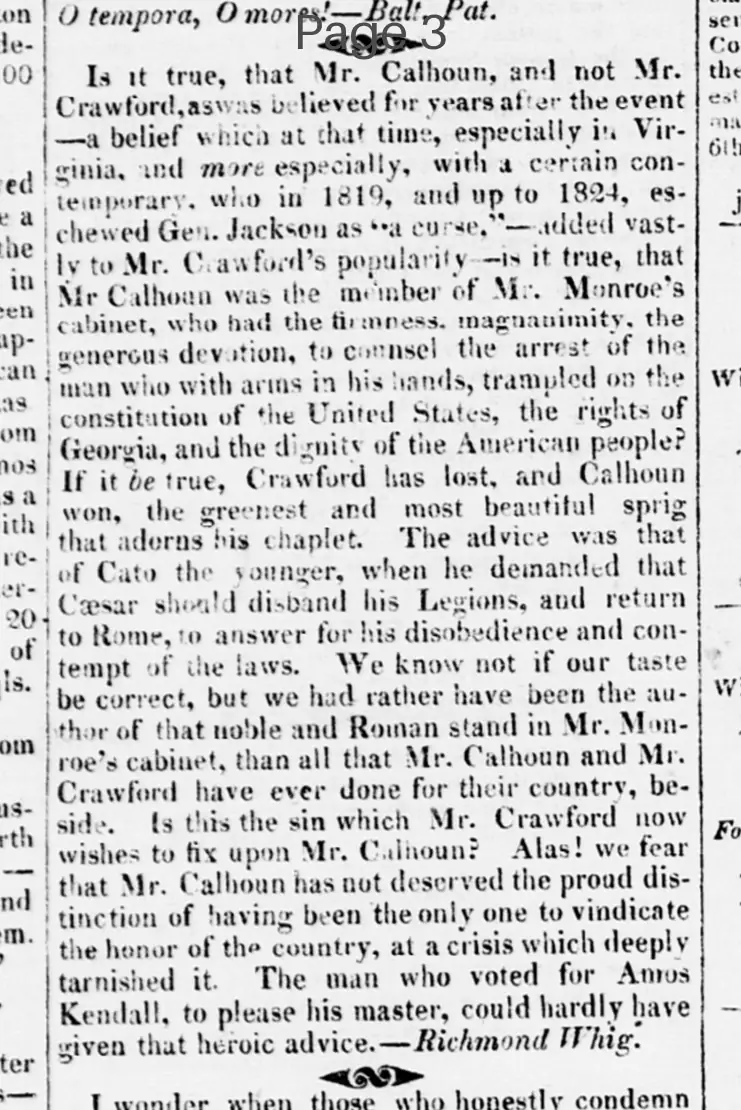
If it be true, Crawford has lost, and Calhoun won, the greenest and most beautiful sprig that adorns his chaplet. The advice was that of Cato the younger, when he demanded that Caesar should disband his Legions, and return to Rome, to answer for his disobedience and contempt of the laws. We know not if our taste be correct, but we had rather have been the author of that noble and Roman stand in Mr. Monroe's cabinet, than all that Mr. Calhoun and Mr. Crawford have ever done for their country, besides. Is this the sin which Mr. Crawford now wishes to fix upon Mr. Calhoun? Alas! we fear that Mr. Calhoun has not deserved the proud distinction of having been the only one to vindicate the honor of the country, at a crisis which deeply tarnished it. The man who voted for Amos Kendall, to please his master, could hardly have given that heroic advice.—Richmond Whig.
What sub-type of article is it?
What keywords are associated?
What entities or persons were involved?
Where did it happen?
Domestic News Details
Primary Location
Virginia
Event Date
1819 To 1824
Key Persons
Outcome
debate over attribution of cabinet advice to arrest jackson, affecting reputations of calhoun and crawford amid a national crisis.
Event Details
Rhetorical questioning in Richmond Whig whether Calhoun, not Crawford, advised Monroe's cabinet to arrest Jackson for trampling the Constitution, Georgia's rights, and U.S. dignity; praises such advice as heroic like Cato's against Caesar; doubts Calhoun's role due to later actions.