Thank you for visiting SNEWPapers!
Sign up free
The Wilmingtonian, And Delaware Register
Wilmington, New Castle County, Delaware
What is this article about?
Report on manufacturing in Egypt: challenges in cotton spinning due to climate; declining woollen cloth at Bourlak; new salt production by Italian Basi supplying viceroy; Syrian colony at Zabaik cultivating silk with limited output.
Clipping
OCR Quality
Full Text
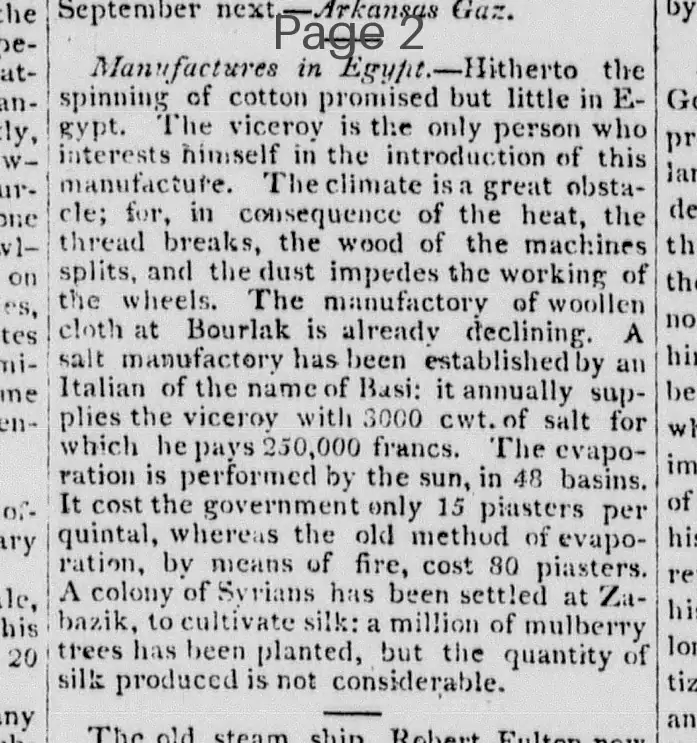
spinning of cotton promised but little in Egypt. The viceroy is the only person who
interests himself in the introduction of this
manufacture. The climate is a great obstacle: for, in consequence of the heat, the
thread breaks, the wood of the machines
splits, and the dust impedes the working of
the wheels. The manufactory of woollen
cloth at Bourlak is already declining. A
salt manufactory has been established by an
Italian of the name of Basi: it annually supplies the viceroy with 3000 cwt. of salt for
which he pays 250,000 francs. The evaporation is performed by the sun, in 48 basins.
It cost the government only 15 piasters per
quintal, whereas the old method of evaporation, by means of fire, cost 80 piasters.
A colony of Syrians has been settled at Zabaik, to cultivate silk: a million of mulberry trees has been planted, but the quantity of
silk produced is not considerable.
What sub-type of article is it?
What keywords are associated?
What entities or persons were involved?
Where did it happen?
Foreign News Details
Primary Location
Egypt
Key Persons
Outcome
cotton spinning faces climate obstacles; woollen cloth manufactory declining; salt manufactory produces 3000 cwt annually for 250,000 francs, costing 15 piasters per quintal vs. old 80; silk production from syrian colony not considerable despite million mulberry trees.
Event Details
The viceroy supports cotton spinning introduction, but heat causes thread breaks, machine wood splits, and dust impedes wheels. Woollen cloth at Bourlak declines. Italian Basi's salt manufactory uses sun evaporation in 48 basins, supplying viceroy cheaply. Syrians at Zabaik cultivate silk with planted mulberry trees, yielding little.