Thank you for visiting SNEWPapers!
Sign up free
Story
August 3, 1833
New Hampshire Statesman And State Journal
Concord, Merrimack County, New Hampshire
What is this article about?
The ranunculus (buttercup) is highly poisonous, killing dogs via ingestion or wounds and causing pain in humans; cattle avoid it, leading to rapid spread in pastures. Trenching recommended for control, offering widespread employment. (Cited: London Times)
Clipping
OCR Quality
100%
Excellent
Full Text
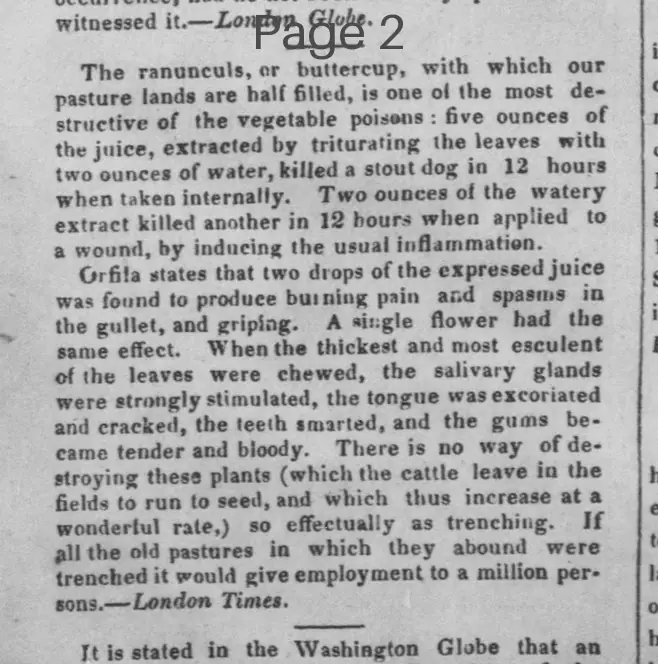
The ranunculus, or buttercup, with which our pasture lands are half filled, is one of the most destructive of the vegetable poisons: five ounces of the juice, extracted by triturating the leaves with two ounces of water, killed a stout dog in 12 hours when taken internally. Two ounces of the watery extract killed another in 12 hours when applied to a wound, by inducing the usual inflammation. Orfila states that two drops of the expressed juice was found to produce burning pain and spasms in the gullet, and griping. A single flower had the same effect. When the thickest and most esculent of the leaves were chewed, the salivary glands were strongly stimulated, the tongue was excoriated and cracked, the teeth smarted, and the gums became tender and bloody. There is no way of destroying these plants (which the cattle leave in the fields to run to seed, and which thus increase at a wonderful rate,) so effectually as trenching. If all the old pastures in which they abound were trenched it would give employment to a million persons.—London Times.
What sub-type of article is it?
Curiosity
Medical Curiosity
What themes does it cover?
Nature
Misfortune
What keywords are associated?
Ranunculus
Buttercup
Vegetable Poison
Trenching Pastures
What entities or persons were involved?
Orfila
Where did it happen?
Pasture Lands
Story Details
Key Persons
Orfila
Location
Pasture Lands
Story Details
The ranunculus or buttercup is a destructive vegetable poison; its juice kills dogs internally or via wounds, causes pain and spasms in humans, and stimulates salivary glands painfully when chewed. Cattle avoid it, allowing it to spread; trenching is the best control method, potentially employing a million people.