Thank you for visiting SNEWPapers!
Sign up free
Literary
October 7, 1824
The Wilmingtonian, And Delaware Register
Wilmington, New Castle County, Delaware
What is this article about?
Jack Newbottle writes to the editor recounting his impoverished marriage in 1810, daily grog habit, family quarrels, and poverty as a woodsawyer. After spilling his rum and hearing a temperance sermon, he quits drinking, discovering alcohol is unnecessary, leading to family harmony and financial improvement.
Clipping
OCR Quality
95%
Excellent
Full Text
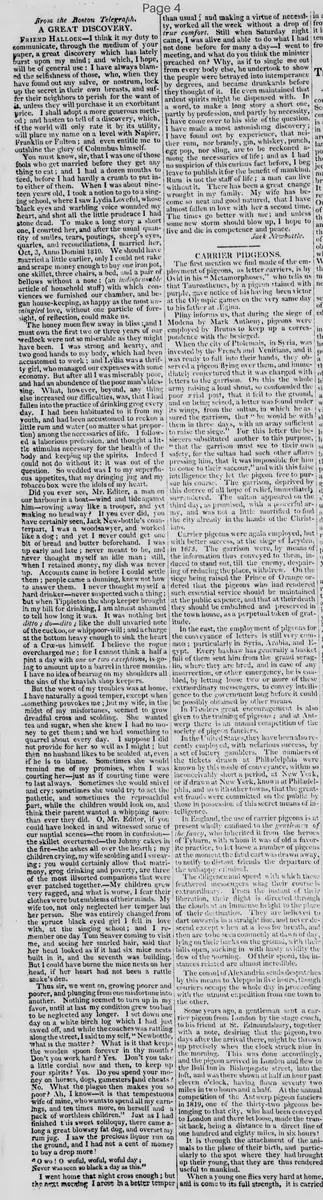
Friend Hallock—I think it my duty to communicate, through the medium of your paper, a great discovery which has lately burst upon my mind; and which, I hope, will be of general use: I have always blamed the selfishness of those, who, when they have found out any salve, or nostrum, lock up the secret in their own breasts, and suffer their neighbors to perish for the want of it, unless they will purchase it at an exorbitant price. I shall adopt a more generous method; and hasten to tell of a discovery, which, if the world will only rate it by its utility, will place my name on a level with Napier, Franklin or Fulton; and even entitle me to outshine the glory of Columbus himself.
You must know, sir, that I was one of those fools who get married before they get any thing to eat; and I had a dozen mouths to feed, before I had hardly a crumb to put into either of them. When I was about nineteen years old, I took a notion to go to a singing school, where I saw Lydia Lovetul, whose black eyes and warbling voice wounded my heart, and shot all the little prudence I had stone dead. To make a long story a short one, I courted her, and after the usual quantity of smiles, tears, poutings, sheep's eyes, quarrels, and reconciliations, I married her, Oct. 3, Anno Domini 1810. We should have married a little earlier, only I could not rake and scrape money enough to buy one iron pot, one skillet, three chairs, a bed, and a pair of bellows without a nose; (an indispensable article of household stuff) with which conveniences we furnished our chamber, and began house-keeping, as happy as the most unmixed love, without one particle of foresight, of reflection, could make us.
The honey moon flew away in bliss; and I must own the first two or three years of our wedlock were not so miserable as they might have been. I was strong and hearty, and two good hands to my body, which had been accustomed to work; and Lydia was a thrifty girl, who managed our expenses with some economy. But after all I was miserably poor, and had an abundance of the poor man's blessing. What, however, beyond any thing else increased our difficulties, was, that I had fallen into the practice of drinking grog every day. I had been habituated to it from my youth, and had been accustomed to reckon a little rum and water (no matter what proportion) among the necessaries of life. I followed a laborious profession, and thought a little stimulus necessary for the health of the body and keeping up the spirits. Indeed I could not do without it: it was out of the question. So wedded was I to my superfluous appetites, that my drinking jug and my tobacco box were the idols of my heart.
Did you ever see, Mr. Editor, a man on our harbour in a boat—wind and tide against him—rowing away like a trooper, and yet making no headway? If you ever did, you have certainly seen Jack New-bottle's counterpart. I was a woodsawyer, and worked like a dog: and yet I never could get one bit of bread and butter beforehand. I was up early and late; never meant to be, and never thought myself an idle man; still, when I retained money, my dish was never up. Accounts came in before I could settle them; people came a dunning, knew not how to answer them. I never thought myself a hard drinker—never suspected such a thing; but when Tippleton the shop keeper brought in my bill for drinking, I am almost ashamed to tell how long it was. It was nothing but ditto; do-ditto: like the dull unvaried note of the cuckoo, or whippoor-will; and a charge at the bottom heavy enough to sink the heart of a Crœsus himself. I believe the rogue overcharged me; for I cannot think a half a pint a day with one or two exceptions, is going to amount up to a barrel in three months. I have no idea of bearing on my shoulders all the sins of the knavish shop keepers.
But the worst of my troubles was at home. I have naturally a good temper, except when something provokes me; but my wife, in the midst of my misfortunes, seemed to grow dreadful cross and scolding. She wanted tea and sugar, when she knew I had no money to get them; and we had something to quarrel about every day. I suppose I did not provide for her so well as I might; but then no husband likes to be scolded at, even if he is to blame. Sometimes she would remind me of my promises, when I was courting her—just as if courting time were to last always. Sometimes she would snivel and cry: sometimes she would try to act the pathetic, and sometimes the reproachful part, while the children would look on, and think their parent wanted a whipping more than ever they did. O, Mr. Editor, if you could have looked in and witnessed some of our nuptial scenes—the room in confusion—the skillet overturned—the Johnny cakes in the fire—the ashes all over the hearth; my children crying, my wife scolding and I swearing; you would certainly allow that matrimony, grog drinking and poverty, are three of the most ill-sorted companions that were ever patched together. My children grew very ragged, and what is worse, I fear their clothes were but emblems of their minds. My wife too, not only neglected her temper but her person. She was entirely changed from the spruce black eyed girl I fell in love with, at the singing school; and I remember one day Tom Seaver coming to visit me, and seeing her snarled hair, said that her head looked as if it had six mice nests built in it, and the seventh was building. But I could have borne the mice nests on her head, if her heart had not been a rattle snake's den.
Thus sir, we went on, growing poorer and poorer, and plunging from one misfortune into another. Nothing seemed to turn up in my favor, until at last my condition grew too bad to be neglected any longer. I set down one day on a white birch log which I had just sawed off, and while the coaches was rattling along the street, I said to myself, "Newbottle, what is the matter? What is it that keeps the wooden spoon forever in thy mouth? Don't you work hard? Yes. Don't you take a little cordial now and then, to keep up your spirits? Yes. Do you spend your money on horses, dogs, gamesters and cheats? No. What the plague then makes you so poor? Ah, I know—it is that tempestuous wife of mine, who wants to spend all my earnings, and ten times more, on herself and a pack of worthless children." Just as I had finished this sweet soliloquy, there came along a great blowsey fat dog, and overset my rum jug. I saw the precious liquor run on the ground, and I had not a cent of money to buy a drop more!
O wo! O woful, woful, woful day; Never was seen so black a day as this. I went home that night cross enough; but the next morning I arose in a better temper than usual; and making a virtue of necessity, worked all the week without a drop of true comfort. Still when Saturday night came, I was alive and able to do what I had not done before for many a day—I went to meeting, and what do you think the minister preached on? Why, as if to single me out from every body else, he undertook to show the people were betrayed into intemperance by degrees, and became drunkards before they thought of it. He even maintained that ardent spirits might be dispensed with. In a word, to make a long story a short one, partly by profession, and partly by necessity, I have come over to his side of the question. I have made a most astonishing discovery; I have found out by experience, that neither rum, nor brandy, gin, whiskey, punch, egg pop, nor sling, are to be reckoned among the necessaries of life: and as I had no suspicion of this curious fact before, I beg leave to publish it for the benefit of mankind. Rum is not the staff of life: a man can live without it. There has been a great change wrought in my family. My wife has become so neat and good natured, that I have almost fallen in love with her a second time. The times go better with me; and unless some new storm should blow up, I hope to live and die in competence and peace.
Jack Newbottle.
You must know, sir, that I was one of those fools who get married before they get any thing to eat; and I had a dozen mouths to feed, before I had hardly a crumb to put into either of them. When I was about nineteen years old, I took a notion to go to a singing school, where I saw Lydia Lovetul, whose black eyes and warbling voice wounded my heart, and shot all the little prudence I had stone dead. To make a long story a short one, I courted her, and after the usual quantity of smiles, tears, poutings, sheep's eyes, quarrels, and reconciliations, I married her, Oct. 3, Anno Domini 1810. We should have married a little earlier, only I could not rake and scrape money enough to buy one iron pot, one skillet, three chairs, a bed, and a pair of bellows without a nose; (an indispensable article of household stuff) with which conveniences we furnished our chamber, and began house-keeping, as happy as the most unmixed love, without one particle of foresight, of reflection, could make us.
The honey moon flew away in bliss; and I must own the first two or three years of our wedlock were not so miserable as they might have been. I was strong and hearty, and two good hands to my body, which had been accustomed to work; and Lydia was a thrifty girl, who managed our expenses with some economy. But after all I was miserably poor, and had an abundance of the poor man's blessing. What, however, beyond any thing else increased our difficulties, was, that I had fallen into the practice of drinking grog every day. I had been habituated to it from my youth, and had been accustomed to reckon a little rum and water (no matter what proportion) among the necessaries of life. I followed a laborious profession, and thought a little stimulus necessary for the health of the body and keeping up the spirits. Indeed I could not do without it: it was out of the question. So wedded was I to my superfluous appetites, that my drinking jug and my tobacco box were the idols of my heart.
Did you ever see, Mr. Editor, a man on our harbour in a boat—wind and tide against him—rowing away like a trooper, and yet making no headway? If you ever did, you have certainly seen Jack New-bottle's counterpart. I was a woodsawyer, and worked like a dog: and yet I never could get one bit of bread and butter beforehand. I was up early and late; never meant to be, and never thought myself an idle man; still, when I retained money, my dish was never up. Accounts came in before I could settle them; people came a dunning, knew not how to answer them. I never thought myself a hard drinker—never suspected such a thing; but when Tippleton the shop keeper brought in my bill for drinking, I am almost ashamed to tell how long it was. It was nothing but ditto; do-ditto: like the dull unvaried note of the cuckoo, or whippoor-will; and a charge at the bottom heavy enough to sink the heart of a Crœsus himself. I believe the rogue overcharged me; for I cannot think a half a pint a day with one or two exceptions, is going to amount up to a barrel in three months. I have no idea of bearing on my shoulders all the sins of the knavish shop keepers.
But the worst of my troubles was at home. I have naturally a good temper, except when something provokes me; but my wife, in the midst of my misfortunes, seemed to grow dreadful cross and scolding. She wanted tea and sugar, when she knew I had no money to get them; and we had something to quarrel about every day. I suppose I did not provide for her so well as I might; but then no husband likes to be scolded at, even if he is to blame. Sometimes she would remind me of my promises, when I was courting her—just as if courting time were to last always. Sometimes she would snivel and cry: sometimes she would try to act the pathetic, and sometimes the reproachful part, while the children would look on, and think their parent wanted a whipping more than ever they did. O, Mr. Editor, if you could have looked in and witnessed some of our nuptial scenes—the room in confusion—the skillet overturned—the Johnny cakes in the fire—the ashes all over the hearth; my children crying, my wife scolding and I swearing; you would certainly allow that matrimony, grog drinking and poverty, are three of the most ill-sorted companions that were ever patched together. My children grew very ragged, and what is worse, I fear their clothes were but emblems of their minds. My wife too, not only neglected her temper but her person. She was entirely changed from the spruce black eyed girl I fell in love with, at the singing school; and I remember one day Tom Seaver coming to visit me, and seeing her snarled hair, said that her head looked as if it had six mice nests built in it, and the seventh was building. But I could have borne the mice nests on her head, if her heart had not been a rattle snake's den.
Thus sir, we went on, growing poorer and poorer, and plunging from one misfortune into another. Nothing seemed to turn up in my favor, until at last my condition grew too bad to be neglected any longer. I set down one day on a white birch log which I had just sawed off, and while the coaches was rattling along the street, I said to myself, "Newbottle, what is the matter? What is it that keeps the wooden spoon forever in thy mouth? Don't you work hard? Yes. Don't you take a little cordial now and then, to keep up your spirits? Yes. Do you spend your money on horses, dogs, gamesters and cheats? No. What the plague then makes you so poor? Ah, I know—it is that tempestuous wife of mine, who wants to spend all my earnings, and ten times more, on herself and a pack of worthless children." Just as I had finished this sweet soliloquy, there came along a great blowsey fat dog, and overset my rum jug. I saw the precious liquor run on the ground, and I had not a cent of money to buy a drop more!
O wo! O woful, woful, woful day; Never was seen so black a day as this. I went home that night cross enough; but the next morning I arose in a better temper than usual; and making a virtue of necessity, worked all the week without a drop of true comfort. Still when Saturday night came, I was alive and able to do what I had not done before for many a day—I went to meeting, and what do you think the minister preached on? Why, as if to single me out from every body else, he undertook to show the people were betrayed into intemperance by degrees, and became drunkards before they thought of it. He even maintained that ardent spirits might be dispensed with. In a word, to make a long story a short one, partly by profession, and partly by necessity, I have come over to his side of the question. I have made a most astonishing discovery; I have found out by experience, that neither rum, nor brandy, gin, whiskey, punch, egg pop, nor sling, are to be reckoned among the necessaries of life: and as I had no suspicion of this curious fact before, I beg leave to publish it for the benefit of mankind. Rum is not the staff of life: a man can live without it. There has been a great change wrought in my family. My wife has become so neat and good natured, that I have almost fallen in love with her a second time. The times go better with me; and unless some new storm should blow up, I hope to live and die in competence and peace.
Jack Newbottle.
What sub-type of article is it?
Epistolary
Essay
What themes does it cover?
Temperance
Moral Virtue
What keywords are associated?
Temperance
Drinking Habit
Poverty
Marriage Strife
Personal Reform
Family Improvement
What entities or persons were involved?
Jack Newbottle
Literary Details
Author
Jack Newbottle
Subject
Discovery That Alcohol Is Unnecessary For Life
Form / Style
Personal Letter Recounting Life Experiences
Key Lines
I Have Made A Most Astonishing Discovery; I Have Found Out By Experience, That Neither Rum, Nor Brandy, Gin, Whiskey, Punch, Egg Pop, Nor Sling, Are To Be Reckoned Among The Necessaries Of Life: And As I Had No Suspicion Of This Curious Fact Before, I Beg Leave To Publish It For The Benefit Of Mankind.
Rum Is Not The Staff Of Life: A Man Can Live Without It.
Matrimony, Grog Drinking And Poverty, Are Three Of The Most Ill Sorted Companions That Were Ever Patched Together.