Thank you for visiting SNEWPapers!
Sign up free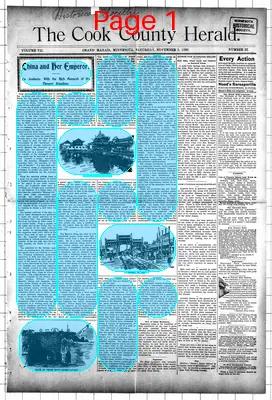
The Cook County Herald
Grand Marais, Cook County, Minnesota
What is this article about?
Article describes preparations for the annual diplomatic audience with Emperor Kuang Hsu in Pekin, including ceremony details, Forbidden City access, interactions with officials like Li Hung Chang, history of Chinese capitals, Pekin's structure, and Shanghai's municipal organization.
Merged-components note: Merged images into the story component as they correspond to the captions at the end of the article text describing Shanghai and Pekin.
Clipping
OCR Quality
Full Text
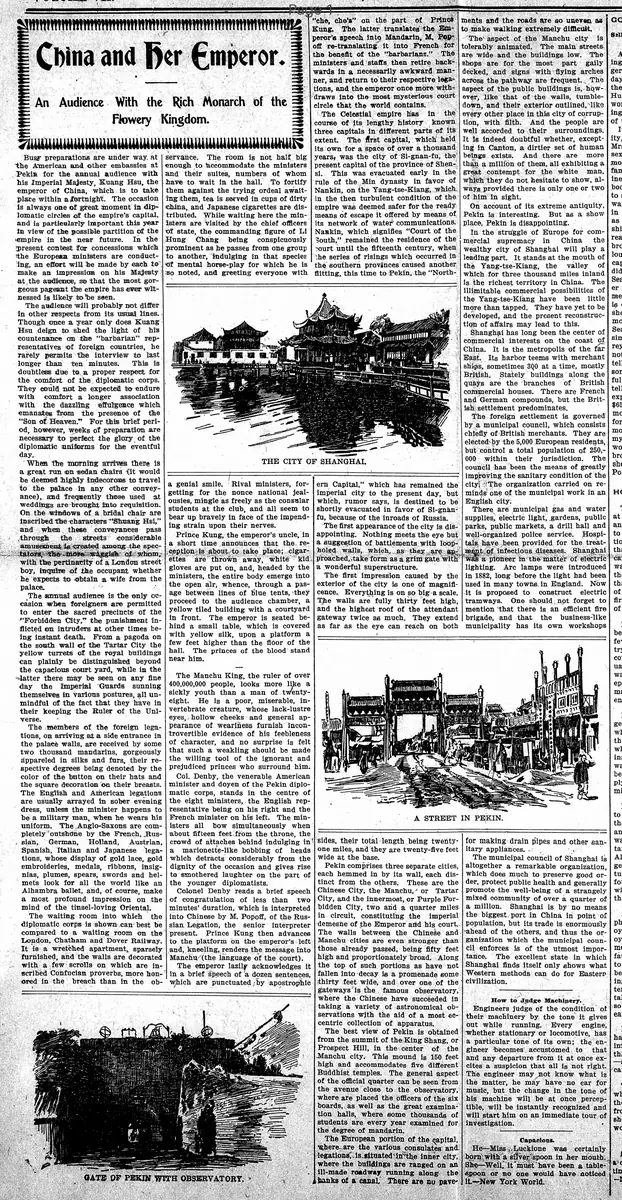
An Audience With the Rich Monarch of the Flowery Kingdom.
Busy preparations are under way, at the American and other embassies at Pekin for the annual audience with his Imperial Majesty. Kuang Hsu, the emperor of China, which is to take place within a fortnight. The occasion is always one of great moment in diplomatic circles of the empire's capital, and is particularly important this year in view of the possible partition of the empire in the near future. In the present contest for concessions which the European ministers are conducting, an effort will be made by each to make an impression on his Majesty at the audience, so that the most gorgeous pageant the empire has ever witnessed is likely to be seen.
The audience will probably not differ in other respects from its usual lines. Though once a year only does Kuang Hsu deign to shed the light of his countenance on the "barbarian" representatives of foreign countries, he rarely permits the interview to last longer than ten minutes. This is doubtless due to a proper respect for the comfort of the diplomatic corps. They could not be expected to endure with comfort a longer association with the dazzling effulgence which emanates from the presence of the "Son of Heaven." For this brief period, however, weeks of preparation are necessary to perfect the glory of the diplomatic uniforms for the eventful day.
When the morning arrives there is a great run on sedan chairs (it would be deemed highly indecorous to travel to the palace in any other conveyance), and frequently those used at weddings are brought into requisition. On the windows of a bridal chair are inscribed the characters "Shuang Hsi," and when these conveyances pass through the streets considerable amusement is created among the spectators, the more waggish of whom, with the pertinacity of a London street boy, inquire of the occupant whether he expects to obtain a wife from the palace.
The annual audience is the only occasion when foreigners are permitted to enter the sacred precincts of the "Forbidden City," the punishment inflicted on intruders at other times being instant death. From a pagoda on the south wall of the Tartar City the yellow turrets of the royal buildings can plainly be distinguished beyond the capacious court yard, while in the latter there may be seen on any fine day the Imperial Guards sunning themselves in various postures, all unmindful of the fact that they have in their keeping the Ruler of the Universe.
The members of the foreign legations, on arriving at a side entrance in the palace walls, are received by some two thousand mandarins, gorgeously appareled in silks and furs, their respective degrees being denoted by the color of the button on their hats and the square decoration on their breasts. The English and American legations are usually arrayed in sober evening dress, unless the minister happens to be a military man, when he wears his uniform. The Anglo-Saxons are completely outshone by the French, Russian, German, Holland, Austrian, Spanish, Italian and Japanese legations, whose display of gold lace, gold embroideries, medals, ribbons, insignia, plumes, spears, swords and helmets look for all the world like an Alhambra ballet, and, of course, make a most profound impression on the mind of the tinsel-loving Oriental.
The waiting room into which the diplomatic corps is shown can best be compared to a waiting room on the London, Chatham and Dover Railway. It is a wretched apartment, sparsely furnished, and the walls are decorated with a few scrolls on which are inscribed Confucian proverbs, more honored in the breach than in the observance. The room is not half big enough to accommodate the ministers and their suites, numbers of whom have to wait in the hall. To fortify them against the trying ordeal awaiting them, tea is served in cups of dirty china, and Japanese cigarettes are distributed. While waiting here the ministers are visited by the chief officers of state, the commanding figure of Li Hung Chang being conspicuously prominent as he passes from one group to another, indulging in that species of mental horse-play for which he is so noted, and greeting everyone with "che, cho's" on the part of Prince Kung. The latter translates the Emperor's speech into Mandarin- M Popoff re-translating it into French for the benefit of the "barbarians." The ministers and staffs then retire backwards in a necessarily awkward manner, and return to their respective legations, and the emperor once more withdraws into the most mysterious court circle that the world contains.
The Celestial empire has in the course of its lengthy history known three capitals in different parts of its extent. The first capital, which held its own for a space of over a thousand years, was the city of Si-gnan-fu, the present capital of the province of Shen-si. This was evacuated early in the rule of the Min dynasty in favor of Nankin, on the Yang-tse-Kiang, which in the then turbulent condition of the empire was deemed safer for the ready means of escape it offered by means of its network of water communications. Nankin, which signifies "Court of the South," remained the residence of the court until the fifteenth century, when the series of risings which occurred in the southern provinces caused another flitting, this time to Pekin, the "Northern Capital," which has remained the imperial city to the present day, but which, rumor says, is destined to be shortly evacuated in favor of Si-gnan-fu, because of the inroads of Russia.
The first appearance of the city is disappointing. Nothing meets the eye but a suggestion of battlements with loophole walls, which, as they are approached, take form as a grim gate with a wonderful superstructure. The first impression caused by the exterior of the city is one of magnificence. Everything is on so big a scale. The walls are fully thirty feet high, and the highest roof of the attendant gateway twice as much. They extend as far as the eye can reach on both sides, their total length being twenty-one miles, and they are twenty-five feet wide at the base.
Pekin comprises three separate cities, each hemmed in by its wall, each distinct from the others. These are the Chinese City, the Manchu, or Tartar City, and the innermost, or Purple Forbidden City, two and a quarter miles in circuit, constituting the imperial demesne of the Emperor and his court. The walls between the Chinese and Manchu cities are even stronger than those already passed, being fifty feet high and proportionately broad. Along the top of such portions as have not fallen into decay is a promenade some thirty feet wide, and over one of the gateways is the famous observatory, where the Chinese have succeeded in taking a variety of astronomical observations with the aid of a most eccentric collection of apparatus.
The best view of Pekin is obtained from the summit of the King Shang, or Prospect Hill, in the center of the Manchu city. This mound is 150 feet high and accommodates five different Buddhist temples. The general aspect of the official quarter can be seen from the avenue close to the observatory, where are placed the officers of the six boards, as well as the great examination halls, where some thousands of students are every year examined for the degree of mandarin.
The European portion of the capital where are the various consulates and legations, is situated in the inner city, where the buildings are ranged on an ill-made roadway running along the banks of a canal. There are no pavements for making drain pipes and other sanitary appliances. The municipal council of Shanghai is altogether a remarkable organization, which does much to preserve good order, protect public health and generally promote the well-being of a strangely mixed community of over a quarter of a million. Shanghai is by no means the biggest port in China in point of population, but its trade is enormously ahead of the others, and thus the organization which the municipal council enforces is of the utmost importance. The excellent state in which Shanghai finds itself only shows what Western methods can do for Eastern civilization.
[Caption: THE CITY OF SHANGHAI]
[Caption: A STREET IN PEKIN.]
What sub-type of article is it?
What themes does it cover?
What keywords are associated?
What entities or persons were involved?
Where did it happen?
Story Details
Key Persons
Location
Pekin, China; Shanghai, China
Event Date
Annual Audience Within A Fortnight
Story Details
Preparations and details of the annual diplomatic audience with Emperor Kuang Hsu in Pekin amid fears of empire partition; description of ceremony, Forbidden City, mandarins, and officials; historical shifts of Chinese capitals; architectural overview of Pekin; praise for Shanghai's Western-influenced municipal council.