Thank you for visiting SNEWPapers!
Sign up free
Story
May 4, 1896
The Providence News
Providence, Providence County, Rhode Island
What is this article about?
Joint committee report uncovers mismanagement, extravagance, and failure at Rhode Island College of Agriculture and Mechanic Arts in Kingston, criticizing President John Hosea Washburn and urging reforms amid debates over relocation.
Clipping
OCR Quality
95%
Excellent
Full Text
AGRICULTURAL SCHOOL REPORT.
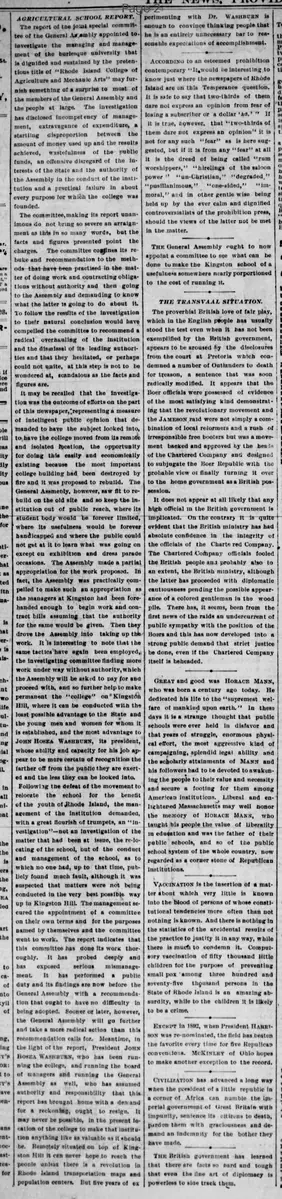
The report of the joint special committee of the General Assembly appointed to investigate the managing and management of the burlesque university that is dignified and sustained by the pretentious title of "Rhode Island College of Agriculture and Mechanic Arts" may furnish something of a surprise to most of the members of the General Assembly and the people at large. The investigation has disclosed incompetency of management, extravagance of expenditure, a startling disproportion between the amount of money used up and the results achieved, wastefulness of the public funds, an offensive disregard of the interests of the State and the authority of the Assembly in the conduct of the institution and a practical failure in about every purpose for which the college was founded.
The committee, making its report unanimous do not bring so severe an arraignment as this in so many words, but the facts and figures presented point the charges. The committee confines its rebuke and recommendation to the methods that have been practised in the matter of doing work and contracting obligations without authority and then going to the Assembly and demanding to know what the latter is going to do about it. To follow the results of the investigation to their natural conclusion would have compelled the committee to recommend a radical overhauling of the institution and the dismissal of its leading authorities and that they hesitated, or perhaps could not unite, at this step is not to be wondered at, scandalous as the facts and figures are.
It may be recalled that the investigation was the outcome of efforts on the part of this newspaper, representing a measure of intelligent public opinion that demanded to have the subject looked into, to have the college moved from its remote and isolated location, the opportunity for doing this easily and economically existing because the most important college building had been destroyed by fire and it was proposed to rebuild. The General Assembly, however, saw fit to rebuild on the old site and so keep the institution out of public reach, where its student body would be forever limited, where its usefulness would be forever handicapped and where the public could not get at it to learn what was going on except on exhibition and dress parade occasions. The Assembly made a partial appropriation for the work proposed. In fact, the Assembly was practically compelled to make such an appropriation as the managers at Kingston had been forehanded enough to begin work and contract bills assuming that the authority for the same would be given. Then they drove the Assembly into taking up the work. It is interesting to note that the same tactics have again been employed, the investigating committee finding more work under way without authority, which the Assembly will be asked to pay for and proceed with, and so further help to make permanent the "college" on Kingston Hill, where it can be conducted with the least possible advantage to the State and the young men and women for whom it is established, and the most advantage to John Hosea Washburn, its president, whose ability and capacity for his job appear to be more certain of recognition the farther off from the public they are exerted and the less they can be looked into.
Following the defeat of the movement to relocate the school for the benefit of the youth of Rhode Island, the management of the institution demanded, with a great flourish of trumpets, an "investigation"—not an investigation of the matter that had been at issue, the relocating of the school, but of the conduct and management of the school, as to which no one had, up to that time, publicly found much fault, although it was suspected that matters were not being conducted in the very best possible way up in Kingston Hill. The management secured the appointment of a committee on their own terms and for the purposes named by themselves and the committee went to work. The report indicates that this committee has done its work thoroughly. It has probed deeply and has exposed serious mismanagement. It has performed a public duty and its findings are now before the General Assembly with a recommendation that ought to have no difficulty in being adopted. Sooner or later, however, the General Assembly will go further and take a more radical action than this recommendation calls for. Meantime, in the light of the report, President John Hosea Washburn, who has been running the college, and running the board of managers and running the General Assembly as well, who has assumed authority and responsibility that this report has brought home with a demand for a reckoning, ought to resign. It may never be possible, in the present location of the college to make that institution anything like as valuable as it should be. Remotely situated on top of Kingston Hill it can never hope to reach the people unless there is a revolution in Rhode Island transportation maps and population centers. But five years of experimenting with Dr. Washburn is enough to convince thinking people that he is an entirely unnecessary bar to reasonable expectations of accomplishment.
The report of the joint special committee of the General Assembly appointed to investigate the managing and management of the burlesque university that is dignified and sustained by the pretentious title of "Rhode Island College of Agriculture and Mechanic Arts" may furnish something of a surprise to most of the members of the General Assembly and the people at large. The investigation has disclosed incompetency of management, extravagance of expenditure, a startling disproportion between the amount of money used up and the results achieved, wastefulness of the public funds, an offensive disregard of the interests of the State and the authority of the Assembly in the conduct of the institution and a practical failure in about every purpose for which the college was founded.
The committee, making its report unanimous do not bring so severe an arraignment as this in so many words, but the facts and figures presented point the charges. The committee confines its rebuke and recommendation to the methods that have been practised in the matter of doing work and contracting obligations without authority and then going to the Assembly and demanding to know what the latter is going to do about it. To follow the results of the investigation to their natural conclusion would have compelled the committee to recommend a radical overhauling of the institution and the dismissal of its leading authorities and that they hesitated, or perhaps could not unite, at this step is not to be wondered at, scandalous as the facts and figures are.
It may be recalled that the investigation was the outcome of efforts on the part of this newspaper, representing a measure of intelligent public opinion that demanded to have the subject looked into, to have the college moved from its remote and isolated location, the opportunity for doing this easily and economically existing because the most important college building had been destroyed by fire and it was proposed to rebuild. The General Assembly, however, saw fit to rebuild on the old site and so keep the institution out of public reach, where its student body would be forever limited, where its usefulness would be forever handicapped and where the public could not get at it to learn what was going on except on exhibition and dress parade occasions. The Assembly made a partial appropriation for the work proposed. In fact, the Assembly was practically compelled to make such an appropriation as the managers at Kingston had been forehanded enough to begin work and contract bills assuming that the authority for the same would be given. Then they drove the Assembly into taking up the work. It is interesting to note that the same tactics have again been employed, the investigating committee finding more work under way without authority, which the Assembly will be asked to pay for and proceed with, and so further help to make permanent the "college" on Kingston Hill, where it can be conducted with the least possible advantage to the State and the young men and women for whom it is established, and the most advantage to John Hosea Washburn, its president, whose ability and capacity for his job appear to be more certain of recognition the farther off from the public they are exerted and the less they can be looked into.
Following the defeat of the movement to relocate the school for the benefit of the youth of Rhode Island, the management of the institution demanded, with a great flourish of trumpets, an "investigation"—not an investigation of the matter that had been at issue, the relocating of the school, but of the conduct and management of the school, as to which no one had, up to that time, publicly found much fault, although it was suspected that matters were not being conducted in the very best possible way up in Kingston Hill. The management secured the appointment of a committee on their own terms and for the purposes named by themselves and the committee went to work. The report indicates that this committee has done its work thoroughly. It has probed deeply and has exposed serious mismanagement. It has performed a public duty and its findings are now before the General Assembly with a recommendation that ought to have no difficulty in being adopted. Sooner or later, however, the General Assembly will go further and take a more radical action than this recommendation calls for. Meantime, in the light of the report, President John Hosea Washburn, who has been running the college, and running the board of managers and running the General Assembly as well, who has assumed authority and responsibility that this report has brought home with a demand for a reckoning, ought to resign. It may never be possible, in the present location of the college to make that institution anything like as valuable as it should be. Remotely situated on top of Kingston Hill it can never hope to reach the people unless there is a revolution in Rhode Island transportation maps and population centers. But five years of experimenting with Dr. Washburn is enough to convince thinking people that he is an entirely unnecessary bar to reasonable expectations of accomplishment.
What sub-type of article is it?
Historical Event
What themes does it cover?
Justice
Misfortune
What keywords are associated?
College Mismanagement
Investigation Report
Public Funds Waste
Rhode Island College
Kingston Hill Location
What entities or persons were involved?
John Hosea Washburn
General Assembly
Where did it happen?
Rhode Island, Kingston Hill
Story Details
Key Persons
John Hosea Washburn
General Assembly
Location
Rhode Island, Kingston Hill
Story Details
A joint special committee of the General Assembly investigates the Rhode Island College of Agriculture and Mechanic Arts, revealing incompetency, extravagance, waste of public funds, and disregard for state interests, leading to calls for overhaul and the president's resignation.