Thank you for visiting SNEWPapers!
Sign up free
The Wheeling Daily Intelligencer
Wheeling, Ohio County, West Virginia
What is this article about?
Washington report on July 23 details federal government expenses from the great strike and Coxey movements, including marshal costs exceeding $250,000 and War Department transportation bills, to be borne by U.S. taxpayers beyond Chicago's losses.
Clipping
OCR Quality
Full Text
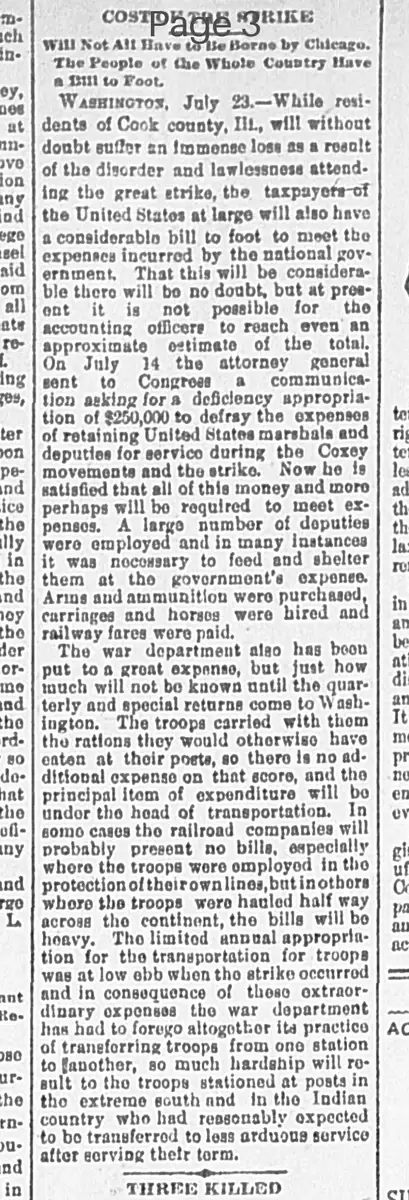
The People of the Whole Country Have a Bill to Foot.
Washington, July 23.—While residents of Cook county, Ill., will without doubt suffer an immense loss as a result of the disorder and lawlessness attending the great strike, the taxpayers of the United States at large will also have a considerable bill to foot to meet the expenses incurred by the national government. That this will be considerable there will be no doubt, but at present it is not possible for the accounting officers to reach even an approximate estimate of the total.
On July 14 the attorney general sent to Congress a communication asking for a deficiency appropriation of $250,000 to defray the expenses of retaining United States marshals and deputies for service during the Coxey movements and the strike. Now he is satisfied that all of this money and more perhaps will be required to meet expenses. A large number of deputies were employed and in many instances it was necessary to feed and shelter them at the government's expense. Arms and ammunition were purchased, carriages and horses were hired and railway fares were paid.
The war department also has been put to a great expense, but just how much will not be known until the quarterly and special returns come to Washington. The troops carried with them the rations they would otherwise have eaten at their posts, so there is no additional expense on that score, and the principal item of expenditure will be under the head of transportation. In some cases the railroad companies will probably present no bills, especially where the troops were employed in the protection of their own lines, but in others where the troops were hauled half way across the continent, the bills will be heavy. The limited annual appropriation for the transportation for troops was at low ebb when the strike occurred and in consequence of these extraordinary expenses the war department has had to forego altogether its practice of transferring troops from one station to another, so much hardship will result to the troops stationed at posts in the extreme south and in the Indian country who had reasonably expected to be transferred to less arduous service after serving their term.
What sub-type of article is it?
What keywords are associated?
What entities or persons were involved?
Where did it happen?
Domestic News Details
Primary Location
Cook County, Ill.
Event Date
July 23
Key Persons
Outcome
expenses exceeding $250,000 for marshals and deputies; additional war department transportation costs; hardship to troops due to foregone transfers.
Event Details
Federal government incurs significant costs from disorder and lawlessness of the great strike and Coxey movements, including employment, feeding, sheltering of deputies, purchases of arms and ammunition, hiring of carriages and horses, and railway fares; War Department faces heavy transportation bills for troops, impacting routine transfers.