Thank you for visiting SNEWPapers!
Sign up free
Lynchburg Virginian
Lynchburg, Virginia
What is this article about?
In September Court at Patrick Court-house, N. H. Claiborne speaks to constituents about congressional actions, praises the deposit bill for regulating public funds and distributing surplus to states, opposes excessive spending and internal improvements, and endorses Judge White for president while rejecting Van Buren.
Clipping
OCR Quality
Full Text
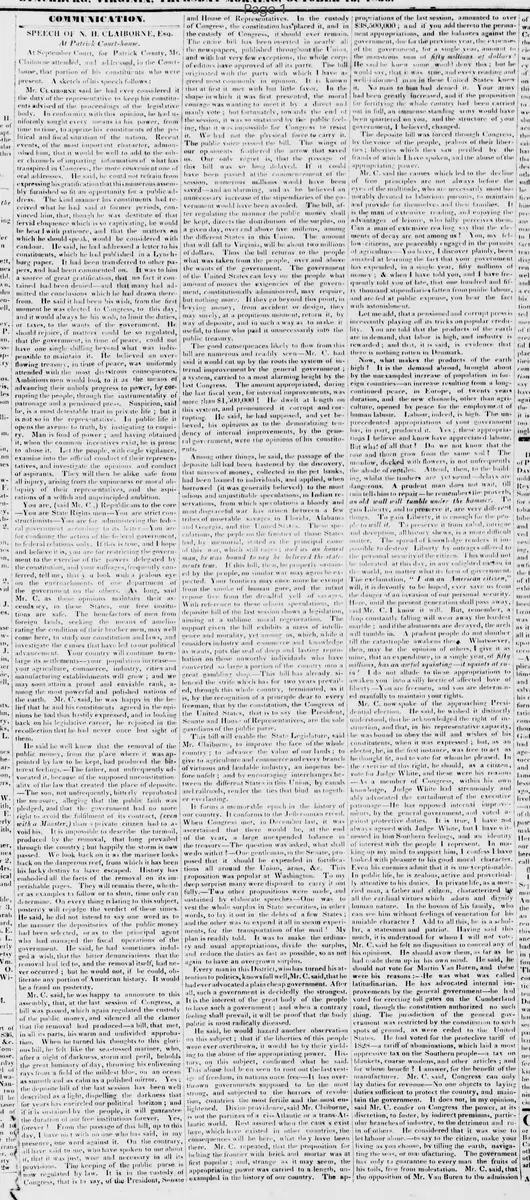
SPEECH OF N. H. CLAIBORNE, Esq.
At Patrick Court-house,
At September Court, for Patrick County, Mr. Claiborne attended, and addressed, in the Court-house, that portion of his constituents who were present. A sketch of his speech follows:
Mr. Claiborne said he had ever considered it the duty of the representative to keep his constituents advised of the proceedings of the legislative body. In conformity with this opinion, he had uniformly sought every means in his power, from time to time, to apprise his constituents of the political and fiscal situation of the nation. Recent events, of the most important character, admonished him, that it would be well to add to the other channels of imparting information of what has transpired in Congress, the more convenient one of oral addresses. He said, he could not refrain from expressing his gratification that this numerous assembly furnished so fit an opportunity for a public address. The kind manner his constituents had received what he had said at former periods, convinced him, that, though he was destitute of that fervid eloquence which is so captivating, he would be heard with patience, and that the matters on which he should speak, would be considered with candour. He said, he had addressed a letter to his constituents, which he had published in a Lynchburg paper. It had been transferred to other papers, and had been commented on. It was to him a source of great gratification, that no fact it contained had been denied—and that many had admitted the conclusions which he had drawn therefrom. He said it had been his wish, from the first moment he was elected to Congress, to this day, and it would always be his wish, to limit the duties, or taxes, to the wants of the government. He should rejoice, if matters could be so regulated, that the government, in time of peace, could not have one single shilling beyond what was indispensable to maintain it. He believed an overflowing treasury, in time of peace, was uniformly attended with the most disastrous consequences. Ambitious men would look to it as the means of advancing their unholy progress to power, by corrupting the people, through the instrumentality of patronage and a pensioned press. Suspicion, said he, is a most detestable trait in private life; but it is not so in the representative. In public life it opens the avenue to truth, by instigating to enquiry. Man is fond of power; and having obtained it, when the common incentives exist, he is prone to abuse it. Let the people, with eagle vigilance, examine into the official conduct of their representatives, and investigate the opinions and conduct of aspirants. They will then be alike safe from all injury, arising from the supineness or moral obliquity of their representatives, and the aspirations of a selfish and unprincipled ambition.
You are, (said Mr. C.) Republicans to the core—You are State Rights men—You are strict constructionists—You are for administering the federal government according to its letter—You are for confining the action of the federal government to federal relations only. If this is true, and I hope and believe it is, you are for restricting the government to the exercise of the powers delegated by the constitution, and your suffrages, frequently conferred, tell me, that you look with a jealous eye on the encroachments of one department of the government on the others. As long, said Mr. C. as these opinions maintain their ascendancy, in these States, our free institutions are safe. The benefactors of men from foreign lands, seeking the means of ameliorating the condition of their brother men, may well come here, to study our constitution and laws, and investigate the causes that have led to our political advancement. Your country will continue to enlarge its settlements—your population increase—your agriculture, commerce, industry, cities and manufacturing establishments will grow; and we may soon attain a proud and enviable rank, among the most powerful and polished nations of the earth. Mr. C. said, he was happy in the belief that he and his constituents agreed in the opinions he had thus hastily expressed, and in looking back on his legislative career, he rejoiced in the recollection that he had never once lost sight of them.
He said he well knew that the removal of the public money, from the place where it was appointed by law to be kept, had produced the bitterest feelings.—The father, not unfrequently advocated it, because of the supposed unconstitutionality of the law that created the place of deposite.—The son, not unfrequently, bitterly reprobated the measure, alleging that the public faith was pledged, and that the government had no more right to avoid the fulfilment of its contract, (even with a Monster,) than a private citizen had to avoid his. It is impossible to describe the turmoil, produced by the removal, that long prevailed through the country; but happily the storm is now passed. We look back on it as the mariner looks back on the dangerous reef, from which it has been his lucky destiny to have escaped. History has embodied all the facts of the removal on its imperishable pages. They will remain there, whether as examples to follow or to shun, time only can determine. On every thing relating to this subject, posterity will rejudge the verdict of these times.
He said, he did not intend to say one word as to the manner the depositories of the public money had been selected, or as to the principal agent who had managed the fiscal operations of the government. He said, he had sometimes indulged a wish, that the bitter denunciations that the removal had led to, and the removal itself, had never occurred; but he would not, if he could, obliterate any portion of American history. It would be a fraud on posterity.
Mr. C. said, he was happy to announce to this assembly, that, at the last session of Congress, a bill was passed, which again regulated the custody of the public money, and silenced all the clamor that the removal had produced—a bill, that met, in all its parts, his warm and undivided approbation. When he turned his thoughts to this glorious bill, he felt like the sea-tossed mariner, who, after a night of darkness, storm and peril, beholds the great luminary of day, throwing his enlivening rays from a field of the mildest blue, on an ocean as smooth and as calm as a polished mirror. Yes; the deposite bill of the last session has been well described as a light, dispelling the darkness that for years has encircled our political horizon; and if it is sustained by the people, it will guarantee the duration of our free institutions forever. Yes, forever! From the passage of this bill, up to this day, I have met with no one who has said, in my presence, one word against it. On the contrary, all have said to me, who have spoken to me about it, that it was just, wise and necessary in all its provisions. The keeping of the public purse is now regulated by law. It is in the custody of Congress, that is to say, of the President, Senate and House of Representatives. In the custody of Congress, the constitution has placed it, and in the custody of Congress, it should ever remain.
The entire bill has been inserted in nearly all the newspapers, published throughout the Union, and with but very few exceptions, the whole corps of editors have approved of all its parts. The bill originated with the party with which I have agreed most commonly in opinion. It is known that at first it met with but little favor. In the shape in which it was first presented, the moral courage was wanting to meet it by a direct and manly vote; but fortunately, towards the end of the session, it was so sustained by the public feeling, that it was impossible for Congress to resist it. We had not the physical force to carry it. The public voice passed the bill. The wings of our opponents feathered the arrow that saved us. Our only regret is, that the passage of this bill was so long delayed. If it could have been passed at the commencement of the session, numerous millions would have been saved—and an alarming, and as he believed an unnecessary increase of the stipendiaries of the government would have been avoided. The bill, after regulating the manner the public money shall be kept, directs the distribution of the surplus, on a given day, over and above five millions, among the different States in this Union. The amount that will fall to Virginia, will be about two millions of dollars. Thus the bill returns to the people what was taken from the people, over and above the wants of the government. The government of the United States can levy on the people what amount of money the exigencies of the government, constitutionally administered, may require, but nothing more. If they go beyond this point, in levying money, from accident or design, they may surely, at a propitious moment, return it, by way of deposite, and in such a way as to make it useful, to those who paid it unnecessarily into the public treasury.
The good consequences likely to flow from this bill are numerous and readily seen—Mr. C. had said it would cut up by the roots the system of internal improvement by the general government; a system, carried to a most alarming height by the last Congress. The amount appropriated, during the last fiscal year, for internal improvements, was more than $1,500,000! He dwelt at length on this system, and pronounced it corrupt and corrupting. He said, he had supposed, and yet believed, his opinions as to the demoralizing tendency of internal improvements, by the general government, were the opinions of his constituents.
Among other things, he said, the passage of the deposite bill had been hastened by the discovery, that masses of money, collected in the pet banks, had been loaned to individuals, and applied, when borrowed (it was generally believed) to the most odious and unjustifiable speculations, in Indian reservations, from which speculations a bloody and most disgraceful war has arisen between a few tribes of miserable savages in Florida, Alabama and Georgia, and the United States. These speculations, the people on the frontier of those States had, by memorial, stated as the principal cause of this war, which still rages; and as an honest man, he was bound to say he believed the statements true. If this bill, then, be properly sustained by the people, no similar war may again be expected. Your frontiers may once more be exempt from the smoke of human gore, and the infant repose free from the dreadful yell of savages.
With reference to these odious speculations, the deposite bill of the last session shows a legislation, aiming at a sublime moral regeneration. The support given the bill exhibits a mass of intelligence and morality, yet among us, which, while it considers industry and commerce and knowledge as wants, puts the seal of deep and lasting reprobation on those unworthy individuals who have converted so large a portion of the country into a great gambling shop.—This bill has already silenced the strife which has for two years prevailed, through this whole country, terminated, as it is, by the recognition of a principle dear to every freeman, that by the constitution, the Congress of the United States, that is to say the President, Senate and House of Representatives, are the sole guardians of the public purse.
This bill will enable the State Legislature, said Mr. Claiborne, to improve the face of the whole country; to advance the value of our lands; to give to agriculture and commerce and every branch of virtuous and laudable industry, an impetus before unfelt; and by encouraging interchanges between the different States in this Union, by canals and railroads, render the ties that bind us together everlasting.
It forms a memorable epoch in the history of our country. It conforms to the Jeffersonian creed. When Congress met, in December last, it was ascertained that there would be, at the end of the year, a large unexpended balance in the treasury—The question was asked, what shall we do with it?—One gentleman, in the Senate, proposed that it should be expended in fortifications all around the Union, arms, &c. This proposition was popular at Washington. To my deep surprise many were disposed to carry it out fully.—Two other propositions were made, and sustained by elaborate speeches—One was to vest the whole surplus in State securities, in other words, to lay it out in the debts of a few States; and the other was to expend it all in steam experiments, for the transportation of the mail! My plan is readily told. It was to make the ordinary and usual appropriations, divide the surplus, and reduce the duties as fast as possible, so as not again to have an overgrown surplus.
Every man in this District, who has turned his attention to politics, knows full well, Mr. C. said, that he had ever advocated a plain cheap government. After all, such a government is decidedly the strongest. It is the interest of the great body of the people to have such a government; and when a contrary feeling shall prevail, it will be proof that the body politic is most radically diseased.
He said, he would hazard another observation on this subject; that if the liberties of this people were ever overthrown, it would be by their yielding to the abuse of the appropriating power. "History, on this subject, confirmed what he said. This abuse had been seen to root out the last vestige of freedom, in nations once free—It has overthrown governments supposed to be the most strong, and subjected to the horrors of revolution, countries the most fertile and the most enlightened. Divine providence, said Mr. Claiborne, is not the partizan of a cis-Atlantic or a trans-Atlantic world. Rest assured when the causes exist here, which have existed in other countries, the consequences will be here, what they have been there."
Mr. C. repeated, that the proposition for belting the frontier with brick and mortar was at first popular; and, strange as it may seem, the appropriating power was carried to a length, unexampled in the history of our country. The appropriations of the last session, amounted to over $38,500,000; and if you add thereto the permanent appropriations, and the balances against the government, due for the previous year, the expenses of the government, for a single year, amount to the monstrous sum of fifty millions of dollars! He said he knew some would deny this; but he would say, that it was true, and every reading and well-informed man in these United States knew it. No man to him had denied it. Your army had been greatly increased, and if the proposition for fortifying the whole country had been carried out in full, an immense standing army would have been quartered on you, and the structure of your government, I believe, changed.
The deposite bill was forced through Congress, by the voice of the people, jealous of their liberties; liberties which they saw perilled by the frauds of which I have spoken, and the abuse of the appropriating power.
Mr. C. said the causes which led to the decline of free principles are not always before the eyes of the multitude, who are necessarily most honorably devoted to Laborious pursuits, to maintain and provide for themselves and their families. It is the man of extensive reading, and enjoying the advantages of leisure, who fully perceives them. Can a man of extensive reading say that the elements of decay are not among us? You, my fellow-citizens, are peaceably engaged in the pursuits of agriculture—You have, I discover plainly, been amazed at learning the fact that your government has expended, in a single year, fifty millions of money; & when I have told you, and I have frequently told you of late, that one hundred and fifty thousand stipendiaries fatten from public labour, and are fed at public expense, you hear the fact with astonishment.
Let me add, that a pensioned and corrupt press is incessantly playing off its tricks on popular credulity. You are told that the products of the earth are in demand, that labor is high, and industry is rewarded; and that, it is said, is evidence that there is nothing rotten in Denmark.
Now, what makes the products of the earth high? It is the demand abroad, brought about by the unexampled increase of population in foreign countries—an increase resulting from a long-continued peace, in Europe, of twenty years duration, and the new channels, other than agriculture, opened by peace for the employment of human labour. Labour, indeed, is high. The unprecedented appropriations of your government has, in part, produced it. Yes; these appropriations I believe and know have appreciated labour. But what of all that? Do we not know that the rose and thorn grow from the same soil? The meadow, decked with flowers, is not unfrequently the abode of reptiles. Attend, then, to the building, whilst the timbers are yet sound—delays are dangerous. A prudent man does not wait, till ruin tells him to repair—he remembers the proverb, an old wall will tumble under the hammer. To gain Liberty, and to preserve it, are very different things. To gain Liberty, it is enough for the people to will it. To preserve it from cabal, intrigue and deception, all history shews, is a more difficult matter. The spread of knowledge renders it impossible to destroy Liberty by outrages offered to the personal security of the citizen. This would not be tolerated at this day, in any enlightened nation in the world, no matter what its form of government. The exclamation, "I am an American citizen," will, it is devoutly to be hoped, ever save us from the danger of an invasion of our personal security. Here, until the present generation shall pass away, said Mr. C. I know it will. But, remember, a drop constantly falling will wear away the hardest marble; and if the abutments are decayed, the arch will tumble in. A prudent people do not slumber till the catastrophe awakens them. Whatsoever, then, may be the opinion of others, I give it as mine, that an expenditure, in a single year, of fifty millions, has an artful squinting—it squints at ruin! I do not allude to these appropriations to awaken you into a silly hectic of affected love of liberty—You are freemen, and you are determined manfully to maintain your rights.
Mr. C. now spoke of the approaching Presidential election. He said, he wished it distinctly understood, that he acknowledged the right of instruction, and that, in his representative capacity, he was bound to obey the will and wishes of his constituents, when it was expressed; but, as an elector, he, in the first instance, was free to act as he thought fit, and to vote for whom he pleased. In the exercise of this right, he should, as a citizen, vote for Judge White, and these were his reasons—As a member of Congress, within his own knowledge, Judge White had strenuously and ably advocated the curtailment of the executive patronage—He has opposed internal improvements, by the general government, and voted against protective duties. It is true, I have not always agreed with Judge White, but I have witnessed in him Southern feelings, and an identity of interest with the people I represent. In making up my mind to support him, I confess I have looked with pleasure to his good moral character. Even his enemies admit that it is unexceptionable. In public life, he is zealous, active and proverbially attentive to his duties. In private life, as a married man, a father and citizen, characterized by all the cardinal virtues which adorn and dignify human nature. In the bosom of his family, who can see him without feelings of veneration for his amiable character? Add to all this, he is a scholar, a statesman and patriot. Having said this much, it is understood for whom I will not vote.
Mr. C. said he felt no disposition to conceal any of his opinions. He should avow them, as far as he had made them up in his own mind. He said, he should not vote for Martin Van Buren, and these were his reasons:—He was what was called latitudinarian. He has advocated internal improvements by the general government—he had voted for erecting toll gates on the Cumberland road, though the constitution authorized no such thing. The jurisdiction of the general government was restricted by the constitution to such spots of ground, as were ceded to the United States. He had voted for the protective tariff of 1828—a tariff of abominations, which laid a most oppressive tax on the Southern people—a tax on blankets, coarse woolens, and other articles; and for whose benefit? I answer, for the benefit of the manufacturer. Mr. C. said, Congress can only lay duties for revenue—No one objects to laying duties sufficient to protect the country, and maintain the government. It does not, in my opinion, said Mr. C. confer on Congress the power, at its discretion, to foster, by indirect premiums, particular branches of industry, to the detriment and ruin of others. He considered that it was wise to let labour alone.—to say to the citizen, make your living as you choose, by tilling the earth, navigating the seas, or manufacturing. The government has only to guarantee to every man the fruits of his toils, free from molestation. Mr. C. said, that the opposition of Mr. Van Buren to the admission of Missouri into the Union, and the opinions he was known to have expressed as to the right of Congress to legislate on the subject of slavery in the District of Columbia, were of themselves sufficient to prevent him from voting for him. It was not sufficient to maintain that it was bad policy to legislate on the subject. He was in favour of Judge White, who denied the right to legislate on the subject at all. He said he could not submit this subject to the discretion of any one. We were too deeply interested, to submit its control to any human being, whose feelings and opinions were so different from ours. On this subject he should say but little. On it Southern men feel acutely. They are sensitive, when strangers, or those not immediately interested, touch it. Yes, said Mr. C. it is a delicate subject. No rude hands, in this particular, should touch a volcano, that may be ignited by a single spark, and spread desolation and blood around us. But if I had no other objection to Martin Van Buren, it would be sufficient with me that I am well convinced that he is sustained by nearly the whole body of office holders—Another and paramount objection to him is that he is substantially the nominee of the present Chief Magistrate. This, Mr. C. said, I am asked to prove. The allegation has been made by thousands—The letter of the President to Parson Gwin is presumptive evidence of the fact. Who can doubt, after what has recently transpired in Tennessee, that his influence is undisguisedly exerted in favor of Martin Van Buren? His preference of Mr. Van Buren was well known before the Baltimore Convention met, and lately he has openly adopted, in Tennessee, a course, as I just said, that shows a disposition, on his part, to direct public sentiment as to the election. When you reflect that we have, in the United States, at this time, tens of thousands of active men, fed at public expense, dependent on the will of the executive for bread, how greatly, O how greatly, is this interference to be dreaded! Faithful History has told us, that interference has taken place in other countries by the chief rulers as to their successors—but a President here, openly recommending a successor, is without the justification of previous example. I could, if disposed, say more: but I forbear—I will only add, that I have expressed my sentiments freely. I am against concealments. If there be any portion of the human mind, more estimable than all others, it is that which compromises with no error, and is too elevated to encourage delusion for the sake of inglorious advancement.
What sub-type of article is it?
What themes does it cover?
What keywords are associated?
What entities or persons were involved?
Where did it happen?
Story Details
Key Persons
Location
Patrick Court House, Patrick County
Event Date
September Court
Story Details
N. H. Claiborne addresses constituents on his duty to inform them of congressional proceedings, praises the deposit bill regulating public money custody, criticizes internal improvements and government spending, discusses the presidential election supporting Judge White over Martin Van Buren due to policy differences on tariffs, internal improvements, and slavery.