Thank you for visiting SNEWPapers!
Sign up free
Daily National Intelligencer
Washington, District Of Columbia
What is this article about?
Excerpt from Cobbett's Political Register criticizes the Quarterly Review as a government-funded publication masquerading as independent criticism, detailing editor William Gifford's background as a patronage-dependent writer from humble origins.
Merged-components note: Text content shows clear continuation of the Quarterly Review article across adjacent columns with sequential reading order.
Clipping
OCR Quality
Full Text
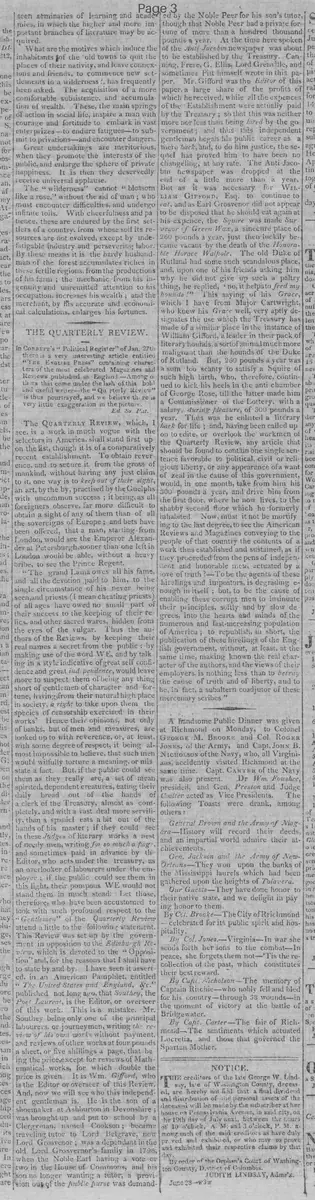
In Cobbett's "Political Register" of Jan. 27th there is a very interesting article entitled "The English Press" containing characters of the most celebrated Magazines and Reviews published in England.—Among others that come under the lash of this bold and useful writer—the "Quarterly Review" is thus pourtrayed, and we believe there is very little exaggeration in the picture.
Ed. So. Pat.
The Quarterly Review, Which, I see, is a work in much vogue with the selectors in America, shall stand first upon the list, though it is of a comparatively recent establishment. To obtain reverence, and to secure it from the gross of mankind, without having any just claim to it, one way is to keep out of their sight, an art, by the by, practised by the Guelphs with uncommon success; it being, as all foreigners observe, far more difficult to obtain a sight of any of them than of all the sovereigns of Europe; and bets have been offered, that a man, starting from London, would see the Emperor Alexander at Petersburgh, sooner than one left in London would be able, without a heavy bribe, to see the Prince Regent.
"The grand Lama owes all his fame, and all the devotion paid to him, to the single circumstance of his never being seen, and priests (I mean cheating priests) of all ages have owed no small part of their success to the keeping of their relics, and other sacred wares, hidden from the eyes of the vulgar. Thus the authors of the Reviews, by keeping their real names a secret from the public; by making use of the word WE, and by talking in a style indicative of great self confidence and great independence, would leave more to suspect them of being any thing short of gentlemen of character and fortune, having, from their natural high place in society, a right to take upon them the species of censorship exercised in their works. Hence their opinions, not only of books, but of men and measures, are looked up to with reverence, or, at least, with some degree of respect, it being almost impossible to believe, that such men would wilfully torture a meaning, or misstate a fact. But, if the public could see them as they really are, a set of mean spirited, dependent creatures, eating their daily bread out of the hands of a clerk of the Treasury, almost as completely, and with a vast deal more servility, than a spaniel eats a bit out of the hands of his master; if they could see in these Judges of literary works a nest of needy men, writing for so much a rag, and sometimes paid in advance by the Editor, who acts under the treasury, as an overlooker of labourers under the employer; if the public could see them in this light, their pompous WE would not stand them in much stead: Let those, therefore, who have been accustomed to look with such profound respect to the "Gentlemen" of the Quarterly Review attend a little to the following statement.
This Review was set up by the government in opposition to the Edinburgh Review, which is devoted to the "Opposition" and, for the reasons that I shall have to state by and by. I have seen it asserted, in an American Pamphlet, entitled "The United States and England, &c." published not long ago, that Southey, the Poet Laureat, is the Editor, or overseer of this work. This is a mistake. Mr. Southey being only one of the principal labourers, or journeymen, writing the review of his own works without payment, and reviews of other works at four pounds a sheet, or five shillings a page, that being the price, except for reviews of Mathematical works, for which double the price is given It is Wm. Gifford, who is the Editor or overseer of this Review.
And, now we will see who this independent gentleman is. He is the son of a shoemaker at Ashburton in Devonshire; was brought up and put to school by a Clergyman, named Cookson; became traveling tutor to Lord Belgrave, now Lord Grosvenor; was a dependant in the old Lord Grosvenor's family in 1796, when the Noble Earl having a vote or two in the House of Commons, and his son no longer wanting a tutor, a provision out of the public purse was demanded by the Noble Peer for his son's tutor. though that Noble Peer had a private fortune of more than a hundred thousand pounds a year. At the time here spoken of the Anti-Jacobin newspaper was about to be established by the Treasury. Canning, Frere, G. Ellis, Lord Grenville, and sometimes Pitt himself wrote in this paper. Mr. Gifford was the Editor of this paper, a large share of the profits of which he received, while all the expences of the Establishment were actually paid by the Treasury; so that this was neither more nor less than being hired by the government; and thus this independent gentleman began his public career as a mere hack, and, to do him justice, the sequel has proved him to have been no changeling, at any rate. The Anti-Jacobin newspaper was dropped at the end of a little more than a year.
But as it was necessary for WILLIAM GIFFORD, Esq. to continue to eat, and as Earl Grosvenor did not appear to be disposed that he should eat again at his expence, the Squire was made Surveyor of Green Wax, a sinecure place of 260 pounds a year, just then luckily becoming vacant by the death of the Honourable Horace Walpole. The old Duke of Rutland had some such scandalous place. and, upon one of his friends asking him why he did not give up such a paltry thing, he replied, no, it helps to feed my hounds!" This saying of his Grace, which I have from Major Cartwright, who knew his Grace well, very aptly designates the use which the Treasury has made of a similar place in the instance of William Gifford, a leader in their pack of literary hounds, a sort of animal much more malignant than the hounds of the Duke of Rutland. But, 260 pounds a year was a sum too scanty to satisfy a Squire of such high birth, who, therefore, continued to kick his heels in the anti chamber of George Rose, till the latter made him a Commissioner of the Lottery, with a salary, during pleasure, of 300 pounds a year. Thus was he enlisted a literary hack for life; and having been called upon to edite, or overlook the workmen of the Quarterly Review, any article that should be found to contain one single sentence favorable to political, civil or religious liberty, or any appearance of a want of zeal in the cause of this government, would, in one month, take from him his 300 pounds a year, and drive him from the first floor, where he now lives, to the shabby second floor which he formerly inhabited. Now, must it not be mortifying to the last degree, to see the American Reviews and Magazines conveying to the people of that country the contents of a work thus established and sustained, as if they proceeded from the pens of independent and honorable men, actuated by a love of truth? -To be the agents of these hirelings and impostors, is degrading enough in itself; but, to be the cause of enabling these corrupt men to insinuate their principles, softly and by slow degrees, into the hearts and minds of the numerous and fast-increasing population of America; to republish, in short, the publication of these hirelings of the English government, without, at least, at the same time, making known the real character of the authors, and the views of their employers, is nothing less than to betray the cause of truth and of liberty, and to be, in fact, a subaltern coadjutor of these mercenary scribes.
What sub-type of article is it?
What themes does it cover?
What keywords are associated?
What entities or persons were involved?
Where did it happen?
Story Details
Key Persons
Location
England
Event Date
January 27th
Story Details
Cobbett's article exposes the Quarterly Review as a government-established counter to the Edinburgh Review, edited by William Gifford, a former shoemaker's son turned patronage-dependent writer, accusing the publication of feigned independence and servility to the Treasury.