Thank you for visiting SNEWPapers!
Sign up free
Letter to Editor
September 19, 1864
Puget Sound Herald
Steilacoom, Pierce County, Washington
What is this article about?
L. C. Gunn, Customs Collector, explains legal restrictions preventing foreign vessels from loading cargo outside Puget Sound's port of entry, citing the Alexandra case, steamboat law violations, and U.S. Treasury guidance, urging Congress to amend the law to restore trade.
Clipping
OCR Quality
96%
Excellent
Full Text
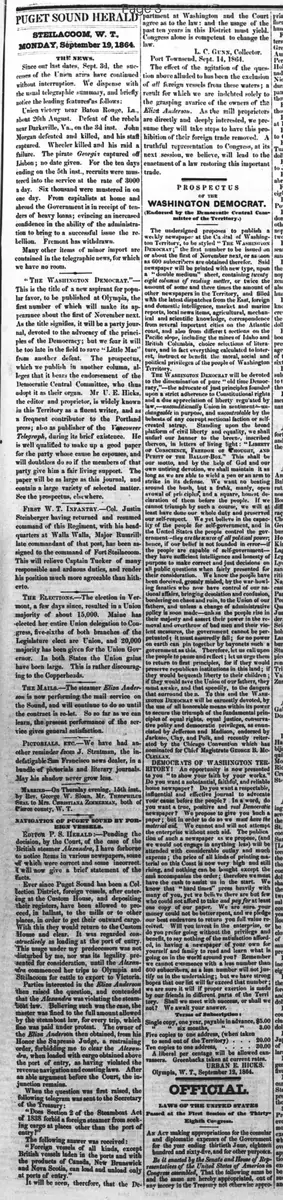
NAVIGATION OF PUGET SOUND BY FOREIGN VESSELS.
EDITOR P. S. HERALD:—Pending the decision, by the Court, of the case of the British steamer Alexandra, I have forborne to notice items in various newspapers, some which were correct and some incorrect. I will now give a brief statement of the facts.
Ever since Puget Sound has been a Collection District, foreign vessels, after entering at the Custom House, and depositing their registers, have been allowed to proceed, in ballast, to the mills or to other places, in order to get their outward cargo. With this they would return to the Custom House and clear. It was regarded constructively as loading at the port of entry. This usage under my predecessors was not disturbed by me, nor was its legality presented for consideration, until the Alexandra commenced her trips to Olympia and Steilacoom for cattle to export to Victoria. Parties interested in the Eliza Anderson then raised the question, and contended that the Alexandra was violating the steamboat law. Believing such was the case, the master was fined to the full amount allowed by the steamboat law, for every trip, which fine was paid under protest. The owner of the Eliza Anderson then obtained, from his Honor the Supreme Judge, a restraining order, forbidding me to clear the Alexandra, when loaded with cargo obtained above the port of entry, as having violated the revenue navigation and coasting laws. After an able argument before the Court, the injunction remains.
When the question was first raised, the following telegram was sent to the Secretary of the Treasury:
"Does Section 2 of the Steamboat Act of 1838 forbid a foreign steamer from seeking cargo at places other than the port of entry?"
The following answer was received:
"Foreign vessels of all kinds, except British vessels laden in the ports and with the products of Canada, New Brunswick and Nova Scotia, can load and unload only at ports of entry."
It will be seen, therefore, that the Department at Washington and the Court agree as to the law: and the usage of the past ten years in this District must yield. Congress alone is competent to change the law.
L. C. GUNN, Collector.
Port Townsend, Sept. 14, 1864.
The effect of the agitation of the question above alluded to has been the exclusion of all foreign vessels from these waters; a result for which we are indebted solely to the grasping avarice of the owners of the Eliza Anderson. As the mill-proprietors are directly and deeply interested, we presume they will take steps to have this prohibition of their foreign trade removed. A truthful representation to Congress, at its next session, we believe, will lead to the enactment of a law restoring this important trade.
EDITOR P. S. HERALD:—Pending the decision, by the Court, of the case of the British steamer Alexandra, I have forborne to notice items in various newspapers, some which were correct and some incorrect. I will now give a brief statement of the facts.
Ever since Puget Sound has been a Collection District, foreign vessels, after entering at the Custom House, and depositing their registers, have been allowed to proceed, in ballast, to the mills or to other places, in order to get their outward cargo. With this they would return to the Custom House and clear. It was regarded constructively as loading at the port of entry. This usage under my predecessors was not disturbed by me, nor was its legality presented for consideration, until the Alexandra commenced her trips to Olympia and Steilacoom for cattle to export to Victoria. Parties interested in the Eliza Anderson then raised the question, and contended that the Alexandra was violating the steamboat law. Believing such was the case, the master was fined to the full amount allowed by the steamboat law, for every trip, which fine was paid under protest. The owner of the Eliza Anderson then obtained, from his Honor the Supreme Judge, a restraining order, forbidding me to clear the Alexandra, when loaded with cargo obtained above the port of entry, as having violated the revenue navigation and coasting laws. After an able argument before the Court, the injunction remains.
When the question was first raised, the following telegram was sent to the Secretary of the Treasury:
"Does Section 2 of the Steamboat Act of 1838 forbid a foreign steamer from seeking cargo at places other than the port of entry?"
The following answer was received:
"Foreign vessels of all kinds, except British vessels laden in the ports and with the products of Canada, New Brunswick and Nova Scotia, can load and unload only at ports of entry."
It will be seen, therefore, that the Department at Washington and the Court agree as to the law: and the usage of the past ten years in this District must yield. Congress alone is competent to change the law.
L. C. GUNN, Collector.
Port Townsend, Sept. 14, 1864.
The effect of the agitation of the question above alluded to has been the exclusion of all foreign vessels from these waters; a result for which we are indebted solely to the grasping avarice of the owners of the Eliza Anderson. As the mill-proprietors are directly and deeply interested, we presume they will take steps to have this prohibition of their foreign trade removed. A truthful representation to Congress, at its next session, we believe, will lead to the enactment of a law restoring this important trade.
What sub-type of article is it?
Informative
Persuasive
Political
What themes does it cover?
Commerce Trade
Economic Policy
What keywords are associated?
Puget Sound Navigation
Foreign Vessels
Port Of Entry
Steamboat Act
Customs Laws
Alexandra Steamer
Eliza Anderson
Trade Restrictions
What entities or persons were involved?
L. C. Gunn, Collector
Editor P. S. Herald
Letter to Editor Details
Author
L. C. Gunn, Collector
Recipient
Editor P. S. Herald
Main Argument
foreign vessels in puget sound must load and unload only at ports of entry per u.s. law and recent court rulings, overturning prior practice; congress must amend the law to allow loading at other locations to restore trade.
Notable Details
British Steamer Alexandra Fined Under Steamboat Act Of 1838
Restraining Order From Supreme Judge
Telegram To Secretary Of The Treasury Confirming Restrictions
Previous 10 Year Usage Now Invalid