Thank you for visiting SNEWPapers!
Sign up free
The People's Voice
Helena, Lewis And Clark County, Montana
What is this article about?
James D. Graham's editorial argues against expanding convict labor in Montana prisons, as recommended by Griffenhagen & Associates. It highlights historical opposition by organized labor, economic failures of past convict industries, and constitutional prohibitions, while defending state institution management and labor gains.
Merged-components note: Merged continuation of the organized labor and convict labor editorial from page 1 to page 3; changed label from story for the continuation.
Clippings
1 of 2
OCR Quality
Full Text
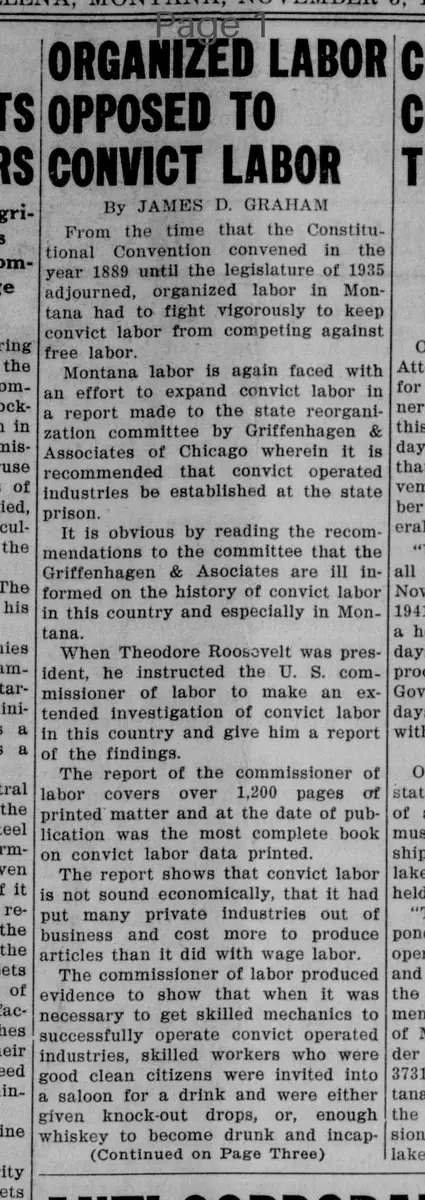
LABOR
OPPOSED TO
CONVICT LABOR
By JAMES D. GRAHAM
From the time that the Constitutional
Convention convened in the
year 1889 until the legislature of 1935
adjourned, organized labor in Montana
had to fight vigorously to keep
convict labor from competing against
free labor.
Montana labor is again faced with
an effort to expand convict labor in
a report made to the state reorganization
committee by Griffenhagen &
Associates of Chicago wherein it is
recommended that convict operated
industries be established at the state
prison.
It is obvious by reading the recommendations
to the committee that the
Griffenhagen & Associates are ill informed
on the history of convict labor
in this country and especially in Montana.
When Theodore Roosevelt was president,
he instructed the U. S. commissioner
of labor to make an extended
investigation of convict labor
in this country and give him a report
of the findings.
The report of the commissioner of
labor covers over 1,200 pages of
printed matter and at the date of publication
was the most complete book
on convict labor data printed.
The report shows that convict labor
is not sound economically, that it had
put many private industries out of
business and cost more to produce
articles than it did with wage labor.
The commissioner of labor produced
evidence to show that when it was
necessary to get skilled mechanics to
successfully operate convict operated
industries, skilled workers who were
good clean citizens were invited into
a saloon for a drink and were either
given knock-out drops, or, enough
whiskey to become drunk and incapable.
(Continued on Page Three)
Organized Labor-
(Continued from Page One)
While in a state of complete intoxication, they were framed up on, arrested and tried for a crime they never committed, with the aid of false witnesses were convicted and given a long term prison sentence. On reaching the state prison the convicted workers were assigned to a convict industry where they either became a foreman, or, a key man in that shop or factory.
For 12 years commencing with the 1923 legislature, laws were enacted creating a convict tannery, garment factory and a convict brick making plant at the Montana state prison. In the building program set up by the special session of the legislature 1933-34, an effort was made to have the state school buildings constructed with convict made brick. Organized labor countered by issuing notice that labor would refuse to handle the convict made bricks and bricks made by wage labor were used on state buildings. At this time the peak of unemployment was on in Montana and throughout the country.
In 1935, the convict tannery and shoe factory were disbanded on account that these plants cost too much to operate and could not compete with free labor on account of the lack of skilled workers to operate the prison shoe factory and tannery. There being no shoe factories and tanneries in Montana, outside of the prison, the necessary skilled workers could not be made drunk, framed up and given a long term prison sentence so that the prison industry could get foremen and key men to successfully operate them.
The constitution of Montana prohibits the farming out of convicts to industry. If it were not for such constitutional provisions, we might expect Griffenhagen & Associates to recommend that the convicts be leased out to contractors and manufacturers for their board, so that the Taxpayers Association might proclaim that the cost of operating the state prison had been reduced, while the unemployed drew out-of-work compensation.
The report of Griffenhagen & Associates on the Warm Springs institution contains nothing new, the information contained therein is what the people of Montana have known for years.
Organized labor in Montana especially the unions of Anaconda and Butte have repeatedly called the attention of the people and legislature to the situation at Warm Springs. The Montana State Federation of Labor over 30 years ago investigated the
situation at the state hospital and repeatedly urged the legislature to make appropriations to correct the situation, but no attention was given to labor's charges.
In 1924 when the late Governor Dixon was campaigning for re-election, he called the voters attention to conditions at the state institutions at Warm Springs and Boulder and urged the people of Montana to elect men to the legislature who would vote an appropriation to take adequate care of these institutions.
Representatives of labor for a number of years have repeatedly requested the State Board of Examiners to put more people to work at the state hospital, so that the employees of that institution would only work the eight hours per day -prescribed by law instead of twelve hours a day.
The members of the board always replied:
"The legislature did not appropriate enough money to allow us to increase the staff at Warm Springs." The representatives of labor could have taken court action, however, if we had secured the eight hour days for the employees of the state hospital the patients would have suffered.
The trouble at Warm Springs and Boulder is caused wholly by the legislature not appropriating sufficient funds to operate and maintain these institutions.
The report of the Griffenhagen & Associates is not complimentary to the superintendent's work at the state hospital.
Doctor Pampel, who is in control at Warm Springs is a man of sterling character, an ideal man for the position, kind hearted and sympathetic towards the patients and doing everything that can be done under the circumstances for their welfare.
No carpet bagging, mercenary reformers can come into Montana and smear Dr. Pampel and get away with it.
The Griffenhagen & Associates report appears to be aimed against labor. The office of labor co-ordinator is to be abolished although that office has done wonderful work in preventing strikes and is much appreciated by both contractors and workers alike.
Three years ago the legislature enacted a measure for the establishing of a department of industrial hygiene which will work for the elimination of occupational diseases. This department has made a great progress so much so that the federal authorities in charge of the nation's health, credits Montana with having the best and most up-to-date industrial hygiene laboratory of any state.
It is now suggested that the department of industrial hygiene be crippled by the discharge of part of the staff, although the federal government pays more than half the cost of operating and maintaining the department of industrial hygiene of Montana.
The Griffenhagen & Associates, the Taxpayers Association and the state reorganization committee appear to desire to make labor the goat. They should be careful as goats have a habit of butting those who tease them.
Labor in Montana will not be the goat for anyone and will resist any attempt to take away from the workers any of the gains that labor has won.
The wage workers of Montana constitute more than fifty-one percent of the population of the state and have no representation on the state reorganization committee.
Our slogan is: NEMO ME IMPUNE LACESSIT.
What sub-type of article is it?
What keywords are associated?
What entities or persons were involved?
Editorial Details
Primary Topic
Opposition To Expanding Convict Labor In Montana Prisons
Stance / Tone
Strongly Supportive Of Organized Labor And Opposed To Convict Labor Expansion
Key Figures
Key Arguments