Thank you for visiting SNEWPapers!
Sign up free
Alexandria Advertiser And Commercial Intelligencer
Alexandria, Virginia
What is this article about?
In the U.S. Senate on January 29, Mr. Chipman concludes his speech on the judiciary bill, arguing for the establishment of inferior courts and the independence of judges during good behavior, protected from removal or salary diminution except by impeachment, to uphold constitutional checks.
Clipping
OCR Quality
Full Text
OF THE UNITED STATES.
Tuesday, January 29.
JUDICIARY.
BILL.
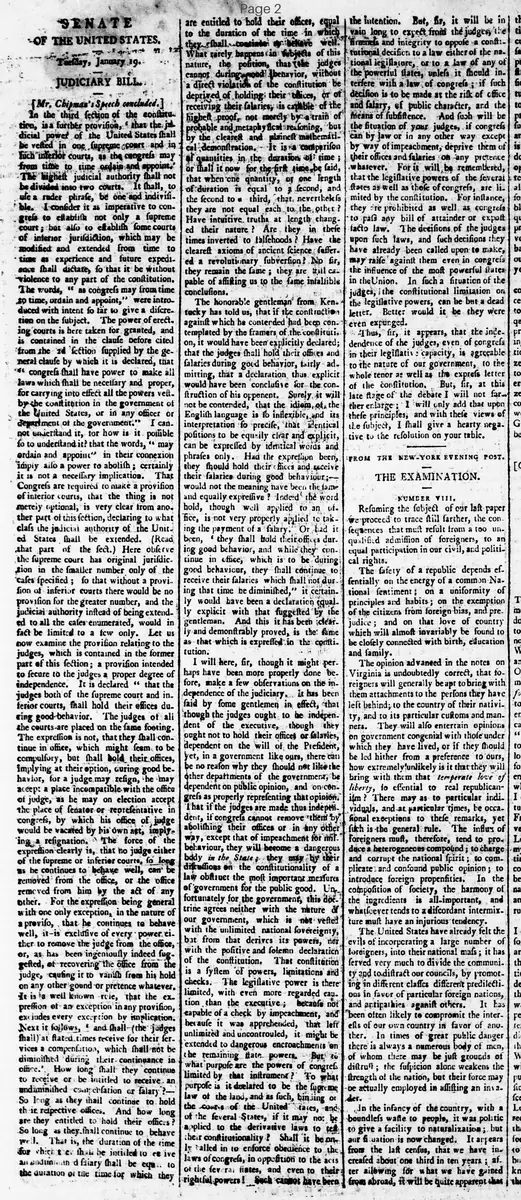
Mr. Chipman's Speech concluded.
In the third section of the constitution, is a further provision, that the judicial power of the United States shall be vested in one supreme court and in such inferior courts, as the congress may from time to time ordain and appoint.
The highest judicial authority shall not be divided into two courts. It shall, to use a ruder phrase, be one and indivisible. I consider it as imperative to congress, to establish not only a supreme court; but also to establish some courts of inferior jurisdiction, which may be modified and extended from time to time as experience and future expediency shall dictate, so that it be without violence to any part of the constitution.
The words, "as congress may from time to time, ordain and appoint," were introduced with intent so far to give a discretion on the subject. The power of erecting courts is here taken for granted, and is contained in the clause before cited from the 2d section supplied by the general clause by which it is declared, that "congress shall have power to make all laws which shall be necessary and proper, for carrying into effect all the powers vested by the constitution in the government of the United States, or in any officer or department of the government." I cannot understand it, for how is it possible to understand it? that the words, "may ordain and appoint" in their connexion imply also a power to abolish; certainly it is not a necessary implication. That Congress are required to make a provision of inferior courts, that the thing is not merely optional, is very clear from another part of this section, declaring to what class the judicial authority of the United States shall be extended. (Read that part of the act.) Here observe the supreme court has original jurisdiction in the smaller number only of the cases specified; so that without a provision of inferior courts there would be no provision for the greater number, and the judicial authority instead of being extended to all the cases enumerated, would in fact be limited to a few only. Let us now examine the provision relating to the judges, which is contained in the former part of this section; a provision intended to secure to the judges a proper degree of independence. It is declared "that the judges both of the supreme court and inferior courts, shall hold their offices during good behavior. The judges of all the courts are placed on the same footing.
The expression is not, that they shall continue in office, which might seem to be compulsory, but shall hold their offices, implying at their option, during good behavior, for a judge may resign, he may accept a place incompatible with the office of judge, as he may on election accept the place of senator or representative in congress, by which his office of judge would be vacated by his own act, implying a resignation. The force of the expression clearly is, that no judge either of the supreme or inferior courts, so long as he continues to behave well, can be removed from the office, or the office removed from him by the act of any other. For the expression being general with one only exception, in the nature of a proviso, that he continues to behave well, it is exclusive of every power either to remove the judge from the office, or, as has been ingeniously indeed suggested, of recovering the office from the judge, causing it to vanish from his hold on any other ground or pretence whatever.
It is a well known rule, that the expression of an exception in any provision, excludes every exception by implication.
Next it follows, and shall the judges shall at stated times receive for their services a compensation, which shall not be diminished during their continuance in office. How long shall they continue to receive or be entitled to receive an undiminished compensation or salary?
So long as they shall continue to hold their respective offices. And how long are they entitled to hold their offices?
So long as they shall continue to behave well. That is, the duration of the time for which they shall be entitled to receive an undiminished salary shall be equal to the duration in which they are entitled to hold their offices, equal to the duration of the time in which they shall continue to behave well.
What rarely happens in subjects of this nature, the position, that the judges cannot during good behavior, without a direct violation of the constitution be deprived of holding their offices, or of receiving their salaries; is capable of the highest proof, not merely by a train of probable and metaphysically logical reasoning, but by the clearest and plainest mathematical demonstration. It is a comparison of quantities in the duration of time; shall it now for the first time be said, that when one quantity, or one length of duration is equal to a second, and the second to a third, that, nevertheless they are not equal each to the other?
Have intuitive truths at length changed their nature? Are they in these times inverted to falsehoods? Have the clearest axioms of ancient science suffered a revolutionary subversion? No sir, they remain the same; they are still capable of leading us to the same infallible conclusions.
The honorable gentleman from Kentucky has told us, that if the construction against which he contended had been contemplated by the framers of the constitution, it would have been explicitly declared: that the judges shall hold their offices and salaries during good behavior, fairly admitting, that a declaration thus explicit would have been conclusive for the construction of his opponent. Surely it will not be contended, that the idiom of the English language is so inflexible, and its interpretation so precise, that identical positions to be equally clear and explicit, can be expressed by identical words and phrases only. Had the expression been, they should hold their offices and receive their salaries during good behaviour;
would not the meaning have been the same and equally expressive? Indeed the word hold, though well applied to an office, is not very properly applied to taking the payment of a salary: Or had it been, 'they shall hold their offices during good behavior, and while they continue in office, which is to be during good behaviour, they shall continue to receive their salaries which shall not during that time be diminished,' it certainly would have been a declaration equally explicit with that suggested by the gentleman. And this it has been clearly and demonstrably proved, is the same as that which is expressed in the constitution:
I will here, sir, though it might perhaps have been more properly done before, make a few observations on the independence of the judiciary. It has been said by some gentlemen in effect, that though the judges ought to be independent of the executive, though they ought not to hold their offices or salaries, dependent on the will of the President, yet, in a government like ours, there can be no reason why they should not like the other departments of the government, be dependent on public opinion, and on congress as properly representing that opinion.
That if the judges are made thus independent, if congress cannot remove them by abolishing their offices or in any other way, except that of impeachment for misbehavior, they will become a dangerous body in the State; they may by their decisions on the constitutionality of a law obstruct the most important measures of government for the public good. Unfortunately for the government, this doctrine agrees neither with the nature of our government, which is not vested with the unlimited national sovereignty, but from that derives its powers, nor with the positive and solemn declaration of the constitution. That constitution is a system of powers, limitations and checks. The legislative power is there limited, with even more regarded caution than the executive; because not capable of a check by impeachment, and because it was apprehended, that left unlimited and uncontrolled, it might be extended to dangerous encroachments on the remaining state power. But to what purpose are the powers of congress limited by that instrument? For what purpose is it declared to be the supreme law of the land, and as such, binding on the courts of the United States, and of the several States, if it may not be applied to the derivative laws to test their constitutionality? Shall it be only called in to enforce obedience to the laws of congress, in opposition to the acts of the several states, and even to their rightful powers! Such cannot have been the intention. But by it will be in vain long to expect from the judges the firmness and integrity to oppose a constitutional decision to a law either of the national legislature, or to a law of any of the powerful states in the Union, unless it should interfere with a law of congress; if such decision is to be made at the risk of office and salary, of public character, and the means of subsistence. And such will be the situation of your judges, if congress can by law or in any other way except by way of impeachment, deprive them of their offices and salaries on any pretence whatever. For it will be remembered, that the legislative powers of the several states as well as those of congress, are limited by the constitution. For instance, they are prohibited as well, as congress to pass any bill of attainder or ex post facto law. The decisions of the judges upon such laws, and such decisions they have already been called upon to make, may raise against them even in congress the influence of the most powerful states in the Union. In such a situation of the judges, the constitutional limitation on the legislative powers, can be but a dead letter. Better would it be they were even expunged.
Thus, sir, it appears, that the independence of the judges, even of congress in their legislative capacity, is agreeable to the nature of our government, to the whole tenor as well as the express letter of the constitution. But, it, at this late stage of the debate I will not further enlarge; I will only add that upon these principles; and with these views of the subject, I shall give a hearty negative to the resolution on your table.
What sub-type of article is it?
What keywords are associated?
What entities or persons were involved?
Where did it happen?
Domestic News Details
Primary Location
United States
Event Date
Tuesday, January 29.
Key Persons
Outcome
mr. chipman announces he will vote against the resolution.
Event Details
Mr. Chipman concludes his speech arguing that Congress must establish inferior courts as required by the Constitution, and that judges of both supreme and inferior courts hold office during good behavior with undiminished compensation, ensuring judicial independence from removal or salary reduction except by impeachment. He refutes arguments for congressional power to abolish courts or diminish judicial security, emphasizing constitutional checks and balances.