Thank you for visiting SNEWPapers!
Sign up free
Alexandria Daily Gazette, Commercial & Political
Alexandria, Virginia
What is this article about?
Spanish merchant Antonio Mordell y Spotorno publishes 'Manifesto to Europe: Or Antonio vs. Napoleon,' denouncing Bonaparte's tyranny, contrasting it with Louis XVI's rule, and urging Europeans and Americans to unite against him. (187 characters)
Clipping
OCR Quality
Full Text
Or Antonio vs. Napoleon.
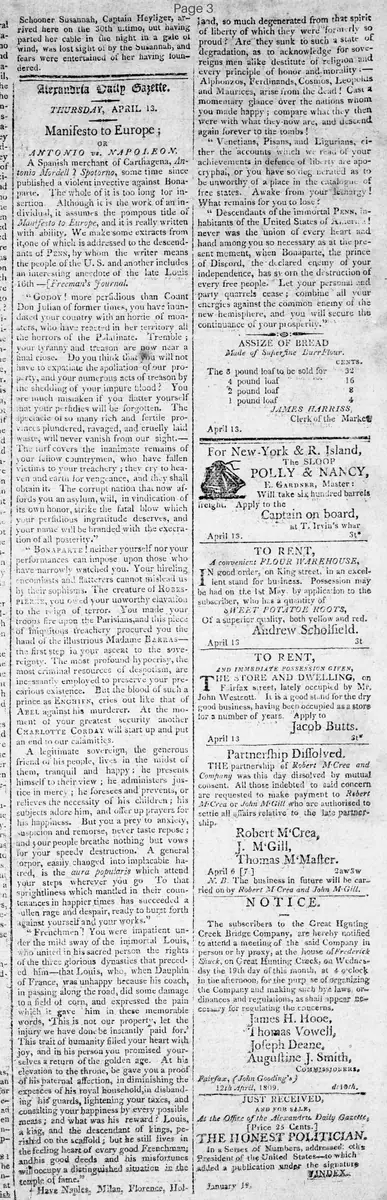
A Spanish merchant of Carthagena, Antonio Mordell y Spotorno, some time since published a violent invective against Bonaparte. The whole of it is too long for insertion. Although it is the work of an individual, it assumes the pompous title of Manifesto to Europe, and it is really written with ability. We make some extracts from it, one of which is addressed to the descendants of Penn, by whom the writer means the people of the U. S. and another includes an interesting anecdote of the late Louis 16th --[Freeman's Journal.
"Bonaparte! more perfidious than Count Don Julian of former times, you have inundated your country with an horde of monsters, who have enacted in her territory all the horrors of the Palatinate. Tremble; your tyranny and treason are now near a final close. Do you think that you will not have to expiate the spoliation of our property, and your numerous acts of treason by the shedding of your impure blood? You are much mistaken if you flatter yourself that your perfidies will be forgotten. The spectacle of so many rich and fertile provinces plundered, ravaged, and cruelly laid waste, will never vanish from our sight.-- The turf covers the inanimate remains of your fellow countrymen, who have fallen victims to your treachery; they cry to heaven and earth for vengeance, and they shall obtain it. The corrupt nation that now affords you an asylum, will, in vindication of its own honor, strike the fatal blow which your perfidious ingratitude deserves, and your name will be branded with the execration of all posterity."
"Bonaparte! neither yourself nor your performances can impose upon those who have narrowly watched you. Your hireling encomiasts and flatterers cannot mislead us by their sophisms. The creature of Robespierre, you owed your unworthy elevation to the reign of terror. You made your troops fire upon the Parisians, and this piece of iniquitous treachery procured you the hand of the illustrious Madame Barras-- the first step in your ascent to the sovereignty. The most profound hypocrisy, the most criminal resources of despotism, are incessantly employed to preserve your precarious existence. But the blood of such a prince as Enghien, cries out like that of Abel against his murderer. At the moment of your greatest security another Charlotte Corday will start up and put an end to our calamities.
A legitimate sovereign, the generous friend of his people, lives in the midst of them, tranquil and happy: he presents himself to their view; he administers justice in mercy; he foresees and prevents, or relieves the necessity of his children; his subjects adore him, and offer up prayers for his happiness. But you a prey to anxiety, suspicion and remorse, never taste repose; and your people breathe nothing but vows for your speedy destruction. A general torpor, easily changed into implacable hatred, is the aura popularis which attend your steps wherever you go To that sprightliness which mantled in their countenances in happier times has succeeded a sullen rage and despair, ready to burst forth against yourself and your works."
"Frenchmen! You were impatient under the mild sway of the immortal Louis, who united in his sacred person the rights of the three glorious dynasties that preceded him--that Louis, who, when Dauphin of France, was unhappy because his coach, in passing along the road, did some damage to a field of corn, and expressed the pain which it gave him in these memorable words, This is not our property, let the injury we have done be instantly paid for.? This trait of humanity filled your heart with joy, and in his person you promised yourselves a return of the golden age. At his elevation to the throne, he gave you a proof of his paternal affection, in diminishing the expenses of his royal household, in disbanding his guards, lightening your taxes, and consulting your happiness by every possible means: and what was his reward? Louis, a king, and the descendant of kings, perished on the scaffold; but he still lives in the feeling heart of every good Frenchman; and his good deeds and his misfortunes will occupy a distinguished situation in the temple of fame."
Have Naples, Milan, Florence, Holland, so much degenerated from that spirit of liberty of which they were formerly so proud? Are they sunk to such a state of degradation, as to acknowledge for sovereigns men alike destitute of religion and every principle of honor and morality :-- Alphonzos, Ferdinands, Cosmos, Leopoids and Maurices, arise from the dead! Cast a momentary glance over the nations whom you made happy ; -compare what they then were with what they now are. and descend again forever to the tombs !
"Venetians, Pisans, and Ligurians, either the accounts which we read of your achievements in defence of liberty are apocryphal, or you have so degenerated as to be unworthy of a place in the catalogue of free states. Awake from your lethargy ! What remains for you to lose?
Descendants of the immortal Penn, inhabitants of the United States of America! never was the union of every heart and hand among you so necessary as at the present moment, when Bonaparte, the prince of Discord, the declared enemy of your independence, has sworn the destruction of every free people. Let your personal and party quarrels cease; combine all your energies against the common enemy of the new-hemisphere, and you will secure the continuance of your prosperity."
What sub-type of article is it?
What keywords are associated?
What entities or persons were involved?
Where did it happen?
Foreign News Details
Primary Location
Cartagena
Key Persons
Event Details
A Spanish merchant from Cartagena, Antonio Mordell y Spotorno, published a manifesto titled 'Manifesto to Europe: Or Antonio vs. Napoleon,' a violent invective against Bonaparte. Extracts address Bonaparte directly, accusing him of tyranny and treason; Frenchmen, contrasting Bonaparte's rule with Louis XVI's benevolence; and call upon historical figures and regions like Naples, Milan, and the United States to resist Bonaparte's despotism.