Thank you for visiting SNEWPapers!
Sign up free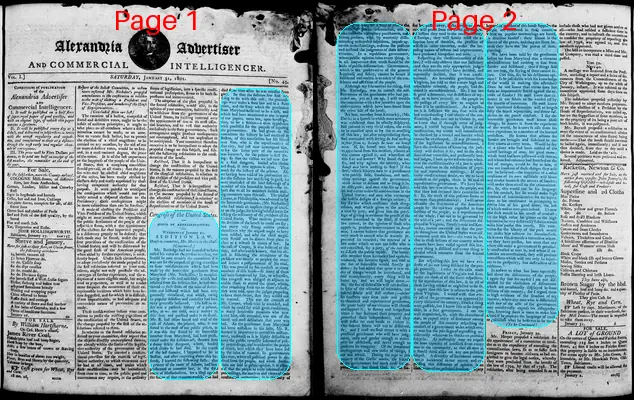
Alexandria Advertiser And Commercial Intelligencer
Alexandria, Virginia
What is this article about?
In the U.S. House of Representatives on January 21, Mr. Rutledge delivers a speech correcting Mr. Nicholson's misstatements about the Sedition Law's effects, clarifying the printer Adams case as a state matter where Adams is alive, defending Judge's decision in Cooper's trial, and emphasizing the law's role in ensuring truthful public information against deception.
Merged-components note: Continuation of congressional debate on the sedition law, indicated by '(Continued.)' and seamless flow of Mr. Rutledge's speech.
Clippings
1 of 2
OCR Quality
Full Text
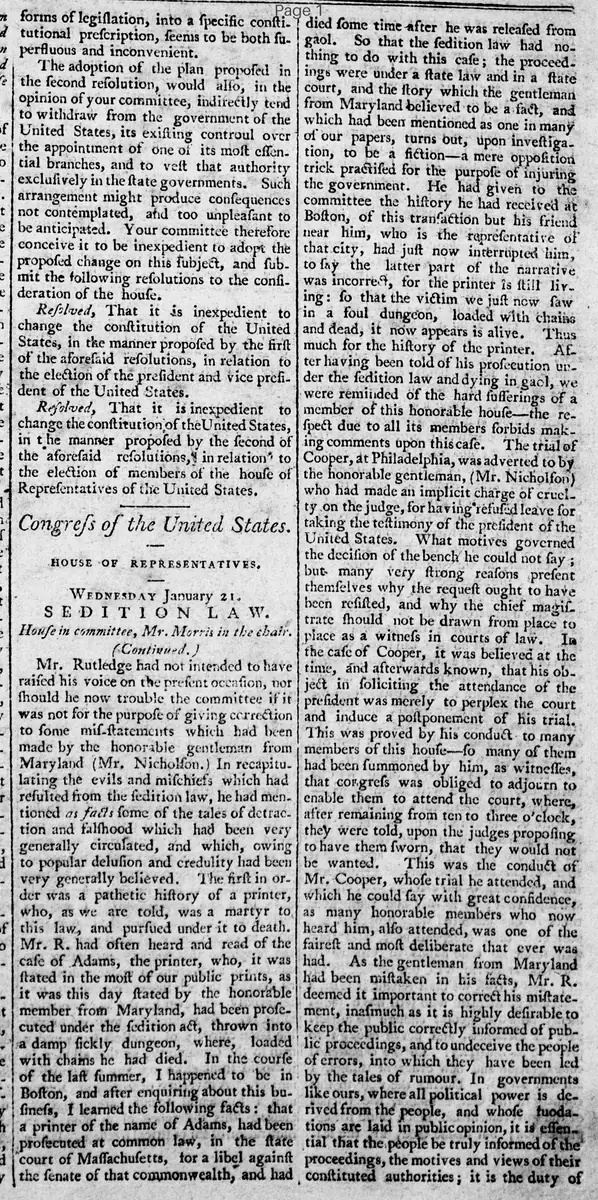
HOUSE OF REPRESENTATIVES.
Wednesday January 21.
SEDITION LAW.
House in committee, Mr. Morris in the chair.
(Continued.)
Mr. Rutledge had not intended to have raised his voice on the present occasion, nor should he now trouble the committee if it was not for the purpose of giving correction to some mis-statements which had been made by the honorable gentleman from Maryland (Mr. Nicholson.) In recapitulating the evils and mischiefs which had resulted from the sedition law, he had mentioned as facts some of the tales of detraction and falsehood which had been very generally circulated, and which, owing to popular delusion and credulity had been very generally believed. The first in order was a pathetic history of a printer, who, as we are told, was a martyr to this law. and pursued under it to death.
Mr. R. had often heard and read of the case of Adams. the printer, who, it was stated in most of our public prints, as it was this day stated by the honorable member from Maryland, had been prosecuted under the sedition act, thrown into a damp sickly dungeon, where, loaded with chains he had died. In the course of the last summer, I happened to be in Boston, and after enquiring about this business. I learned the following facts : that a printer of the name of Adams, had been prosecuted at common law, in the state court of Massachusetts, for a libel against the senate of that commonwealth, and had died some time after he was released from gaol. So that the sedition law had nothing to do with this case: the proceedings were under a state law and in a state court, and the story which the gentleman from Maryland believed to be a fact, and which had been mentioned as one in many of our papers, turns out, upon investigation, to be a fiction--a mere opposition trick practiced for the purpose of injuring the government. He had given to the committee the history he had received at Boston, of this transaction but his friend near him, who is the representative of that city, had just now interrupted him, to say the latter part of the narrative was incorrect, for the printer is still living: so that the victim we just now saw in a foul dungeon, loaded with chains and dead, it now appears is alive. Thus much for the history of the printer. After having been told of his prosecution under the sedition law and dying in gaol, we were reminded of the hard sufferings of a member of this honorable house -the respect due to all its members forbids making comments upon this case. The trial of Cooper, at Philadelphia, was adverted to by the honorable gentleman, (Mr. Nicholson) who had made an implicit charge of cruelty on the judge, for having refused leave for taking the testimony of the president of the United States. What motives governed the decision of the bench he could not say : but- many very strong reasons present themselves why the request ought to have been resisted, and why the chief magistrate should not be drawn from place to place as a witness in courts of law. In the case of Cooper, it was believed at the time, and afterwards known, that his object in soliciting the attendance of the president was merely to perplex the court and induce a postponement of his trial. This was proved by his conduct to many members of this house--so many of them had been summoned by him, as witnesses. that congress was obliged to adjourn to enable them to attend the court, where, after remaining from ten to three o'clock, they were told, upon the judges proposing to have them sworn, that they would not be wanted. This was the conduct of Mr. Cooper, whose trial he attended, and which he could say with great confidence, as many honorable members who now heard him, also attended, was one of the fairest and most deliberate that ever was had. As the gentleman from Maryland had been mistaken in his facts, Mr. R. deemed it important to correct his mistake.ment, inasmuch as it is highly desirable to keep the public correctly informed of public proceedings, and to undeceive the people of errors, into which they have been led by the tales of rumour. In governments like ours, where all political power is derived from the people, and whose foundations are laid in public opinion, it is essential that the people be truly informed of the proceedings, the motives and views of their constituted authorities: it is the duty of the latter to keep in a state of purity the channels of public information, and to make liable to exemplary punishment, malicious persons, who, by wantonly disseminating unfounded suspicions, impose upon the understandings, enflame the passions and mislead the judgments of their fellow citizens. In a republican government, where public opinion rules every thing, it is all important that truth should be the basis of public information. Government, which is the preservative of the general happiness and safety, cannot be secure if falsehood and malice is to rob it of the confidence and affection of the people.
Although my sole motive for rising, said Mr. Rutledge, was to correct the misstatements of the gentleman who had preceded me, yet as I am up, I will trouble the committee with a few remarks upon the observations which have been heard from the other side of the house.
An hon. member from Kentucky, (Mr. Davis) in a speech in which more acrimony was exhibited than he usually displayed, had painted in very vivid colors, the evils to be entailed upon us by the re-enacting of this law ; but after recapitulating them, had concluded with saying he had nothing to fear from it, because he was an honest man. If, sir, honest men have nothing to apprehend from this measure, whence all this clamor against it, and wherefore all this fear and horror ? Why sound the tocsin, and why agitate the country, when honest men have nothing to fear ? If this law, which subjects men to a punishment who publish false, scandalous, and malicious writings against the government, with intent to defame and to bring it into disrepute: and men who stir up sedition and excite unlawful combinations in the United States; and men who encourage the hostile designs of a foreign nation ; I say if a law which constitutes these things crimes, and which gives to the accused a trial by jury, and gives him the privilege of giving in evidence the proofs of the matter contained in the libel, if such a law cannot, in the opinion of those who oppose it, produce inconvenience to honest men, I cannot believe that gentlemen are very much in earnest who so warmly deprecated its renewal; the renewal of a law under which no man can suffer who is not convicted, by a jury, of the intention to disturb the public repose. The honorable member from Kentucky had again introduced, his favorite figure, and told us the sun of federalism would shortly go down : he had added that quite a new order of things would be introduced, and said triumphantly, every thing will be burnt up, and we will begin anew.
Sir, the sun of federalism will not decline ; in spite of the whimsies of reformers, our federal fabric - will still endure;--though its structure may seem rude and gothic to theoretical and experimental gentlemen, the great body of our citizens will cherish and support it ; in stormy and tempestuous times it has sheltered their property and protected their independence, and they will suffer no rude hands to violate it. Our federal fabric will not be dissolved. Sir : and I trust we shall tenant it with a practical gentleman who will have judgment, taste and genius enough to anticipate its usefulness, and nerve enough to preserve its integrity. Of the threatened conflagration and new order of things, I am not afraid. During the rage in this country of the Gallic mania, the friends of the government had much cause for apprehension; but thank God, sir, the ca
What sub-type of article is it?
What themes does it cover?
What keywords are associated?
What entities or persons were involved?
Where did it happen?
Story Details
Key Persons
Location
House Of Representatives
Event Date
Wednesday January 21
Story Details
Mr. Rutledge corrects Mr. Nicholson's misstatements about the Sedition Law, clarifying that printer Adams was prosecuted under state law in Massachusetts and is alive, defends the fairness of Cooper's trial in Philadelphia, and argues for the law's necessity to punish malicious falsehoods and maintain truthful public information in a republic.