Thank you for visiting SNEWPapers!
Sign up free
Editorial
July 19, 1836
Alexandria Gazette
Alexandria, Alexandria County, District Of Columbia
What is this article about?
The editorial criticizes the unequal application of justice in courts, where poor and obscure individuals are easily convicted for minor crimes, while the wealthy and influential escape punishment. It cites the case of E. K. Avery and quotes Shakespeare to highlight class privilege in the legal system.
Clipping
OCR Quality
95%
Excellent
Full Text
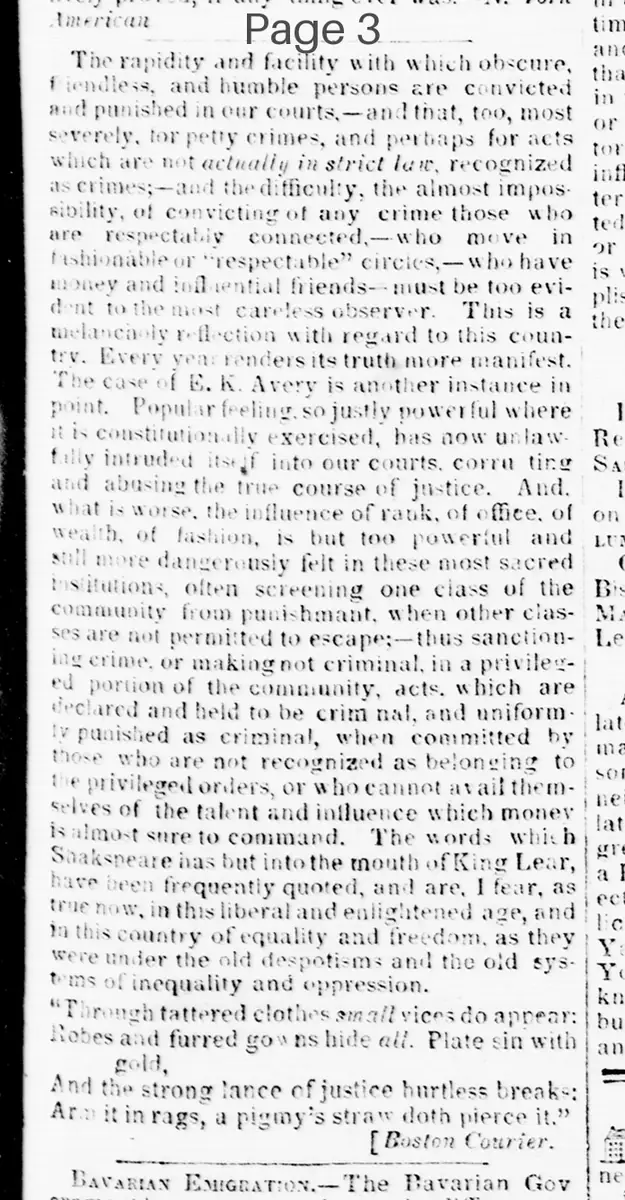
The rapidity and facility with which obscure, friendless, and humble persons are convicted and punished in our courts,—and that, too, most severely, for petty crimes, and perhaps for acts which are not actually in strict law, recognized as crimes;—and the difficulty, the almost impossibility, of convicting of any crime those who are respectably connected,—who move in fashionable or "respectable" circles,—who have money and influential friends—must be too evident to the most careless observer. This is a melancholy reflection with regard to this country. Every year renders its truth more manifest. The case of E. K. Avery is another instance in point. Popular feeling, so justly powerful where it is constitutionally exercised, has now unlawfully intruded itself into our courts, corrupting and abusing the true course of justice. And, what is worse, the influence of rank, of office, of wealth, of fashion, is but too powerful and still more dangerously felt in these most sacred institutions, often screening one class of the community from punishment, when other classes are not permitted to escape:—thus sanctioning crime, or making not criminal, in a privileged portion of the community, acts, which are declared and held to be criminal, and uniformly punished as criminal, when committed by those who are not recognized as belonging to the privileged orders, or who cannot avail themselves of the talent and influence which money is almost sure to command. The words which Shakespeare has put into the mouth of King Lear, have been frequently quoted, and are, I fear, as true now, in this liberal and enlightened age, and in this country of equality and freedom, as they were under the old despotisms and the old systems of inequality and oppression.
"Through tattered clothes small vices do appear:
Robes and furred gowns hide all. Plate sin with gold,
And the strong lance of justice hurtless breaks:
As it in rags, a pigmy's straw doth pierce it."
[Boston Courier.]
"Through tattered clothes small vices do appear:
Robes and furred gowns hide all. Plate sin with gold,
And the strong lance of justice hurtless breaks:
As it in rags, a pigmy's straw doth pierce it."
[Boston Courier.]
What sub-type of article is it?
Crime Or Punishment
Legal Reform
Social Reform
What keywords are associated?
Class Inequality
Criminal Justice
Court Bias
Wealthy Privilege
Petty Crimes
Popular Feeling
Legal Corruption
What entities or persons were involved?
E. K. Avery
Shakespeare
King Lear
Boston Courier
Editorial Details
Primary Topic
Inequality In Criminal Convictions Based On Social Class
Stance / Tone
Critical Of Class Bias In Justice System
Key Figures
E. K. Avery
Shakespeare
King Lear
Boston Courier
Key Arguments
Obscure And Humble Persons Are Easily Convicted And Severely Punished For Petty Crimes
Respectable And Wealthy Individuals Are Nearly Impossible To Convict
Popular Feeling Unlawfully Influences Courts, Corrupting Justice
Influence Of Rank, Wealth, And Fashion Screens Privileged Classes From Punishment
Shakespeare's Words From King Lear Remain True In Modern Society