Thank you for visiting SNEWPapers!
Sign up free
The New Hampshire Gazette
Portsmouth, Rockingham County, New Hampshire
What is this article about?
On May 25, 1832, the U.S. Senate discussed memorials on duties, private bills, Treasury interest, Chesapeake and Ohio Railroad, and the U.S. Bank Charter, with speeches by Webster and Moore. The House concurred on post roads amendments, received a census omissions letter, and debated a bill for 5,000 copies of U.S. laws by Duff Green, opposed by Clay and Foster for high cost, with cheaper alternatives proposed by James Kay & Co.
Clipping
OCR Quality
Full Text
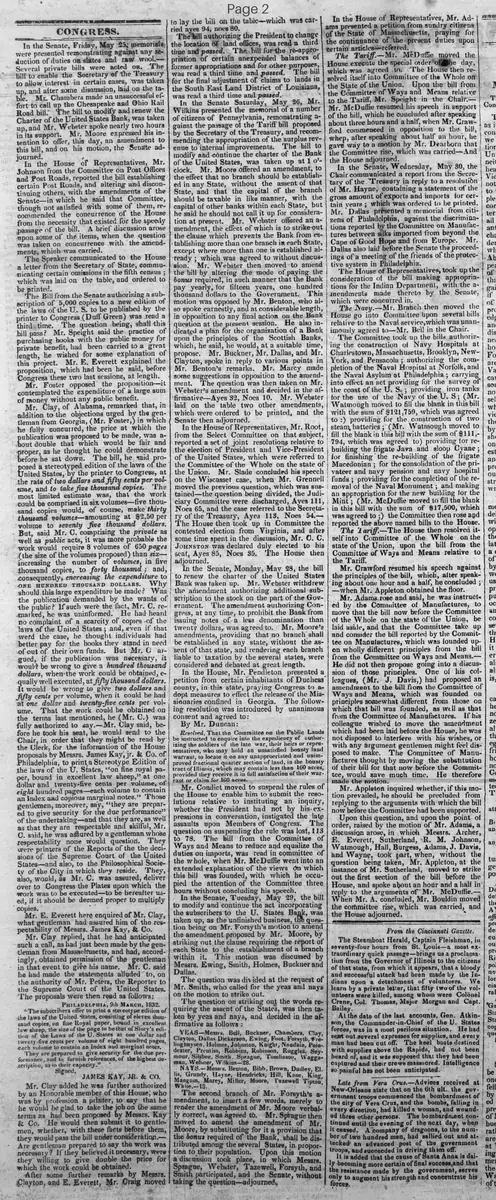
In the Senate, Friday, May 25, memorials were presented remonstrating against any reduction of duties on slates and raw wool. Several private bills were acted on. The bill to enable the Secretary of the Treasury to allow interest in certain cases, was taken up, and after some discussion, laid on the table. Mr. Chambers made an unsuccessful effort to call up the Chesapeake and Ohio Rail Road bill. The bill to modify and renew the Charter of the United States Bank, was taken up, and Mr. Webster spoke nearly two hours in its support. Mr. Moore expressed his intention to offer, this day, an amendment to this bill, and on his motion, the Senate adjourned.
In the House of Representatives, Mr. Johnson from the Committee on Post Offices and Post Roads, reported the bill establishing certain Post Roads, and altering and discontinuing others, with the amendments of the Senate—in which he said that Committee, though not satisfied with some of them, recommended the concurrence of the House from the necessity that existed for the speedy passage of the bill. A brief discussion arose upon some of the items, when the question was taken on concurrence with the amendments, which was carried.
The Speaker communicated to the House a letter from the Secretary of State, communicating certain omissions in the fifth census; which was laid on the table, and ordered to be printed.
The Bill from the Senate authorizing a subscription of 5,000 copies to a new edition of the laws of the U. S. to be published by the printer to Congress (Duff Green) was read a third time. The question being, shall this bill pass? Mr. Speight said the practice of purchasing books with the public money for private benefit, had been carried to a great length, he wished for some explanation of this project. Mr. E. Everett explained the proposition, which had been he said, before Congress these two last sessions, at length. Mr. Foster opposed the proposition—it contemplated the expenditure of a large sum of money without any public benefit. Mr. Clay, of Alabama, remarked that, in addition to the objections urged by the gentleman from Georgia, (Mr. Foster,) in which he fully concurred, the price at which the publication was proposed to be made, was about double that which would be fair and proper, as he thought he could demonstrate before he sat down. The bill, he said proposed a stereotyped edition of the laws of the United States, by the printer to Congress, at the rate of two dollars and fifty cents per volume, and to take five thousand copies. The most limited estimate was, that the work could be comprised in six volumes—five thousand copies would, of course, make thirty thousand volumes—amounting at $2.50 per volume to seventy five thousand dollars. But, said Mr. C. comprising the private as well as public acts, it was more probable the work would require 8 volumes of 650 pages (the size of the volumes proposed) than six—increasing the number of volumes, in five thousand copies, to forty thousand; and consequently, increasing the expenditure to ONE HUNDRED THOUSAND DOLLARS. Why should this large expenditure be made? Was the publication demanded by the wants of the public? If such were the case, Mr. C. remarked, he was uninformed. He had heard no complaint of a scarcity of copies—of the laws of the United States; and, even if that were the case, he thought individuals had better pay for the books they stand in need of out of their own funds. But Mr. C. argued, if the publication was necessary, it would be wrong to give a hundred thousand dollars, when the work could be obtained, equally well executed, at fifty thousand dollars. It would be wrong to give two dollars and fifty cents per volume, when it could be had at one dollar and twenty-five cents per volume. That the work could be obtained on the terms last mentioned, he (Mr. C.) was fully authorized to say. Mr. Clay said, before he took his seat, he would send to the Chair, in order that they might be read by the Clerk, for the information of the House proposals by Messrs. James Kay, jr. & Co. of Philadelphia, to print a Stereotype Edition of the laws of the U. States, "on fine royal paper, bound in excellent law sheep," at one dollar and twenty-five cents per volume, of eight hundred pages—each volume to contain an Index and copious marginal notes. Those gentlemen, moreover, say, "they are prepared to give security for the due performance" of the undertaking—and that they are, as well as that they are respectable and skilful, Mr. C. said, he was assured by a gentleman whose respectability none would question. They were printers of the Reports of the decisions of the Supreme Court of the United States—and also, to the Philosophical Society of the City in which they reside. They, also, would, as Mr. C. was assured, deliver over to Congress the Plates upon which the work was to be executed—to be hereafter used, if it should be deemed proper to multiply copies.
Mr. E. Everett here enquired of Mr. Clay, what gentleman had assured him of the respectability of Messrs. James Kay, & Co. Mr. Clay replied, that he had anticipated such a call, as had just been made by the gentleman from Massachusetts, and had, accordingly, obtained permission of the gentleman in that event to give his name. Mr. C. said he had made the statements alluded to, on the authority of Mr. Peters, the Reporter to the Supreme Court of the United States The proposals were then read as follows:
PHILADELPHIA, 9th MARCH, 1832.
The subscribers offer to print a stereotype edition of the laws of the United States, consisting of eleven thousand copies, on fine Royal paper, bound in excellent law sheep, the size of the page to be that of Story's edition of the Laws of the U. States at one dollar and twenty-five cents per volume of eight hundred pages, each volume to contain an Index and marginal notes. They are prepared to give security for the due performance, and to furnish references, of the highest description, as to their capacity.
Signed,
JAMES KAY, JR. & CO.
Mr. Clay added he was further authorized by an Honorable member of this House; who was by profession a printer, to say that he he would be glad to take the job on the same terms as had been proposed by Messrs. Kay & Co. He would then submit it to gentlemen, whether, with these facts before them, they would pass the bill under consideration. Are gentlemen prepared to say the work was necessary? If they believed it necessary, were they willing to give double the price for which the work could be obtained.
After some further remarks by Messrs. Clayton, and E. Everett, Mr. Craig moved
What sub-type of article is it?
What keywords are associated?
What entities or persons were involved?
Domestic News Details
Event Date
1832 05 25
Key Persons
Outcome
senate adjourned after discussions; house concurred on post roads amendments; census letter printed; bill for laws publication debated with opposition on cost, no final vote mentioned as text cuts off.
Event Details
Senate proceedings included memorials against duty reductions on slates and raw wool, actions on private bills, tabling of Treasury interest bill, failed call for Chesapeake and Ohio Rail Road bill, and debate on U.S. Bank Charter bill with speeches by Webster and Moore. House reported and concurred on post roads bill amendments, received and printed Secretary of State's letter on census omissions, and debated Senate bill for 5,000 copies of U.S. laws by Duff Green, with Speight, Everett, Foster, and Clay opposing due to cost and proposing cheaper alternative by James Kay & Co. of Philadelphia at $1.25 per volume versus $2.50, endorsed by Mr. Peters; further remarks by Clayton, Everett, and motion by Craig.