Thank you for visiting SNEWPapers!
Sign up free
Editorial
January 12, 1866
Southern Christian Advocate
Charleston, Charleston County, South Carolina
What is this article about?
This editorial emphasizes the Christian imperative to help one another, drawing from Christ's teachings and the Good Samaritan parable. It critiques selfishness among the refined and calls for active assistance to those suffering in society, urging readers to see all as neighbors in need.
Clipping
OCR Quality
100%
Excellent
Full Text
HELPING ONE ANOTHER.
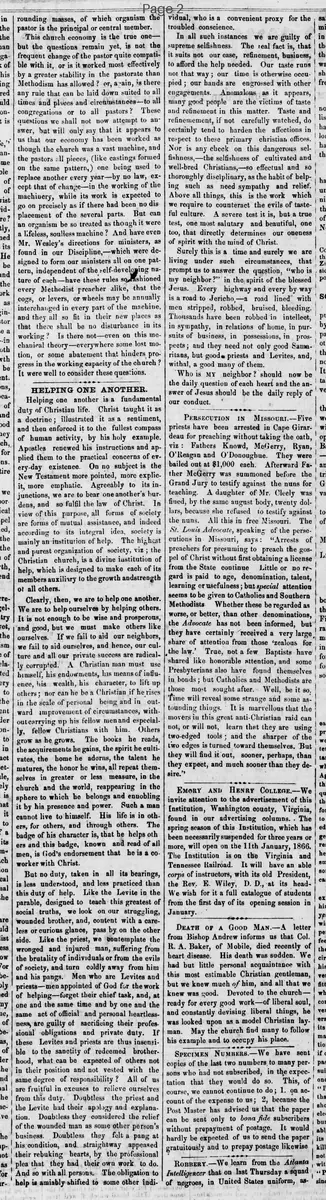
Helping one another is a fundamental duty of Christian life. Christ taught it as a doctrine; illustrated it as a sentiment, and then enforced it to the fullest compass of human activity, by his holy example. Apostles renewed his instructions and applied them to the practical concerns of every-day existence. On no subject is the New Testament more pointed, more explicit, more emphatic. Agreeably to its injunctions, we are to bear one another's burdens, and so fulfil the law of Christ. In view of this purpose, all forms of society are forms of mutual assistance, and indeed according to its integral idea, society is mainly an institution of help. The highest and purest organization of society, viz: the Christian church, is a divine institution of help, which is designed to make each of its members auxiliary to the growth and strength of all others.
Clearly, then, we are to help one another. We are to help ourselves by helping others. It is not enough to be wise and prosperous, and good, but we must make others like ourselves. If we fail to aid our neighbors, we fail to aid ourselves, and hence, our culture and all our private success are radically corrupted. A Christian man must use himself, his endowments, his means of influence, his wealth, his character, to lift up others; nor can he be a Christian if he rises in the scale of personal being and in outward improvement of circumstances, without carrying up his fellow men and especially, fellow Christians with him. Others grow as he grows. The books he reads, the acquirements he gains, the spirit he cultivates, the home he adorns, the talent he matures, the honor he wins, all repeat themselves in greater or less measure, in the church and the world, reappearing in the sphere to which he belongs and ennobling it by his presence and power. Such a man cannot live to himself. His life is in others, for others, and through others. The badge of his character is, that he helps others and this badge, known and read of all men, is God's endorsement that he is a co-worker with Christ.
But no duty, taken in all its bearings, is less understood, and less practiced than this duty of help. Like the Levite in the parable, designed to teach this greatest of social truths, we look on our struggling, wounded brother, and, content with a careless or curious glance, pass by on the other side. Like the priest, we contemplate the wronged and injured man, suffering from the brutality of individuals or from the evils of society, and turn coldly away from him and his pangs. Men who are Levites and priests-men appointed of God for the work of helping-forget their chief task, and, at one and the same time and by one and the same act of official and personal heartlessness, are guilty of sacrificing their professional obligations and private duty. If these Levites and priests are thus insensible to the sanctity of redeemed brotherhood, what can be expected of others not in their position and not vested with the same degree of responsibility? All of us are fruitful in excuses to relieve ourselves from this duty. Doubtless the priest and the Levite had their apology and explanation. Doubtless they considered the relief of the wounded man as some other person's business. Doubtless they felt a pang at his condition, and straightway appeased their rebuking hearts, by the professional plea that they had their own work to do. And so with all persons. The obligation to help is amiably shifted to some other individual, who is a convenient proxy for the troubled conscience.
In all such instances we are guilty of supreme selfishness. The real fact is, that it suits not our case, refinement, business, to afford the help needed. Our taste runs not that way; our time is otherwise occupied; our hands are engrossed with other engagements. Anomalous as it appears many good people are the victims of taste and refinement in this matter. Taste and refinement, if not carefully watched, do certainly tend to harden the affections in respect to these primary christian offices. Nor is any check on this dangerous selfishness.-the selfishness of cultivated and well-bred Christians,-so effectual and so thoroughly disciplinary, as the habit of helping such as need sympathy and relief.
Above all things, this is the work which we require to counteract the evils of tasteful culture. A severe test it is, but a true test, one most salutary and beautiful, one too, that directly determines our oneness of spirit with the mind of Christ.
Surely this is a time and surely we are living under such circumstances, that prompt us to answer the question. "who is my neighbor?" in the spirit of the blessed Jesus. Every highway and every by way is a road to Jericho -a road lined with men stripped, robbed, bruised, bleeding. Thousands have been robbed in intellect, in sympathy, in relations of home, in pursuits of business, in possessions, in prospects; and they need not only good Samaritans, but good priests and Levites, and, withal, a good many of them.
'Who is My neighbor?' should now be the daily question of each heart and the answer of Jesus should be the daily reply of our conduct.
Helping one another is a fundamental duty of Christian life. Christ taught it as a doctrine; illustrated it as a sentiment, and then enforced it to the fullest compass of human activity, by his holy example. Apostles renewed his instructions and applied them to the practical concerns of every-day existence. On no subject is the New Testament more pointed, more explicit, more emphatic. Agreeably to its injunctions, we are to bear one another's burdens, and so fulfil the law of Christ. In view of this purpose, all forms of society are forms of mutual assistance, and indeed according to its integral idea, society is mainly an institution of help. The highest and purest organization of society, viz: the Christian church, is a divine institution of help, which is designed to make each of its members auxiliary to the growth and strength of all others.
Clearly, then, we are to help one another. We are to help ourselves by helping others. It is not enough to be wise and prosperous, and good, but we must make others like ourselves. If we fail to aid our neighbors, we fail to aid ourselves, and hence, our culture and all our private success are radically corrupted. A Christian man must use himself, his endowments, his means of influence, his wealth, his character, to lift up others; nor can he be a Christian if he rises in the scale of personal being and in outward improvement of circumstances, without carrying up his fellow men and especially, fellow Christians with him. Others grow as he grows. The books he reads, the acquirements he gains, the spirit he cultivates, the home he adorns, the talent he matures, the honor he wins, all repeat themselves in greater or less measure, in the church and the world, reappearing in the sphere to which he belongs and ennobling it by his presence and power. Such a man cannot live to himself. His life is in others, for others, and through others. The badge of his character is, that he helps others and this badge, known and read of all men, is God's endorsement that he is a co-worker with Christ.
But no duty, taken in all its bearings, is less understood, and less practiced than this duty of help. Like the Levite in the parable, designed to teach this greatest of social truths, we look on our struggling, wounded brother, and, content with a careless or curious glance, pass by on the other side. Like the priest, we contemplate the wronged and injured man, suffering from the brutality of individuals or from the evils of society, and turn coldly away from him and his pangs. Men who are Levites and priests-men appointed of God for the work of helping-forget their chief task, and, at one and the same time and by one and the same act of official and personal heartlessness, are guilty of sacrificing their professional obligations and private duty. If these Levites and priests are thus insensible to the sanctity of redeemed brotherhood, what can be expected of others not in their position and not vested with the same degree of responsibility? All of us are fruitful in excuses to relieve ourselves from this duty. Doubtless the priest and the Levite had their apology and explanation. Doubtless they considered the relief of the wounded man as some other person's business. Doubtless they felt a pang at his condition, and straightway appeased their rebuking hearts, by the professional plea that they had their own work to do. And so with all persons. The obligation to help is amiably shifted to some other individual, who is a convenient proxy for the troubled conscience.
In all such instances we are guilty of supreme selfishness. The real fact is, that it suits not our case, refinement, business, to afford the help needed. Our taste runs not that way; our time is otherwise occupied; our hands are engrossed with other engagements. Anomalous as it appears many good people are the victims of taste and refinement in this matter. Taste and refinement, if not carefully watched, do certainly tend to harden the affections in respect to these primary christian offices. Nor is any check on this dangerous selfishness.-the selfishness of cultivated and well-bred Christians,-so effectual and so thoroughly disciplinary, as the habit of helping such as need sympathy and relief.
Above all things, this is the work which we require to counteract the evils of tasteful culture. A severe test it is, but a true test, one most salutary and beautiful, one too, that directly determines our oneness of spirit with the mind of Christ.
Surely this is a time and surely we are living under such circumstances, that prompt us to answer the question. "who is my neighbor?" in the spirit of the blessed Jesus. Every highway and every by way is a road to Jericho -a road lined with men stripped, robbed, bruised, bleeding. Thousands have been robbed in intellect, in sympathy, in relations of home, in pursuits of business, in possessions, in prospects; and they need not only good Samaritans, but good priests and Levites, and, withal, a good many of them.
'Who is My neighbor?' should now be the daily question of each heart and the answer of Jesus should be the daily reply of our conduct.
What sub-type of article is it?
Moral Or Religious
Social Reform
What keywords are associated?
Christian Duty
Helping Others
Mutual Assistance
Good Samaritan
Selfishness
Social Help
Moral Obligation
What entities or persons were involved?
Christ
Apostles
Levite
Priest
Good Samaritan
Editorial Details
Primary Topic
Christian Duty To Help One Another
Stance / Tone
Exhortation To Mutual Assistance And Criticism Of Selfishness
Key Figures
Christ
Apostles
Levite
Priest
Good Samaritan
Key Arguments
Helping One Another Is A Fundamental Duty Of Christian Life Taught By Christ And Apostles
Society And The Christian Church Are Institutions Of Mutual Help
Christians Must Use Their Resources To Lift Up Others, Especially Fellow Christians
Failing To Help Others Corrupts Personal Success
Many Neglect This Duty Like The Levite And Priest In The Parable, Using Excuses
Selfishness, Influenced By Taste And Refinement, Hinders Helping Others
Helping Counters The Evils Of Culture And Tests Oneness With Christ's Mind
In Current Times, Many Need Help Like The Man On The Road To Jericho
'Who Is My Neighbor?' Should Guide Daily Conduct