Thank you for visiting SNEWPapers!
Sign up free
Richmond Palladium
Richmond, Wayne County, Indiana
What is this article about?
Reports on the opening sessions of the 27th US Congress in Washington, DC, from December 6-8, 1842, detailing delays in quorum, President's message reception, bill notices, debates on rules including Adams' abolition resolution, eulogy for deceased member, and reactions to Tyler's message.
Merged-components note: Merging sequential reports on U.S. Congress proceedings in Washington from December 6-8, 1842, as they form a coherent narrative on the same topic in reading order.
Clipping
OCR Quality
Full Text
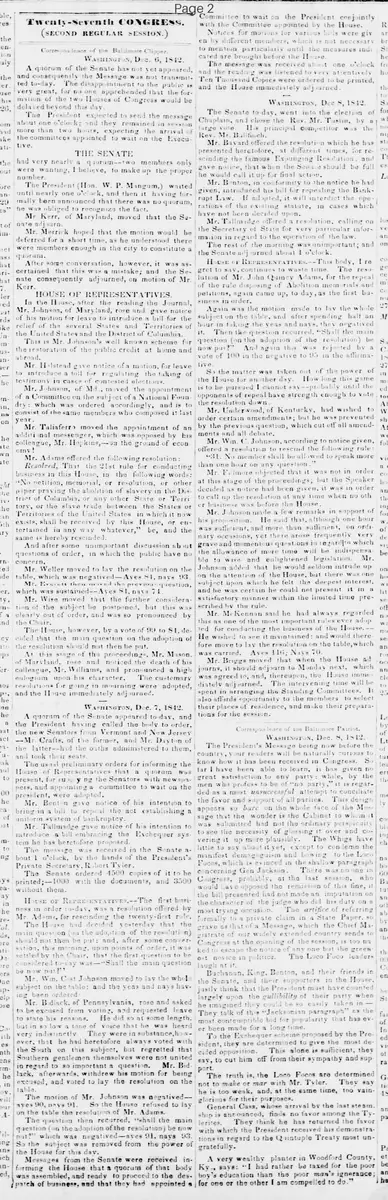
(SECOND REGULAR SESSION.)
Correspondence of the Baltimore Clipper.
WASHINGTON, Dec. 6, 1842.
A quorum of the Senate has not yet appeared, and consequently the Message was not transmitted to-day. The disappointment to the public is very great, for no one apprehended that the formation of the two Houses of Congress would be delayed beyond this day.
The President expected to send the message about one o'clock; and they remained in session more than two hours, expecting the arrival of the committees appointed to wait on the Executive.
THE SENATE had very nearly a quorum--two members only were wanting, I believe, to make up the proper number.
The President (Hon. W. P. Mangum,) waited until nearly one o'clock, and then it having formally been announced that there was no quorum, he was obliged to recognize the fact.
Mr. Kerr, of Maryland, moved that the Senate adjourn.
Mr. Merrick hoped that the motion would be deferred for a short time, as he understood there were members enough in the city to constitute a quorum.
After some conversation, however, it was ascertained that this was a mistake: and the Senate consequently adjourned, on motion of Mr. Kerr.
HOUSE OF REPRESENTATIVES.
In the House, after the reading the Journal, Mr. Johnson, of Maryland, rose and gave notice of his motion for leave to introduce a bill for the relief of the several States and Territories of the United States and the District of Columbia.
This is Mr. Johnson's well known scheme for the restoration of the public credit at home and abroad.
Mr. Hilstead gave notice of a motion, for leave to introduce a bill for regulating the taking of testimony in cases of contested elections.
Mr. Johnson, of Md., moved the appointment of a Committee on the subject of a National Foundry: which was ordered accordingly, and is to consist of the same members who composed it last year.
Mr. Taliaferro moved the appointment of an additional messenger, which was opposed by his colleague, Mr. Hopkins,--on the ground of economy!
Mr. Adams offered the following resolution:
Resolved, That the 21st rule for conducting business in this House, to the following words:
"No petition, memorial, or resolution, or other paper praying the abolition of slavery in the District of Columbia, or any other State or Territory, or the slave trade between the States or Territories of the United States in which it now exists, shall be received by this House, or entertained in any way whatever," be, and the same is hereby rescinded.
And after some unimportant discussion about questions of order, in which the public have no concern,
Mr. Weller moved to lay the resolution on the table, which was negatived--Ayes 81, nays 93.
Mr. Everett then moved the previous question, which was sustained--Ayes 81, nays 71.
Mr. Wise moved that the further consideration of the subject be postponed, but this was clearly out of order, and was so pronounced by the Chair.
The House, however, by a vote of 97 to 81, decided that the main question on the adoption of the resolution should not then be put.
At this stage of the proceedings, Mr. Mason, of Maryland, rose and noticed the death of his colleague, Mr. Williams, and pronounced a high eulogium upon his character. The customary resolutions for going in mourning were adopted, and the House immediately adjourned.
WASHINGTON, Dec. 7, 1842.
A quorum of the Senate appeared to-day, and the President having called the body to order, the new Senators from Vermont and New Jersey --Mr. Crafts, of the former, and Mr. Dayton of the latter--had the oaths administered to them, and took their seats.
The usual preliminary orders for informing the House of Representatives that a quorum was present, for supplying the Senators with newspapers, and appointing a committee to wait on the President, were adopted.
Mr. Benton gave notice of his intention to bring in a bill to repeal the act establishing a uniform system of bankruptcy.
Mr. Tallmadge gave notice of his intention to introduce a bill embracing the Exchequer system he has heretofore proposed.
The message was received in the Senate about 1 o'clock, by the hands of the President's Private Secretary, Robert Tyler.
The Senate ordered 4500 copies of it to be printed;--1000 with the documents, and 3500 without them.
HOUSE OF REPRESENTATIVES.--The first business in order to-day, was a resolution offered by Mr. Adams, for rescinding the twenty-first rule.
The House had decided yesterday that the main question (on the adoption of the resolution) should not then be put: and, after some conversation, this morning, upon points of order, it was settled by the Chair, that the first question to be considered to-day was--"Shall the main question be now put?"
Mr. Wm. Cost Johnson moved to lay the whole subject on the table: and the yeas and nays having been ordered.
Mr. B. Black, of Pennsylvania, rose and asked to be excused from voting, and requested leave to state his reasons.
He did so at some length, but in so low a tone of voice that he was heard very indistinctly. They were in substance, however, that he had heretofore always voted with the South on this subject, but regretted that Southern gentlemen themselves were not united in regard to so important a question. Mr. Black, afterwards, withdrew his motion for being excused, and voted to lay the resolution on the table.
The motion of Mr. Johnson was negatived-- ayes 90, nays 91. So the House refused to lay on the table the resolution of Mr. Adams.
The question then recurred, "shall the main question (on the adoption of the resolution) be now put?" which was negatived--ayes 91, nays 93.
So the subject was removed from the power of the House for this day.
Messages from the Senate were received informing the House that a quorum of that body was assembled, and ready to proceed to the dispatch of business, and that they had appointed a Committee to wait on the President conjointly with the Committee appointed by the House.
Notices for motions for various bills were given by different members, which is not necessary to mention particularly until the measures indicated are brought before the House.
The message was received about one o'clock and the reading was listened to very attentively. Ten Thousand Copies were ordered to be printed, and the House immediately adjourned.
WASHINGTON, Dec. 8, 1842.
The Senate to-day, went into the election of Chaplain, and chose the Rev. Mr. Tustin, by a large vote. His principal competitor was the Rev. Mr. Bulfinch.
Mr. Birard offered the resolution which he has presented heretofore, at different times, for rescinding the famous Expunging Resolution: and gave notice, that when the Senate should be full he would call it up for final action.
Mr. Benton, in conformity to the notice he had given, introduced his bill for repealing the Bankrupt Law. If adopted, it will interdict the operations of the existing statute, in cases which have not been decided upon.
Mr. Tallmadge offered a resolution, calling on the Secretary of State for very particular information in regard to the operation of the law.
The rest of the morning was unimportant; and the Senate adjourned about 1 o'clock.
House of Representatives.--This body, I regret to say, continues to waste time. The resolution of Mr. John Quincy Adams, for the repeal of the rule disposing of Abolition memorials and petitions, again came up, to-day, as the first business in order.
Again was the motion made to lay the whole subject on the table, and after spending half an hour in taking the yeas and nays, they negatived it. Then the question recurred. "Shall the main question (on the adoption of the resolution) be now put?" And again this was rejected by a vote of 100 in the negative to 95 in the affirmative.
So the matter was taken out of the power of the House for another day. How long this game is to be pursued I cannot say--probably until the opponents of repeal have strength enough to vote the resolution down.
Mr. Underwood, of Kentucky, had wished to offer certain amendments; but he was prevented by the previous question, which cut off all amendments and all debate.
Mr. Wm. C. Johnson, according to notice given offered a resolution to rescind the following rule:
"31. No member shall be allowed to speak more than one hour on any question."
Mr. Fillmore objected that it was not in order at this stage of the proceedings; but the Speaker decided as notice had been given, it was in order to call up the resolution at any time when no other business was before the House.
Mr. Johnson made a few remarks in support of his proposition. He said that, although one hour was sufficient, and more than sufficient, on ordinary occasions, yet there arose frequently very grave and momentous questions in regard to which the allowance of more time will be indispensable to wise and enlightened legislation. Mr. Johnson added that he would seldom intrude upon the attention of the House, but there was one subject upon which he felt the deepest interest, and he was certain he could not present it in a satisfactory manner within the limited time prescribed by the rule.
Mr. McKennan said he had always regarded this as one of the most important rules ever adopted for conducting the business of the House.-- He wished to see it maintained: and would therefore move to lay the resolution on the table, which was carried. Ayes 116; Nays 70.
Mr. Briggs moved that when the House adjourns, it should adjourn to Monday next, which was agreed to, and, thereupon, the House immediately adjourned. The intervening time will be spent in arranging the Standing Committees. It also affords opportunity to the members to select their places of residence, and make their preparations for the session.
Correspondence of the Baltimore Patriot.
WASHINGTON, Dec. 8, 1842.
The President's Message being now before the country, your readers will be naturally curious to know how it has been received in Congress. So far as I have been able to learn, it has given no great satisfaction to any party: while, by the men who profess to be of "no party," it is regarded as a most unsuccessful attempt to conciliate the favor and support of all parties. This design appears so bare on the whole face of the Message that the wonder is the Cabinet to whom it was submitted had not the ordinary perspicuity to see the necessity of glossing it over and covering it up more plausibly. The Whigs have little to say about it yet, except to condemn the manifest demagoguism and bowing to the Loco Focos, which is evinced in the shallow paragraph concerning Gen Jackson. There was no one in Congress, probably, at the last session, who would have opposed the remission of this fine, if the bill presented had not made an imputation on the character of the judge who did his duty on a most trying occasion. The artifice of referring formally to a private claim in a State Paper, so grave as that of a Message, which the Chief Magistrate of our widely extended country sends to Congress at the opening of the session, is too naked to escape the notice of any one but the greenest novice in politics.
The Loco Fuco leaders laugh at it. Buchanan, King, Benton, and their friends in the Senate, and their supporters in the House, justly think that the President must have counted largely upon the gullibility of their party when he imagined they could be so easily taken in-- They talk of the "Jacksonian paragraph" as the most contemptible bid for popularity that has ever been made for a long time.
To the Exchequer scheme proposed by the President, they are determined to give the most decided opposition. This alone is sufficient, they say, to cut him off from their sympathy and support.
The truth is, the Loco Focos are determined not to make or mar with Mr. Tyler. They say he is too weak, and, at the same time, too vainglorious for their purposes.
General Cass, whose arrival by the last steam ship is announced, finds no favor among the Tylerites. They think he has returned the favor with which the President received his demonstrations in regard to the Quintuple Treaty most ungratefully.
What sub-type of article is it?
What keywords are associated?
What entities or persons were involved?
Where did it happen?
Domestic News Details
Primary Location
Washington
Event Date
December 6 8, 1842
Key Persons
Outcome
senate and house sessions delayed by quorum issues on dec 6; president's message received dec 7, printed in copies; adams' resolution on slavery rule repeatedly postponed; death notice and eulogy for mr. williams; various bill notices given; house adjourns to monday; mixed reactions to tyler's message across parties.
Event Details
Detailed accounts of Senate and House proceedings during the opening of the 27th Congress second session, including quorum delays, reception of President's message, oaths to new senators, notices for bills on bankruptcy repeal, exchequer system, national foundry, contested elections, relief for states; debates and votes on rescinding the 21st rule regarding abolition petitions led by Mr. Adams, repeatedly tabled or postponed; eulogy for deceased Rep. Williams; election of chaplain; proposal to extend speaking time rule; political commentary on Tyler's message reception by Whigs, Loco Focos, and others.