Thank you for visiting SNEWPapers!
Sign up free
Daily National Intelligencer
Washington, District Of Columbia
What is this article about?
Thomas L. McKenney, Superintendent of Indian Affairs, writes to Col. R. M. Johnson endorsing the Kentucky Baptist Society's plan to educate Native American children from various tribes in Kentucky, providing historical examples of successful Indian Christianization and detailing ongoing missionary efforts among Creeks, Cherokees, and others.
Clipping
OCR Quality
Full Text
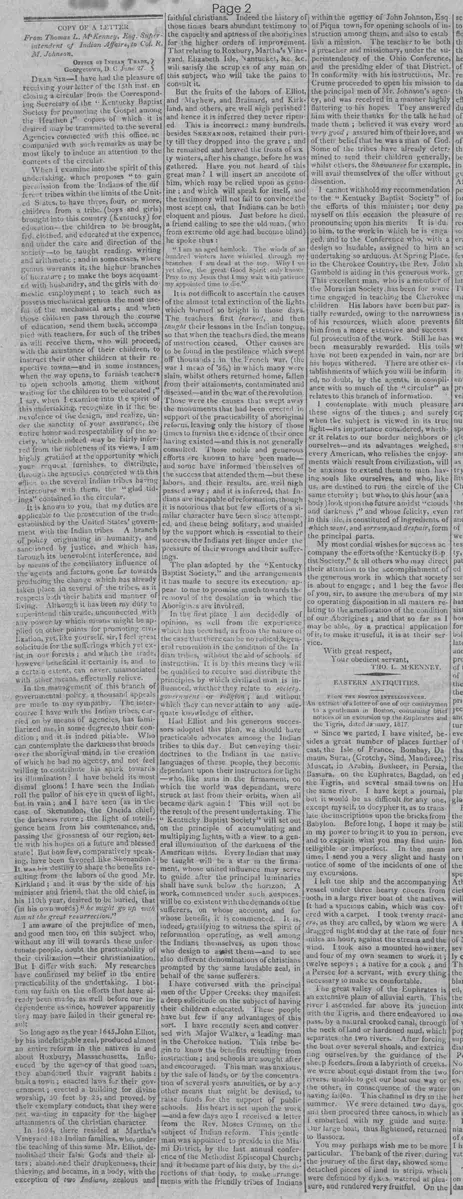
Office of Indian Trade, Georgetown, D. C. June 27.
DEAR SIR—I have had the pleasure of receiving your letter of the 15th inst., enclosing a circular from the Corresponding Secretary of the Kentucky Baptist Society for promoting the Gospel among the Heathen; copies of which it is desired may be transmitted to the several Agencies connected with this office, accompanied with such remarks as may be most likely to induce an attention to the contents of the circular.
When I examine into the spirit of this undertaking, which proposes "to gain permission from the Indians of the different tribes within the limits of the United States, to have three, four, or more, children from a tribe, (boys and girls) brought into this country (Kentucky) for education—the children to be brought, fed, clothed, and educated at the expense, and under the care and direction of the society—to be taught reading, writing and arithmetic; and in some cases, where genius warrants it, the higher branches of literature; to make the boys acquainted with husbandry, and the girls with domestic employment; to teach such as possess mechanical genius the most useful of the mechanical arts; and when those children pass through the course of education, send them back, accompanied with teachers, or such of the tribes as will receive them, who will proceed, with the assistance of their children, to instruct their other children at their respective towns—and in some instances, when the way opens, to furnish teachers to open schools among them without waiting for the children to be educated;" I say, when I examine into the spirit of this undertaking, recognize in it the benevolence of the design, and realize, under the sanctity of your assurance, the entire honor and respectability of the society, which indeed may be fairly inferred from the nobleness of its views, I am highly gratified at the opportunity which your request furnishes to distribute, through the agencies connected with this office to the several Indian tribes having intercourse with them, the "glad tidings" contained in the circular.
It is known to you, that my duties are applicable to the prosecution of the trade established by the United States' government with the Indian tribes. A branch of policy originating in humanity, and sanctioned by justice, and which has, through its benevolent interference, and by means of the conciliatory influence of the agents and factors, gone far towards producing the change which has already taken place in several of the tribes, as it respects both their habits and manner of living. Although it has been my duty to superintend this trade, unconnected with any power by which means might be applied on other points for promoting civilization, yet, like yourself, sir, I feel great solicitude for the sufferings which yet exist in our forests; and which the trade, however beneficial it certainly is, and to a certain extent, can never, unassociated with other means, effectually relieve.
In the management of this branch of governmental policy a thousand appeals are made to my sympathy. The intercourse I have with the Indian tribes, carried on by means of agencies, has familiarized me, in some degree, to their condition; and it is indeed pitiable. Who can contemplate the darkness that broods over the aboriginal mind, in the creation of which he had no agency, and not feel willing to contribute his spark towards its illumination? I have beheld its most dismal gloom! I have seen the Indian roll the pallor of his eye in quest of light, but in vain; and I have seen (as in the case of Skenandon, the Oneida chief) the darkness retire; the light of intelligence beam from his countenance, and, passing the grossness of our region, settle with his hopes on a future and blessed state! But how few, comparatively speaking, have been favored like Skenandon!
It was his destiny to share the benefits resulting from the labors of the good Mr. Kirkland; and it was by the side of his minister and friend, that the old chief, in his 110th year, desired to be buried, that (in his own words) "he might go up with him at the great resurrection."
I am aware of the prejudice of men, and good men too, on this subject who, without any ill will towards these unfortunate people, doubt the practicability of their civilization—their christianization. But I differ with such. My researches have confirmed my belief in the entire practicability of the undertaking. I bottom my faith on the efforts that have already been made, as well before our independence as since, however apparently they may have failed in their general result.
So long ago as the year 1645, John Elliot, by his indefatigable zeal, produced almost an entire reform in the natives in and about Roxbury, Massachusetts. Influenced by the agency of that good man, they abandoned their vagrant habits; built a town; enacted laws for their government; erected a building for divine worship, 50 feet by 25, and proved, by their exemplary conduct, that they were not wanting in capacity for the higher attainments of the christian character.
In 1694, there resided at Martha's Vineyard 180 Indian families, who, under the teaching of this same Mr. Elliot, demolished their false Gods and their altars; abandoned their drunkenness, their thieving, and became, in a body, with the exception of two Indians, zealous and faithful christians. Indeed the history of those times bears abundant testimony to the capacity and aptness of the aborigines for the higher orders of improvement. That relating to Roxbury, Martha's Vineyard, Elizabeth Isle, Nantucket, &c. &c. will satisfy the scruples of any man on this subject, who will take the pains to consult it.
But the fruits of the labors of Elliot, and Mayhew, and Brainard, and Kirkland, and others, are well nigh perished! and hence it is inferred they never ripened. This is incorrect: many hundreds, besides Skenandon, retained their purity till they dropped into the grave; and he remained and braved the frosts of sixty winters, after his change, before he was gathered. Have you not heard of this great man? I will insert an anecdote of him, which may be relied upon as genuine; and which will speak for itself, and the testimony will not fail to convince the most sceptical, that Indians can be both eloquent and pious. Just before he died, a friend calling to see the old man, (who from extreme old age had become blind) he spoke thus:
"I am an aged hemlock. The winds of a hundred winters have whistled through my branches. I am dead at the top. Why I am yet alive, the great Good Spirit only knows. Pray to my Jesus that I may wait with patience my appointed time to die."
It is not difficult to ascertain the Causes of the almost total extinction of the lights which burned so bright in those days. The teachers first learned, and then taught their lessons in the Indian tongue, so that when the teachers died, the means of instruction ceased. Other causes are to be found in the pestilence which swept off thousands; in the French war, (the war I mean of '56,) in which many were slain, whilst others returned home, fallen from their attainments, contaminated and diseased—and in the war of the revolution. Those were the causes that swept away the monuments that had been erected in support of the practicability of aboriginal reform, leaving only the history of those times to furnish the evidence of their once having existed—and this is not generally consulted. Those noble and generous efforts are known to have been made—and some have informed themselves of the success that attended them—but these labors, and their results, are well nigh passed away; and it is inferred, that Indians are incapable of reformation, though it is notorious that but few efforts of a similar character have been since attempted, and these being solitary, and unaided by the support which is essential to their success, the Indians yet linger under the pressure of their wrongs and their sufferings.
The plan adopted by the "Kentucky Baptist Society," and the arrangements it has made to secure its execution, appear to me to promise much towards the removal of the desolation in which the Aborigines are involved.
In the first place I am decidedly of opinion, as well from the experience which has been had, as from the nature of the case that there can be no radical, general renovation in the condition of the Indian tribes, without the aid of schools of instruction. It is by this means they will be qualified to receive and distribute the principles by which civilized man is influenced, whether they relate to society, government or religion; and without which they can never attain to any adequate knowledge of either.
Had Elliot and his generous successors adopted this plan, we should have practicable advocates among the Indian tribes to this day. But conveying their doctrines to the Indians in the native languages of these people, they become dependant upon their instructors for light—who, like suns in the firmament, on which the world was dependant, were struck at last from their orbits, when all became dark again! This will not be the result of the present undertaking. The "Kentucky Baptist Society" will set out on the principle of accumulating and multiplying lights, with a view to a general illumination of the darkness of the American wilds. Every Indian that may be taught will be a star in the firmament, whose united influence may serve to guide after the principal luminaries shall have sunk below the horizon. A work, commenced under such auspices, will be co-existent with the demands of the sufferers, on whose account, and for whose benefit, it is commenced. It is, indeed, gratifying to witness the spirit of reformation operating, as well among the Indians themselves, as upon those who design to assist them—and to see also different denominations of christians prompted by the same laudable zeal, in behalf of the same sufferers.
I have conversed with the principal men of the Upper Creeks: they manifest a deep solicitude on the subject of having their children educated. These people have but few if any advantages of this sort. I have recently seen and conversed with Major Walker, a leading man in the Cherokee nation. This tribe begin to know the benefits resulting from instruction; and schools are sought after and encouraged. This man was anxious, by the sale of lands, or by the concentration of several years annuities, or by any other means that might be devised, to raise funds for the support of public schools. His heart is set upon the work—and a few days ago I received a letter from the Rev. Moses Crume, on the subject of Indian reform. This gentleman was appointed to preside in the Miami District, by the last annual conference of the Methodist Episcopal Church; and it became part of his duty, by the directions of that body, to make arrangements with the friendly tribes of Indians within the agency of John Johnson, Esq. of Piqua town, for opening schools of instruction among them, and also to establish a mission. The teacher to be both a preacher and missionary, under the superintendency of the Ohio Conference, and the presiding elder of that District.
In conformity with his instructions, Mr. Crume proceeded to open his mission to the principal men of Mr. Johnson's agency, and was received in a manner highly flattering to his hopes. They answered him with their thanks for the talk he had made them; believed it was every word very good: assured him of their love, and of their belief that he was a man of God. Some of the tribes have already determined to send their children generally, whilst others, the Shawanese for example, will avail themselves of the offer without dissention.
I cannot withhold my recommendation to the "Kentucky Baptist Society" of the efforts of this minister; nor deny myself on this occasion the pleasure of pronouncing upon his merits. It is due to him, to the work in which he is engaged, and to the Conference who, with a design so laudable, assigned to him an undertaking so arduous. At Spring Place in the Cherokee Country, the Rev. John Gambold is aiding in this generous work. This excellent man, who is a member of the Moravian Society, has been for some time engaged in teaching the Cherokee children. His labors have been but partially rewarded, owing to the narrowness of his resources, which alone prevents him from a more extensive and successful prosecution of the work. Still he has been measurably rewarded. His toils have not been expended in vain, nor are his hopes withered. There are other establishments of which you will be informed, no doubt, by the agents, in compliance with so much of the "circular" as relates to this branch of information.
I contemplate with much pleasure these signs of the times; and surely when the subject is viewed in its true light—its importance considered, whether it relates to our border neighbors or ourselves—and its advantages weighed, every American, who relishes the enjoyments which result from civilization, will be anxious to extend them to men having souls like ourselves, and who, like us, are destined to run the circle of the same eternity; but who, to this hour (as a body) look upon the future amidst "clouds and darkness;" and whose felicity, even in this life, is constituted of ingredients of which want, and sorrow, and despair, form the principal parts.
My most cordial wishes for success accompany the efforts of the Kentucky Baptist Society, & all others who may direct their attention to the accomplishment of the generous work in which that society is about to engage; and I beg the favor of you, sir, to assure the members of my co-operating disposition in all matters relating to the amelioration of the condition of our Aborigines; and that so far as I may be able, by a practical application of it, to make it useful, it is at their service.
With great respect,
Your obedient servant,
THO. L. M'KENNEY.
What sub-type of article is it?
What keywords are associated?
What entities or persons were involved?
Where did it happen?
Domestic News Details
Primary Location
Georgetown, D. C.
Event Date
June 27
Key Persons
Outcome
endorsement of the kentucky baptist society's educational plan for indian children; distribution of circular to agencies; historical examples of successful indian education and christianization; ongoing missionary efforts among tribes like creeks, cherokees, shawanese.
Event Details
McKenney responds to Johnson's letter by supporting the Kentucky Baptist Society's initiative to bring Indian children to Kentucky for education in literacy, arithmetic, trades, and Christianity, then return them as teachers. He discusses historical missionary successes and failures, emphasizes the need for schools, and reports positive responses from Upper Creeks, Cherokees, Methodists in Miami District, and Moravians in Cherokee country.